 Seattle Exterior
 A Deliberate, Narrow Choice
Most siding contractors will sell you whatever you want to buy. Vinyl if you want the lowest bid, LP SmartSide if you want a wood look on a budget, cedar if you want the real thing, fiber cement if you want the best long-term performer. We don't work that way. Seattle Exterior Contractor installs one siding product: James Hardie fiber cement. That's it. We don't carry vinyl, LP SmartSide, Cemplank, Allura, primed spruce panels, or cedar lap siding, and we won't quote a job in any of those materials.
That's an unusual policy, and it's worth explaining rather than just stating. It's not that every other product is worthless — vinyl has its place, cedar has real appeal, LP SmartSide has improved over the years. It's that after years of tearing old siding off King County homes and seeing what actually survives our climate versus what fails early, we decided we'd rather stand behind one system we trust completely than offer a menu of products with different failure modes and different warranty headaches. This page explains the reasoning, not to talk anyone out of a product they already love, but so homeowners understand what they're actually choosing between.
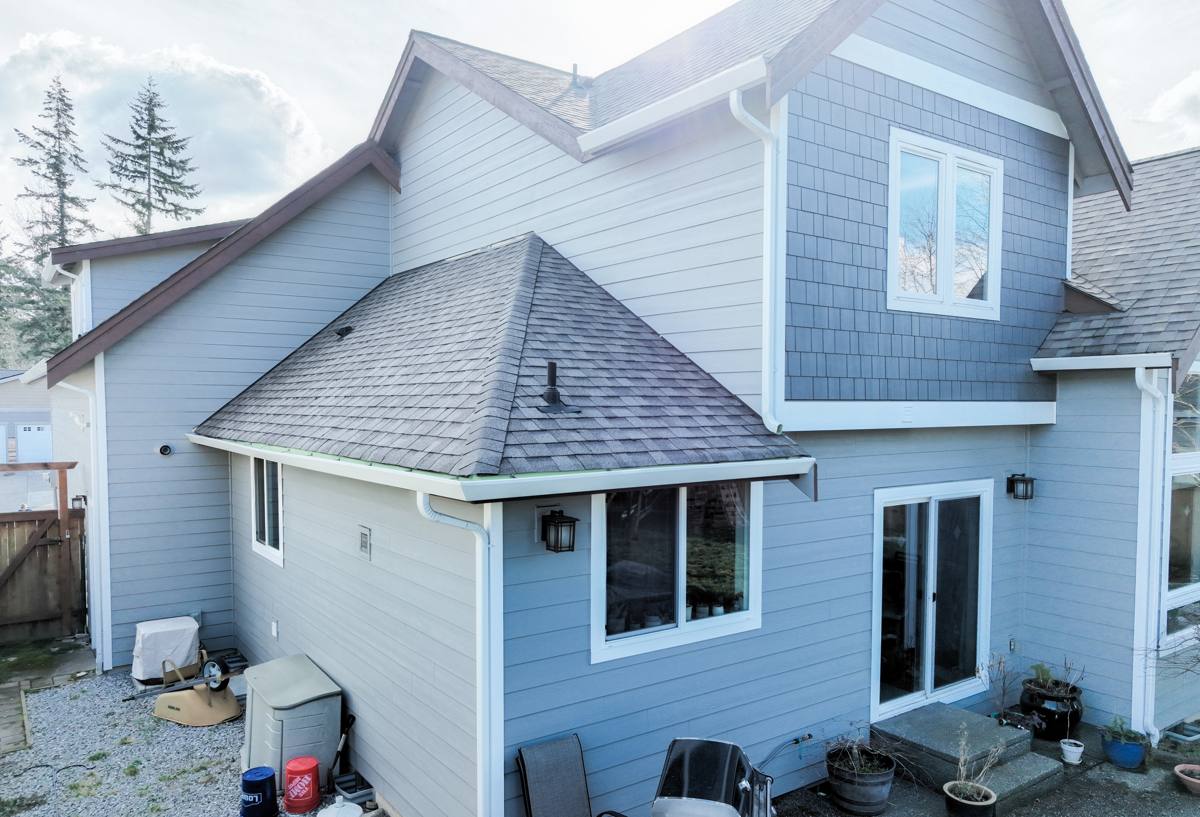
What Seattle's Climate Does to Siding
Seattle doesn't get hurricanes or extreme freeze-thaw cycles, and that leads some homeowners to assume siding here has it easy. It doesn't. The specific combination of conditions around Puget Sound is hard on exterior materials in ways that are easy to underestimate.
Moisture, Almost Constantly
King County gets long stretches of driving rain, often wind-blown rather than falling straight down, which pushes water sideways into seams, laps, and fastener penetrations that a drier climate would never test. Siding here doesn't get a season off to dry out completely — it's wet more months than it's dry.
Salt Air Near the Sound
Homes closer to Puget Sound deal with salt-laden air that accelerates corrosion on fasteners, trim, and any material that isn't genuinely built for coastal exposure. It's a slower, quieter form of wear than storm damage, but it adds up over a decade or two.
A Real Moss Season
Our mild, damp winters are exactly what moss and mildew want. Anything organic — real wood, or a product with a paper or wood-fiber component — gives moss and mold something to take hold of. Siding that stays damp under a moss mat for weeks at a time ages faster than siding that sheds water and dries.
None of this means siding in Seattle is doomed. It means the margin for error is smaller here than in a drier climate, and the product and installation quality matter more than they would somewhere with six dry months a year.
Why We Don't Install Everything on the Market
Here's the honest version of why we narrowed our offering, product by product.
Vinyl Siding
Vinyl is inexpensive and low-maintenance in mild, dry climates. In our wind-driven rain, though, vinyl's seams and J-channels are more prone to water intrusion behind the panel than a properly lapped and caulked fiber cement installation, and vinyl can warp or become brittle with age and UV exposure. It's also purely a surface product — it can't be painted a genuinely different color without specialty products, and repairs after impact damage are visible because exact color matches fade unevenly over time.
LP SmartSide and Other Engineered Wood
Engineered wood siding has gotten better over the years, and it looks good going on. But it's still wood-based, which means it's more vulnerable to moisture absorption at cut edges and seams than fiber cement, and it needs consistent field-applied caulking and paint maintenance to keep water out. In a climate that's damp most of the year, that maintenance schedule is unforgiving — miss a few years of caulk touch-up and the product's own moisture resistance depends heavily on how well it was sealed on day one.
Primed Spruce and Real Cedar
Real wood siding has genuine appeal and we understand why homeowners want it. But solid wood is the most maintenance-intensive option in a climate like ours — it needs regular refinishing, it's the most attractive material to moss and mildew, and it's combustible. For a company that wants to install something once and have it perform for decades with minimal upkeep, wood didn't fit.
Cemplank and Allura
These are other fiber cement manufacturers, and fiber cement as a category is the right call for this climate. Our decision to standardize on James Hardie specifically comes down to product line depth — Hardie engineers climate-specific formulations (more on that below), backs installations with a strong transferable warranty, and has the factory-finish system and dealer network we've found most consistent over years of installs. It's less a rejection of the competitors and more a decision to become genuinely expert in one system rather than moderately familiar with several.
| Factor | Vinyl | Engineered Wood (LP) | Real Wood/Cedar | James Hardie Fiber Cement |
|---|---|---|---|---|
| Combustible | Yes (melts/deforms) | Yes | Yes | No |
| Moisture sensitivity | Moderate (seam intrusion) | Higher (wood core) | Highest | Low when installed to spec |
| Repaint/refinish cycle | Rarely repainted | Every 5-8 years | Every 3-5 years | ColorPlus: 15 years before repaint typical |
| Moss/mildew resistance | Good | Fair | Poor | Good |
| Typical manufacturer warranty | 20-30 yr, prorated | 5-year limited, varies | None standard | 30-year non-prorated, transferable |
The James Hardie System, Explained
Fiber cement is a mix of Portland cement, sand, and cellulose fiber, cured under pressure into a rigid board. It doesn't burn, it doesn't rot the way wood does, and it doesn't expand and contract with humidity the way vinyl or wood can. That base chemistry is why we trust the category. What separates James Hardie within that category is engineering specific to regional climate and a factory finish process we don't have to manage in the field.
HZ5 Engineering for the Pacific Northwest
James Hardie makes climate-specific product formulations under its HZ (HardieZone) system. HZ5 is engineered for regions with significant moisture exposure and freeze-thaw activity — which describes King County well. It's a different formulation than the product sold in the arid Southwest, and it's the version we install here.
ColorPlus Factory Finish
Rather than painting siding on site, Hardie's ColorPlus boards are finished at the factory with a baked-on, multi-coat finish that's more uniform and more UV- and moisture-resistant than a field-applied paint job. It also means color touch-up products are formulated to match exactly, and the finish is backed by its own separate warranty against fading and peeling.
Product Lines We Work With
HardiePlank lap siding is the workhorse for most Seattle homes — traditional lap profiles in a range of widths and textures. HardieShingle gives the look of cedar shakes without the maintenance. HardiePanel is used for vertical applications and accent sections. We match the profile and texture to the home rather than pushing one look on every project.
Correct Installation Is Half the Product
Fiber cement's reputation problems, where they exist, almost always trace back to installation, not the material itself. Hardie publishes detailed installation specifications, and a job that skips them can fail even with the best board on the market. This is where a lot of the "fiber cement had problems" stories actually come from.
- Correct clearance from grade, decks, and roof lines so the board isn't sitting in standing water or splashback
- Proper flashing at every window, door, and horizontal transition — the single most common source of hidden moisture damage
- Manufacturer-specified nailing pattern and fastener type, set correctly (not overdriven, not underdriven)
- Correct lap and gap dimensions with sealant only where Hardie's specs call for it, not everywhere
- House wrap and weather-resistive barrier installed and lapped correctly underneath, before the first board goes up
- Caulking joints and butt seams with a product rated for the application, not general-purpose caulk
We treat this checklist as non-negotiable on every job, because a beautiful ColorPlus finish over a poorly flashed window is still going to leak eventually. The product and the installation aren't separate variables — they're one system.
Warranty and Long-Term Value
James Hardie backs its siding with a 30-year non-prorated limited warranty on the substrate and a separate finish warranty on ColorPlus color retention, and both are transferable to a new owner if the home sells — something worth mentioning to a buyer or noting in a listing. That transferability matters more than it sounds like it should: siding is a decades-long investment, and a warranty that survives a sale protects resale value, not just the current owner.
The upfront cost of fiber cement is higher than vinyl and comparable to or above engineered wood. Where it pencils out is the total cost of ownership — fewer repaint cycles, less moisture-related repair work, and a warranty structure that doesn't erode in value the way prorated warranties do as they age.
What This Means for Your Home
If you're closer to the Sound and dealing with salt exposure, or you've got a north-facing wall that never fully dries out through our wet months, the material choice matters more than it would on a drier, more sheltered lot. If your current siding is wood or an older engineered product showing early moss growth, soft spots, or paint failure, that's usually a sign the material is losing its fight with the climate, not a sign your home needs more frequent maintenance forever. A full replacement with a system engineered for this region, installed correctly the first time, tends to be the more durable answer.
We're not going to tell you fiber cement is right for every homeowner's budget or aesthetic preference — it isn't the cheapest option, and it isn't required by code. But when a homeowner asks us to install something we don't believe will hold up here, we'd rather explain why and lose that job than install a product we don't trust on a Seattle exterior.
If you're weighing a siding replacement or want a second opinion on what's currently on your home, we're happy to take a look and give you a straight, no-pressure estimate — use the form below to get started.