 Seattle Exterior
 Bellevue Siding Has to Work Harder Than It Looks
Bellevue sits in the same wet marine climate as the rest of the Puget Sound region, and that shapes what a siding system needs to do over the life of a home. Long stretches of driving rain, high humidity that lingers under tree canopy and along shaded north walls, and a moss and algae season that can run most of the year all put steady pressure on exterior materials. Homes closer to the lake or in low-lying, tree-shaded lots see it worst — siding that stays damp for days at a time is siding that's working overtime just to hold its shape and its paint.
None of this means Bellevue is a uniquely brutal place to own a house. It means the margin for error in siding selection and installation is smaller here than it would be in a dry inland climate. A siding product that's marginal on moisture resistance, or an installation that leaves even small gaps in the weather barrier, will show problems in King County years before it would somewhere drier. That's the lens we use on every Bellevue siding project: build for the water, not just for the day it goes up looking good.
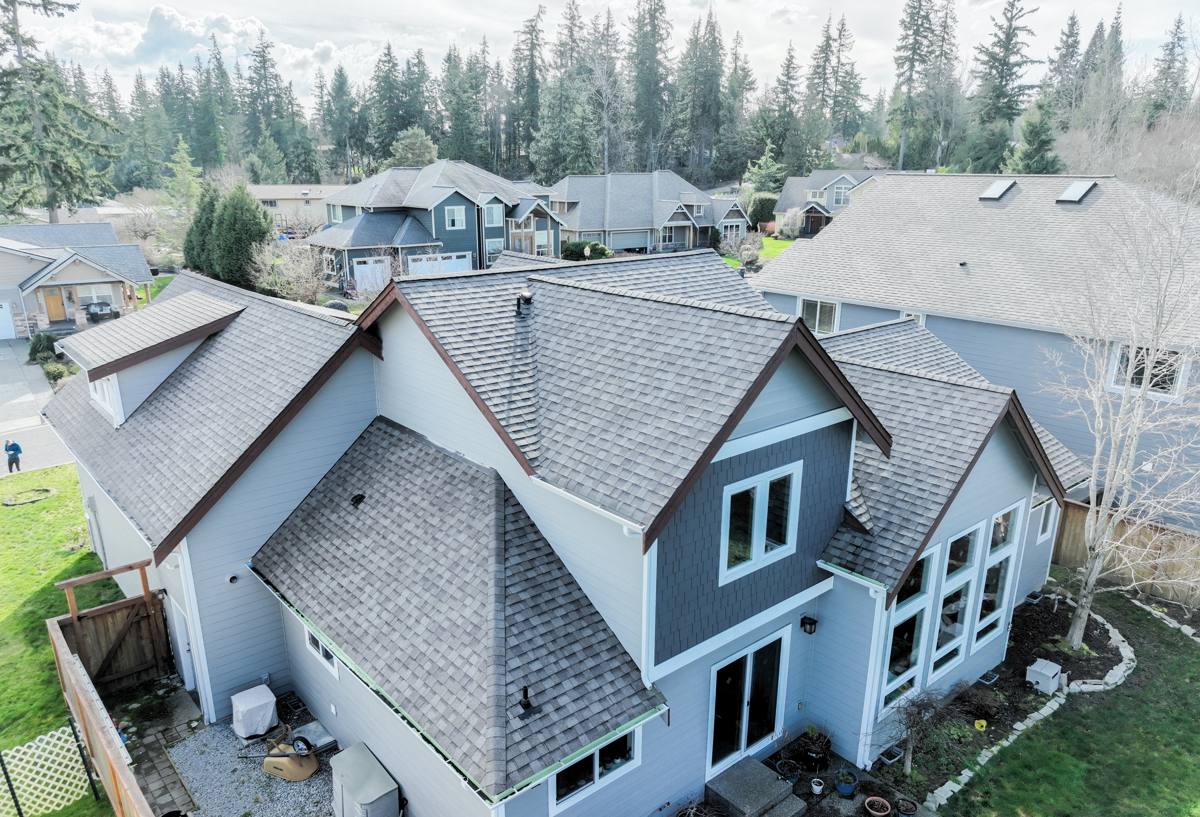
What a Correct Siding Installation Actually Involves
Siding is a system, not a single layer. The visible boards get all the attention, but the parts underneath them are what actually keep water out of the wall assembly. A rushed or undertrained crew can hang boards that look fine from the street and still set a home up for rot, mold, or paint failure within a few years.
The Weather-Resistive Barrier
Before any siding goes up, the wall needs a continuous, properly lapped weather-resistive barrier (housewrap or equivalent). Seams have to overlap correctly, top over bottom, so water sheds down and out instead of finding its way behind the barrier. Every penetration — outlets, hose bibs, light fixtures — needs to be sealed back into that barrier, not just caulked at the surface.
Flashing at Every Transition
Windows, doors, decks, rooflines, and any place where siding meets a different material are the highest-risk spots on the house. Correct flashing directs water back out and away from the wall rather than trusting caulk alone to keep it out. This is the step that gets skipped or shortcut most often on rushed jobs, and it's also the step most responsible for the moisture damage we see when we're called out to look at a failing wall.
Fastening and Clearances
Fiber cement siding has specific fastener patterns, nail placement, and butt joint requirements set by the manufacturer — deviating from them can void the warranty and compromise how the boards perform in wind and moisture. Ground clearance and a gap at grade, decks, and patios matter too: siding installed too close to soil, concrete, or hardscaping wicks up moisture and starts breaking down from the bottom, regardless of how good the material is.
Why We Install Only James Hardie Fiber Cement Siding
We made a decision, as a company, to install James Hardie fiber cement siding exclusively. We don't install vinyl, LP SmartSide, Cemplank, Allura, or primed wood siding like spruce or cedar. That's not a marketing position — it's a standard we hold because of what we've seen happen to lower-tier products in exactly this climate.
James Hardie fiber cement is non-combustible, holds paint and factory-applied color far longer than wood or engineered wood products, and doesn't feed moisture-related rot the way wood-based sidings can when a seal fails. Hardie's ColorPlus factory finish is baked on under controlled conditions, which gives more consistent, longer-lasting color than field-applied paint. For a region with Bellevue's rain and humidity load, that combination of moisture stability and finish durability is the difference between siding that needs attention in year eight and siding that's still doing its job at year thirty.
The HZ Product Lines
Hardie engineers its siding by climate zone. The HZ10 line is formulated for wetter, colder regions like the Pacific Northwest, which is what we use on Bellevue homes. That climate-specific engineering matters more than most homeowners realize — a siding product built for a dry southwestern climate doesn't perform the same way under sustained Puget Sound moisture.
Warranty That Actually Transfers
James Hardie backs its fiber cement products with a long, transferable limited warranty, which matters both for how long you'll own the home and for resale. A strong, well-documented warranty on the siding is something a buyer's inspector and lender will both notice.
Why We Don't Install the Alternatives
Vinyl siding is inexpensive and easy to install, but it expands and contracts significantly with temperature swings, can warp or crack in impact, and doesn't hold up structurally the way fiber cement does over decades. LP SmartSide, Cemplank, and Allura are all reasonable engineered or fiber cement products in their own right, but each comes with trade-offs in moisture performance, finish durability, or warranty structure that we weren't willing to build our reputation on. Primed wood species like spruce or cedar look great when new, but they demand an ongoing maintenance commitment — recaulking, repainting, watching for rot at joints and end cuts — that most homeowners underestimate until they're several years in. We'd rather install one product we trust completely than offer several we'd have to caveat.
Signs Bellevue Homeowners Should Watch For
Siding failure is usually gradual, and by the time it's obvious from the street, moisture may already be behind the wall. Some early warning signs worth a closer look:
- Paint that's peeling, bubbling, or chalking heavily, especially on shaded or north-facing walls
- Soft or spongy spots when you press on the siding near the bottom edge or around windows
- Persistent moss, algae, or dark staining that comes back quickly after cleaning
- Visible gaps, warping, or separation at butt joints and corners
- Cracked or missing caulk at window and door trim
- A musty smell or visible mold on interior walls that share an exterior wall with problem siding
- Siding that was installed with little or no clearance from the ground, a deck, or a patio
Our Installation Process
Every Bellevue project follows the same sequence, whether it's a single wall repair-and-match or a full re-side.
1. On-Site Assessment
We walk the exterior, check the existing siding and sheathing condition, look at grading and drainage around the foundation, and identify any areas with existing moisture damage that need to be addressed before new siding goes on.
2. Tear-Off and Sheathing Check
Old siding comes off and the sheathing underneath gets inspected. Any soft, rotted, or water-damaged sheathing is replaced before we move forward — covering damaged sheathing with new siding just hides a problem that will resurface.
3. Weather Barrier and Flashing
A new weather-resistive barrier goes on with proper overlaps, and flashing is installed at every window, door, and transition point per manufacturer specification.
4. Hardie Installation
Boards, panels, or shingle-style siding go up per James Hardie's fastening and clearance requirements, with attention to butt joints, corner treatment, and consistent reveal lines.
5. Trim, Caulk, and Final Detail
Trim is set, joints are sealed with the correct exterior-grade sealant, and the full job is walked and inspected before we call it finished.
6. Walkthrough
We go through the finished exterior with the homeowner, explain the warranty documentation, and cover basic care going forward.
Cost Factors on a Bellevue Siding Project
Every home is different, but the same handful of factors drive cost on most projects in this area:
| Factor | Why It Matters |
|---|---|
| Home size and wall complexity | More corners, gables, and dormers mean more cuts, more flashing detail, and more labor time |
| Existing sheathing condition | Rot or water damage found during tear-off adds repair scope before new siding can go on |
| Siding profile chosen | Lap, shingle-style, and panel Hardie products differ in material and install time |
| Trim and detail work | Window and door trim, fascia, and corner detail add labor beyond flat wall coverage |
| Site access | Tight lots, steep grades, or limited staging space common in some Bellevue neighborhoods can affect labor time |
| Tear-off and disposal | Removing and hauling old siding, especially multiple layers, adds to the scope |
Because sheathing condition often isn't fully known until tear-off, we build any potential repair costs into the conversation up front so there are no surprises mid-project.
How Fiber Cement Compares to the Alternatives
| Material | Moisture Behavior in PNW Climate | Finish Durability | Ongoing Maintenance |
|---|---|---|---|
| James Hardie fiber cement | Engineered for wet climates (HZ10); resists moisture-driven warping | Factory ColorPlus finish holds color for years | Low — occasional wash, no repainting cycle in most cases |
| Vinyl | Doesn't rot, but expands/contracts and can warp under heat or impact | Color molded in but fades over time; can't be easily repainted to match | Low, but limited repair options if damaged |
| LP SmartSide / engineered wood | Treated to resist moisture, but end cuts and seams remain a vulnerability | Field or factory finish; performance varies by install quality | Moderate — seam and cut-edge inspection recommended |
| Primed cedar or spruce | Natural wood; absorbs moisture without diligent sealing and maintenance | Field-applied paint, shorter repaint cycle | High — regular painting, caulking, and rot inspection |
Why a Crew That Already Works Bellevue Matters
Siding installation isn't just a product decision — it's an execution decision. A crew that regularly works in and around Bellevue and greater King County has already seen how this climate treats different wall orientations, how moss builds up on shaded siding, and where moisture tends to find its way in on homes of this region's age and construction styles. That familiarity shows up in the details: where extra flashing attention gets paid, how clearances are handled near decks and patios, and which trim details actually hold up through a Puget Sound winter.
It also means accountability. A local crew is the one you call if a question comes up two years after installation, not a name from out of the area with no ongoing presence here. For a product backed by a long transferable warranty, having a contractor who's still local and reachable matters as much as the product itself.
Caring for James Hardie Siding After Installation
Part of what makes Hardie a lower-maintenance choice in this climate is how little upkeep it actually needs when installed correctly:
- Rinse siding periodically to keep moss and algae from taking hold, especially on shaded walls
- Keep gutters clear so water isn't overflowing directly onto siding runs
- Trim back vegetation and tree limbs that keep siding shaded and damp
- Check caulking at trim and penetrations every couple of years and touch up as needed
- Address any impact damage or chips promptly so the substrate stays protected
If your Bellevue home's siding is showing its age, or you're planning a project and want it done right the first time, we're happy to take a look and walk you through what we'd recommend. Reach out for a free, no-pressure estimate using the form below.