 Seattle Exterior
 Why Siding Choice Matters More in Green Lake Than People Think
Green Lake homes sit in a pocket of Seattle that looks calm on a sunny day and gets hammered the other nine months of the year. The lake itself keeps humidity high right around the neighborhood, the tree canopy along the trail and surrounding streets holds moisture against north-facing walls, and the broader marine climate that defines King County — damp air rolling in off Puget Sound, long stretches of driving rain, and a moss season that can run from October into May — doesn't spare inland neighborhoods just because they're not waterfront. Siding here isn't a cosmetic decision. It's the one layer standing between your framing and a climate that never really dries out.
We install exclusively James Hardie fiber cement siding, and this page is about what that means specifically for a Green Lake property — not a generic rundown of siding options.
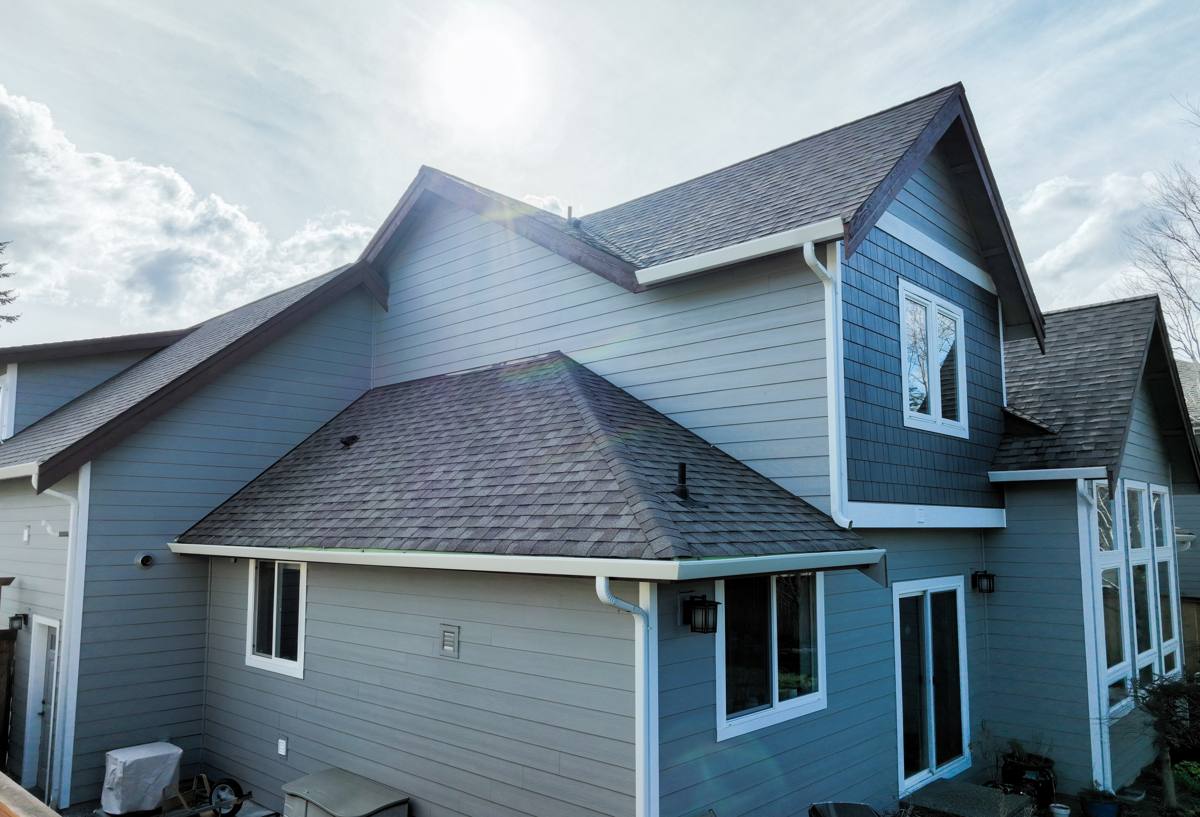
What This Climate Actually Does to Siding
Before talking about products, it helps to understand the failure modes we see repeatedly on homes in this part of Seattle:
Moisture that doesn't leave
Wood-based and wood-adjacent siding products absorb water at cut edges, seams, and fastener penetrations. In a climate where surfaces can stay damp for days after a storm, that absorbed moisture doesn't get a chance to fully dry before the next rain arrives. Over years, that cycle is what causes swelling, delamination, and rot at the bottom courses and around windows.
Moss and organic growth
Shaded, north- and west-facing walls near mature trees — common around Green Lake — stay damp longer and grow moss and algae faster than walls in full sun. Moss holds water against the siding surface and, if left unaddressed, works into seams and behind trim.
Wind-driven rain
Seattle's storms rarely come straight down. Wind pushes rain sideways and up under laps, trim, and butt joints. Any siding system that isn't detailed correctly at those junctions becomes a water entry point regardless of what the material itself is rated to withstand.
UV and temperature swings, just less of them
Compared to drier regions, UV degradation and thermal expansion are smaller factors here — but the trade-off is more total days of exposure to moisture, which is the more damaging force for most siding materials in this region.
Why Fiber Cement Is the Right Material for This Exposure
James Hardie fiber cement siding is made from cement, sand, and cellulose fibers, cured into a dense, dimensionally stable board. It doesn't absorb water the way wood or wood-composite products do, it won't rot, and it's non-combustible. For a neighborhood like Green Lake, where shade and lake humidity keep walls damp longer than in drier parts of the city, that moisture resistance is the whole point.
Just as important: Hardie's ColorPlus factory finish is baked on and warranted separately from the siding substrate, which means the paint layer is engineered for the same wet-climate exposure rather than relying on a field-applied coat to hold up on its own.
What we do not install, and why it matters here
We don't install vinyl, LP SmartSide, primed wood, cedar, or other fiber cement brands. That's a deliberate standard, not a limitation of what's available. Vinyl can warp and gap at seams over time, which becomes a bigger problem in a climate with this much wind-driven rain. Wood and wood-composite products need consistent maintenance to keep moisture out, and a shaded, moss-prone lot is exactly the setting where that maintenance schedule gets demanding fast. We'd rather put one material on Green Lake homes and stand behind it fully than offer a menu of products with different long-term risk profiles.
The Hardie Product Lines That Fit This Neighborhood
James Hardie engineers its siding by climate zone, and homes in Seattle and the rest of King County fall under the HZ5 zone — the specification built for regions with sustained moisture exposure. That's not a marketing label; it affects the formulation and installation requirements of the product itself.
| Product | Typical Use on Green Lake Homes | Why It Fits |
|---|---|---|
| HardiePlank lap siding | Most common choice for full re-sides | Traditional horizontal profile, sheds water efficiently when lapped and flashed correctly |
| HardieShingle siding | Accent gables, dormers, Craftsman-style detailing | Matches the shingle-style architecture common on older Green Lake and Wallingford-adjacent homes without the maintenance burden of cedar shingle |
| HardiePanel vertical siding | Modern facades, accent walls, porch ceilings | Clean vertical lines popular on updated and newer builds in the area |
| HardieTrim boards | Corners, window and door casing, fascia | Non-combustible trim that won't rot at the joints where most water intrusion starts |
What a Correct Installation Actually Involves
Fiber cement siding is only as good as its installation. Most of the siding failures we get called out to inspect in Seattle aren't material failures — they're installation shortcuts that let water behind the siding plane. On a climate like this one, those shortcuts show up faster than they would somewhere drier.
- A drainage plane (weather-resistant barrier) installed correctly behind the siding, with all seams taped and shingled to shed water downward
- Proper clearance between the bottom of the siding and grade, roofing, decks, and paved surfaces — a common corner that gets cut and the single biggest cause of moisture damage at the base of walls
- Correct fastener type, placement, and spacing per Hardie's published HZ5 installation instructions, not a generalized spec sheet
- All factory-cut and field-cut edges sealed before installation — an exposed cut edge is the fastest path for water into the board
- Flashing integrated at every window, door, and roof-to-wall intersection, not just caulked over
- Butt joints and trim seams sealed with a caulk rated for the ColorPlus finish so the color match and the seal both hold up
- Adequate gap and rainscreen detailing on shaded or tree-covered walls where moisture sits longest
Skipping any one of these doesn't usually cause a visible problem in year one. It shows up in year five or six as staining, soft spots, or paint failure at specific joints — by which point the fix is more invasive than it would have been to do correctly the first time.
How We Approach a Green Lake Project
Site walk and moisture assessment
We start by walking the exterior and checking the existing siding, trim, and sheathing for hidden moisture — particularly on shaded and north-facing walls, where problems tend to hide longest. This tells us whether we're dealing with a straightforward re-side or whether there's sheathing or framing repair to plan for first.
Tear-off versus overlay
We remove the existing siding down to the sheathing rather than installing over it. On a home with any history of moisture intrusion — common in older Green Lake housing stock — overlaying just traps whatever is already happening behind the wall. Full tear-off lets us fix the drainage plane and any damaged sheathing before the new siding goes on.
Permitting
Exterior re-side work in Seattle typically requires permitting through the city, and we handle that as part of the job rather than leaving it to the homeowner.
Detailing for the specific lot
Every Green Lake property has its own exposure — some walls get more direct rain, others sit in the shade of neighboring trees most of the day. We adjust flashing, clearance, and rainscreen detailing wall by wall rather than applying one spec to the whole house.
What Drives Cost on a Fiber Cement Project
Every estimate is specific to the house, but these are the factors that move the number most:
| Factor | Why It Matters |
|---|---|
| Home size and number of stories | More square footage and higher elevations mean more material and more labor, including staging for upper stories |
| Tear-off scope | Full removal of existing siding down to sheathing costs more upfront than overlay, but avoids trapping existing moisture problems |
| Sheathing or framing repair | Any rot found during tear-off has to be repaired before new siding goes on — this is discovered work, not something we can price sight unseen |
| Trim and detail complexity | Gables, dormers, multiple roof-to-wall intersections, and shingle accents all add labor |
| Siding profile and color | Lap, shingle, and panel products install at different rates, and custom ColorPlus colors carry different lead times than standard colors |
Why It Matters That We Already Work in This Neighborhood
A crew that's worked Green Lake and the surrounding Seattle neighborhoods knows which walls typically hold moisture longest, how the tree canopy on a given block affects moss growth, and what the city's permitting process actually requires — not in theory, but from having gone through it. That familiarity shows up in fewer surprises mid-project and in detailing decisions that account for how this specific climate behaves, not a generic weather profile. It also means we're not learning the neighborhood on your house.
Get a Straight Answer on Your Home
If your current siding is showing moss buildup, soft spots, or paint failure at the seams, or if you're planning ahead for a re-side, we're happy to walk the exterior with you and give you a clear, no-pressure assessment of what your home actually needs. Use the form below to request a free estimate.