 Seattle Exterior
 Composite Decking Built for Kirkland's Climate, Not Just Kirkland's Views
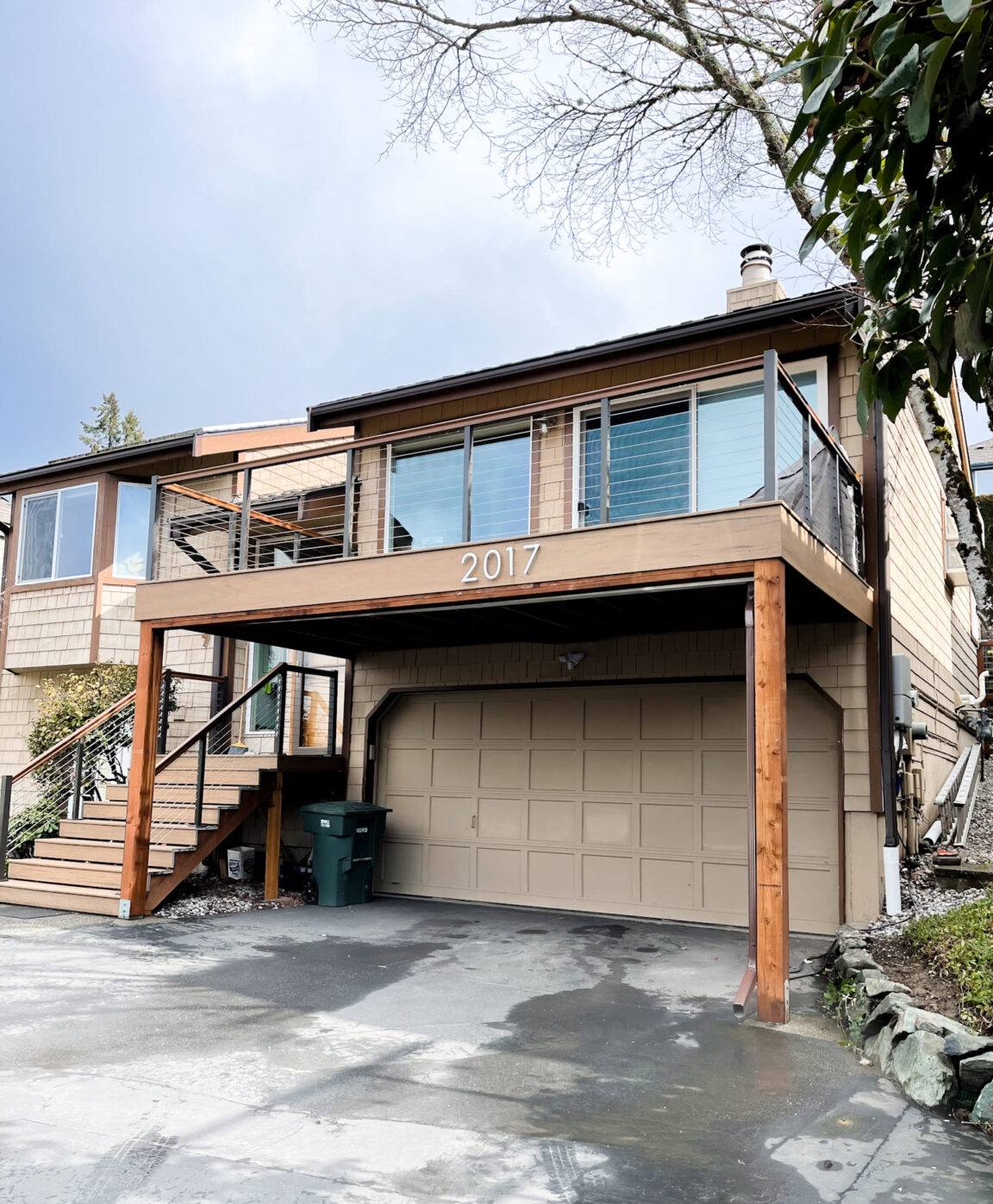
Kirkland homes see a lot of outdoor living — lake frontage, hillside lots with territorial views, backyards shaded by mature evergreens. All of that is exactly why composite decking has become the go-to choice here over the last decade. But a deck that looks right in the showroom and a deck that survives eight months of King County drizzle, moss growth, and freeze-thaw cycles are two different projects. The difference is almost never the decking board itself — it's what's underneath it, how it drains, and whether the crew that installed it understood the local conditions before the first joist went down.
This page covers what composite decking work actually requires in Kirkland specifically: the moisture and moss pressures unique to this part of the Seattle area, what a properly built deck looks like from the framing up, and why hiring a crew that already works this territory matters more with composite than with almost any other exterior product.
Why the Local Climate Changes the Job
Composite decking is marketed as low-maintenance, and compared to wood it is. But "low-maintenance" does not mean "climate-proof," and the Seattle area's combination of marine-influenced humidity, long stretches of driving rain, and short, weak-angle winter sun creates conditions that punish sloppy installation work. A few specifics worth understanding before you commit to a deck:
- Moss and algae pressure is constant, not seasonal. Shaded lots, tree cover, and high ambient humidity mean organic growth on decking surfaces isn't a once-a-year problem — it's a year-round maintenance line item if drainage and airflow underneath the deck aren't handled correctly.
- Driving rain finds gaps. Wind-driven rain off the water and through the hills doesn't fall straight down — it gets pushed sideways into board seams, fastener holes, and any transition where the decking meets siding, stairs, or a ledger board.
- Freeze-thaw cycling is mild but real. King County doesn't see extreme cold, but repeated light freezes after a soaked surface can work at fasteners and expand hairline gaps in poor-quality connections over several seasons.
- Lake-adjacent lots trap moisture longer. Homes near Lake Washington and the smaller waterways around Kirkland often sit on lots with heavier ground moisture and less air movement at ground level, which slows drying time under and around the deck structure.
None of this means composite decking is a poor choice for this area — it's actually one of the better choices, since it doesn't rot, splinter, or need annual staining the way wood does. But the installation has to account for these conditions, or you end up with a deck that still grows moss, still traps water, and still needs more attention than the product was supposed to require.
What a Correct Composite Deck Build Involves
The Substructure Is What Actually Matters
Composite boards are only as good as what they sit on. In this climate, we treat the substructure — ledger, joists, beams, posts, and footings — as the part of the job that determines whether the deck lasts 10 years or 30. That means:
- Proper ledger board flashing and separation from the house wall, so water shed off the deck doesn't wick back into the home's sheathing.
- Joist tape or an equivalent moisture barrier on framing lumber, since composite decking traps humidity against the joists more than open wood decking does.
- Footings sized and set to local frost depth and soil conditions, not just whatever the fewest-footing layout allows.
- Joist spacing tightened where manufacturer specs call for it — many composite products require closer joist spacing than traditional wood decking, especially on diagonal patterns or stair treads.
Drainage and Airflow Underneath
This is the step that gets skipped most often and causes the most callbacks. A deck built tight to grade, or over soil that doesn't drain, holds moisture against the underside of the boards and framing indefinitely. A correct build accounts for slope away from the house, ventilation gaps where the structure allows it, and — on lower decks close to grade — a plan for water to actually leave the area instead of pooling underneath.
Fastening System
Hidden fastener clip systems are standard on most composite lines now, and for good reason: face-screwing composite boards creates entry points for water and a visible seam where moss and grime collect first. Clip systems also allow the board to expand and contract with temperature swings without splitting or bowing — something that matters more here than in drier climates because these boards see more wet-dry cycling over a year.
Composite vs. Wood vs. PVC — An Honest Comparison for This Climate
| Factor | Composite | Pressure-Treated Wood | PVC (Cellular Vinyl) |
|---|---|---|---|
| Moisture resistance | Strong — capped boards shed water well | Requires ongoing sealing to resist rot | Excellent — fully synthetic, no organic content |
| Moss/algae resistance | Good with proper airflow; some growth possible in deep shade | Poor — wood grain holds moisture and organic matter | Very good — smooth, non-porous surface |
| Maintenance | Occasional wash; no staining or sealing | Annual cleaning, sealing or staining | Minimal; occasional wash |
| Upfront cost | Mid to upper-mid | Lowest | Highest |
| Feel underfoot / appearance | Wood-like grain, wide color range | Natural wood look, ages and grays | Very uniform; some find it less natural-looking |
| Structural sensitivity to install quality | High — drainage and framing errors show up as moss, staining, board movement | Moderate — wood tolerates minor errors but rots faster overall | High — expansion gaps must be precise |
We install all three depending on the homeowner's budget and priorities, but for most Kirkland projects, composite is the practical middle ground: it holds up to the local moisture load far better than wood without the top-end cost of PVC. The table above is about trade-offs, not a knock on any one product — the right choice depends on your lot's shade, drainage, and how hands-off you want the deck to be.
Our Process for a Kirkland Composite Deck Project
- On-site assessment. We look at grade, drainage, existing structure (if replacing an old deck), sun/shade exposure, and how the deck ties into the house.
- Design and product selection. Board profile, color, and railing/fastener system chosen based on your budget and the shade/moisture profile of the lot.
- Permitting. Deck projects in this area typically require a permit depending on size, height, and attachment to the structure — we handle the application and inspection scheduling.
- Demo (if applicable). Removal of the old deck, with an inspection of the ledger and any framing that will be reused or needs replacement.
- Framing and substructure. Footings, posts, beams, joists, ledger flashing, and moisture barrier tape — built to hold up under the drainage and moss pressures covered above.
- Decking installation. Boards, hidden fasteners, stair and railing components, with attention to expansion gaps and edge details where water is most likely to intrude.
- Final walkthrough and inspection. Local building inspection sign-off where required, plus our own final check before we call the job done.
Maintaining a Composite Deck in a Wet, Shaded Climate
Composite decking cuts maintenance dramatically compared to wood, but "no maintenance" isn't accurate in this region — especially on lots with tree cover or lake-adjacent humidity. A short, realistic maintenance routine:
- Sweep debris (needles, leaves, seed pods) off the deck regularly — trapped organic debris holds moisture and feeds moss growth.
- Wash the surface once or twice a year with a soft-bristle brush and a mild deck cleaner; avoid pressure washers on composite unless used carefully at low pressure and wide fan tip.
- Check that gaps between boards and at the deck perimeter stay clear so water can drain through rather than pool.
- Inspect railing posts and stair connections annually for any movement, since these take the most structural stress over time.
- Trim back overhanging branches where possible to reduce shade and speed up drying time on the deck surface.
Why Hiring a Crew That Already Works Kirkland Matters
Composite decking is a product where installation quality shows up years later, not on day one — a poorly flashed ledger or under-ventilated substructure looks fine at handoff and causes problems in year three or four. A crew that regularly works Kirkland and the broader Seattle area already knows the drainage habits of local soil types, how shaded lots near mature trees behave differently than open lots, and what King County's permitting and inspection process expects for deck attachment and footing depth. That local pattern recognition is the difference between a deck that's designed for this specific climate and one that's built to a generic national spec sheet.
It also matters for accountability. A local, established contractor is easy to reach if a warranty question comes up down the road — no chasing down an out-of-town crew that did one job in the neighborhood and moved on.
Signs Your Current Deck Needs Attention
If you're deciding between repair and full replacement, a few signs point toward a rebuild rather than a patch:
- Soft or spongy spots in the decking surface or framing underneath
- Persistent moss or black staining that returns quickly after cleaning
- Visible gaps or movement at the ledger board where the deck meets the house
- Railing posts that flex or feel loose under moderate pressure
- Fasteners backing out or rust staining around screw heads
Any of these can usually be diagnosed accurately with an on-site look at the framing, not just the surface boards.
If you're weighing composite decking for a Kirkland property — new build, replacement, or a deck that's showing its age — we're glad to come take a look and give you a straightforward, no-pressure estimate based on your actual lot conditions. Use the form below to get started.