 Seattle Exterior
 Ballard's Marine Climate Is Rougher on Siding Than Most of Seattle Realizes
Ballard sits close enough to Puget Sound and the ship canal that homes here take a different kind of weathering than siding a few miles inland. Salt-laden air off the water accelerates corrosion on fasteners and metal trim, damp marine winds drive rain sideways into wall assemblies that were only designed to shed water falling straight down, and the shade from mature trees combined with persistent humidity gives moss and algae a long growing season that barely lets up between November and June. None of this means Ballard homes are falling apart faster than the rest of King County — it means the siding here needs repair work that actually accounts for these conditions, rather than a generic patch job that ignores why the damage happened in the first place.
We've been doing exterior work across Seattle long enough to see the pattern clearly: a repair that looks fine the day it's finished but wasn't built for Ballard's specific exposure will usually fail again within a few wet seasons. Getting it right the first time matters more here than in drier, more sheltered neighborhoods.
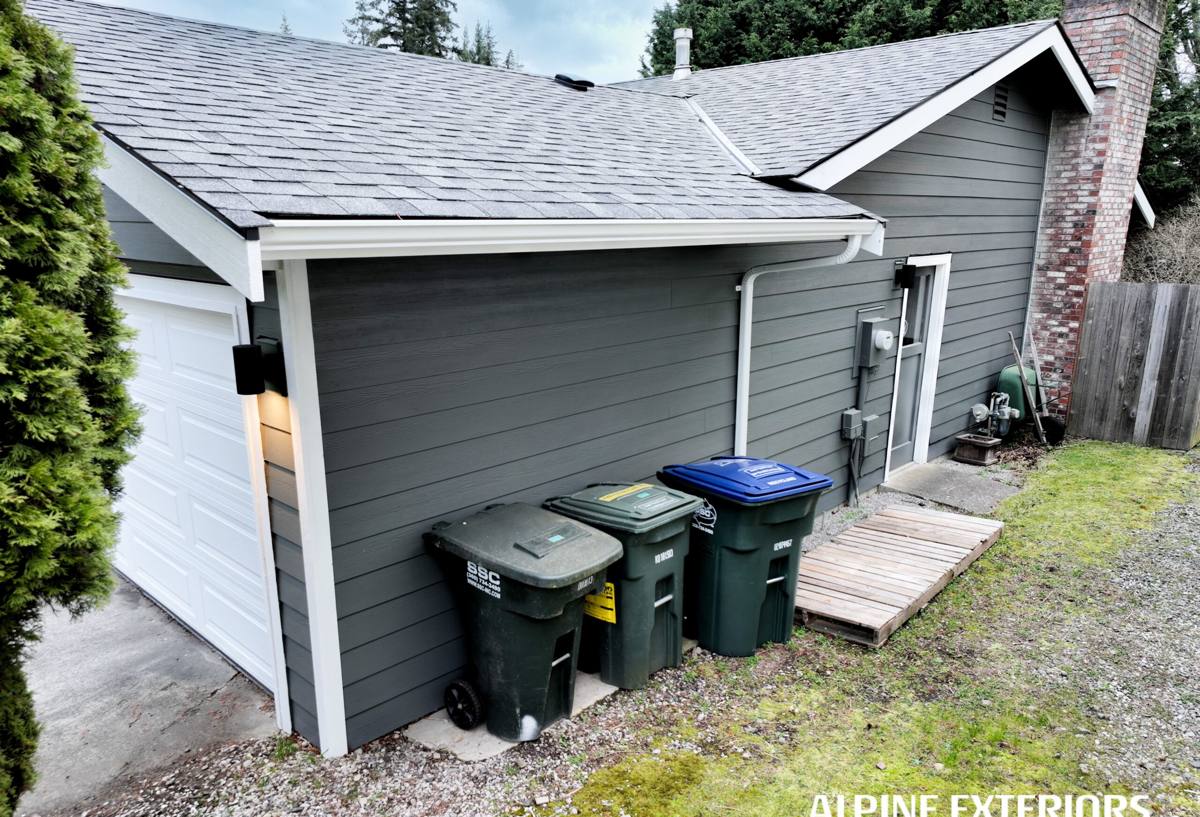
Signs Your Ballard Home's Siding Needs Attention
Most siding problems don't announce themselves with a dramatic failure — they show up as small, easy-to-dismiss symptoms first. Homeowners who catch these early save themselves from much larger repair bills later.
- Dark green or black streaking, especially on north-facing walls or sections shaded by trees or neighboring structures
- Soft or spongy spots when you press on a wall — a sign moisture has reached the substrate underneath
- Paint that's bubbling, peeling, or failing faster than it should on an otherwise well-maintained house
- Visible gaps, warping, or cupping in individual boards or panels
- Rust streaks below nail heads or trim fasteners, common with the salt content in coastal air
- A musty smell in an interior room that backs up to an exterior wall
- Caulk that's cracked, shrunk, or pulled away at seams and trim joints
Any one of these on its own might be minor. Several showing up together, or moisture damage that's clearly spread beyond the surface, usually means the repair needs to go deeper than cosmetic patching.
Why Moss Deserves Special Attention
Moss isn't just cosmetic. It holds moisture against the siding surface far longer than bare material would dry on its own, and thick moss growth can work into seams and lap joints, prying them open over time. In Ballard's tree-shaded, marine-humid pockets, moss can establish itself on siding within a single damp season if the surface isn't sealed and draining properly. A repair that removes the visible moss but doesn't address why that section stays wet longer than the rest of the wall is a repair that will need to be redone.
What a Correct Siding Repair Actually Involves
A siding repair that holds up in Ballard's conditions is not simply "replace the damaged board and caulk the edges." Done correctly, it involves several steps that are easy to skip if a crew is moving fast:
- Diagnosing the actual cause — failed flashing, a missing kick-out at a roof-wall intersection, poor original installation, or simple age and exposure. Replacing siding without fixing the cause means the new material fails the same way.
- Opening up the area enough to inspect the water-resistive barrier and sheathing underneath, not just the visible siding surface.
- Confirming the substrate is dry and sound before anything new goes back on. Sealing moisture in behind new siding is one of the most common repair mistakes we see.
- Matching or properly integrating the replacement material so water still sheds correctly at every seam, especially where old and new material meet.
- Re-flashing and re-caulking correctly, with attention to the specific joints and penetrations that let water in the first time.
Skipping any of these steps is how a "repair" turns into a repeat service call twelve months later.
How Different Siding Materials Hold Up in Ballard
What a house is currently sided in changes what a proper repair looks like, and it changes how often that home is likely to need repair work in the first place. Here's an honest comparison based on how these materials actually behave in a marine, moss-prone climate:
| Material | Moss & Moisture Behavior | Salt Air Exposure | Typical Repair Complexity |
|---|---|---|---|
| Cedar / wood lap | Absorbs moisture readily; moss and rot take hold fast without diligent maintenance | Fasteners and trim corrode; wood itself is not affected by salt directly | Often requires matching aged wood tone and grain, which gets harder as boards weather unevenly |
| Vinyl siding | Doesn't absorb water, but moss grows on its surface film and traps moisture against the wall behind it | Can become brittle over time; expands/contracts more with temperature swings near the water | Panels are often discontinued after a few years, making exact color matches difficult |
| Fiber cement (James Hardie) | Engineered non-combustible, moisture-resistant substrate; factory finish resists moss adhesion far longer than bare wood | Fiber cement itself doesn't corrode; using stainless or coated fasteners protects against salt-driven rust | Consistent factory-milled product makes patching and blending straightforward when done to spec |
This is exactly why, when a repair calls for replacing a damaged section rather than just resealing what's there, we rebuild it in James Hardie fiber cement — regardless of what the rest of the house is currently clad in. More on that below.
Our Ballard Siding Repair Process
- On-site inspection. We look at the damaged area and the surrounding wall assembly, not just the spot you called about — moisture problems rarely stay contained to one board.
- Honest diagnosis. We tell you what's actually causing the damage, whether it's a flashing failure, an installation flaw, ordinary age, or a combination.
- Written scope and options. You get a clear explanation of what a proper repair requires, what it costs, and — if the damage is widespread — whether repair or replacement is the more sensible investment.
- Removal and substrate check. We open up the affected section, confirm the sheathing and barrier underneath are sound, and dry out anything that needs it before closing the wall back up.
- Repair and reintegration. Damaged material is replaced, flashing and drainage details are corrected, and the new section is finished to blend with the surrounding siding as closely as possible.
- Final walkthrough. We show you what was found, what was fixed, and what to watch for going forward.
Repair or Replace? Knowing the Difference
Not every siding problem justifies a full re-side, and not every homeowner needs to hear that they do. As a rule of thumb:
- Isolated damage — a cracked board from storm debris, one section with a flashing failure, localized moss on a shaded wall — is usually a straightforward repair.
- Widespread moisture damage, siding that's failing across multiple elevations, or a house where the original installation had systemic flashing problems is often more cost-effective to address as a full replacement rather than chasing repairs year after year.
- Age matters too. Wood or older vinyl siding that's already near the end of its practical service life may not be worth investing repair dollars into if it's going to need replacing within a few years regardless.
We'll tell you honestly which category your home falls into. A contractor who always recommends full replacement, or who always recommends repair regardless of what they find, isn't giving you a real assessment.
Why We Rebuild Damaged Sections in James Hardie, Not the Original Material
We install James Hardie fiber cement siding exclusively — we don't install vinyl, LP SmartSide, or unfinished cedar, and that standard carries into repair work too. When a repair calls for replacing a section of damaged siding with new material, we use James Hardie rather than matching the original product, for a few practical reasons:
- It's non-combustible, which matters for wildfire ember exposure that has become a more regular late-summer concern across Western Washington in recent years.
- The ColorPlus factory finish holds color and resists the kind of surface breakdown that lets moss and algae get a foothold, which is a direct answer to Ballard's moss problem rather than a cosmetic upgrade.
- It's engineered for the Pacific Northwest's moisture exposure specifically, through Hardie's climate-specific HZ product lines, rather than being a general-purpose material adapted to our weather after the fact.
- It carries a strong transferable warranty when installed to manufacturer spec, which protects the investment for you or a future buyer.
We understand this means a repaired section may not be a perfect visual match to 20-year-old cedar or discontinued vinyl in every case, and we'll be upfront with you about that trade-off before any work starts. In our experience, most Ballard homeowners would rather have a repair that actually holds up to the next ten wet seasons than one that matches perfectly today and fails again in three years.
Why a Crew That Already Works Ballard Matters
Siding repair isn't one-size-fits-all across Seattle. A crew that mostly works drier, more sheltered neighborhoods can miss things that are second nature to a crew that's regularly out in Ballard's specific exposure — how far moss creeps in a single season on a shaded north wall, which flashing details actually hold up against wind-driven rain off the water, or how salt air changes what fastener and trim choices make sense. Familiarity with a neighborhood's actual failure patterns, not just general siding knowledge, is what separates a repair that lasts from one that's a temporary fix.
It also means faster, more accurate estimates. When we already understand how Ballard homes typically age and fail, we spend less time guessing and more time giving you a straight answer about what's actually going on with your siding.
Keeping Your Siding Repair Working for the Long Haul
A good repair should buy you years of trouble-free performance, but a little homeowner maintenance extends that considerably in a climate like this one:
- Trim back tree branches and vegetation that keep any wall section in constant shade and moisture
- Rinse visible moss or algae growth off siding surfaces before it thickens, rather than waiting for it to become an eyesore
- Walk the exterior once or twice a year, especially after major storms, checking caulk lines and looking for new soft spots
- Keep gutters clear so overflow isn't running down wall surfaces it was never meant to handle
- Address small issues — a cracked caulk joint, a loose piece of trim — before the next wet season rather than after
If you're noticing moss buildup, soft spots, or paint failure on your Ballard home's siding, we're happy to take a look and give you a straightforward assessment — no pressure, no upsell, just an honest read on what your siding actually needs. Reach out below for a free estimate.