 Seattle Exterior
 Why Bellevue Decks Wear Out Faster Than Homeowners Expect
Most decks in the Bellevue area don't fail because the wood was bad or the builder was careless. They fail because the Puget Sound climate is genuinely hard on exterior wood structures, and very few decks are built with that climate as the starting assumption. Long stretches of driving rain, heavy shade from mature trees on many Bellevue lots, and a moss season that can run from fall through spring all combine to keep deck surfaces and framing damp far more of the year than most manufacturers' warranties account for.
A deck that would hold up fine in a drier climate can start showing soft spots, cupped boards, and slick moss growth within a handful of years here. That's not a knock on any particular material — it's just what happens when wood and wood-adjacent products spend months at a time absorbing moisture instead of drying out between rains. Understanding that is the first step to building something that actually lasts in this area.
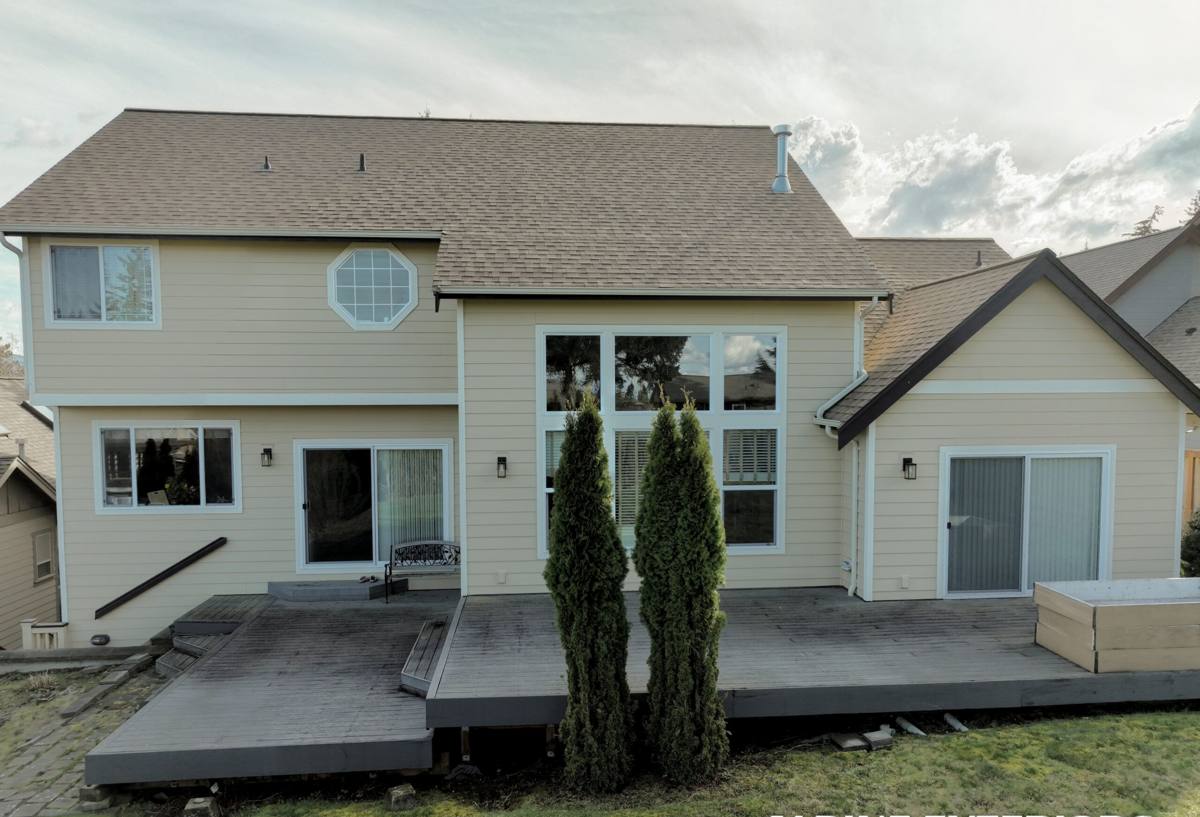
Signs Your Deck Has Crossed From "Repairable" to "Replace It"
Not every tired-looking deck needs to be torn out. But there's a point where patching individual boards or re-staining stops being worth the money, and pushing past that point usually means throwing good money after bad. Watch for these:
- Soft, spongy, or discolored spots in the decking when you press on them with your foot
- Screws or nail heads that have backed out or that spin freely without biting
- Visible gaps or rot where deck boards meet the house — a common moisture trap in wet climates
- Persistent moss or algae film that returns within weeks of cleaning, even in the same spots
- Wobble or movement in the railing posts, or a ledger board pulling away from the house
- Structural framing (joists, beams, posts) that shows rot, splitting, or insect damage underneath the deck
If it's cosmetic surface wear on an otherwise sound frame, repair or refinishing can make sense. Once the framing itself is compromised, replacement is almost always the more honest recommendation — and the safer one, since deck failures tend to happen suddenly rather than gradually.
What a Correct Deck Replacement Actually Involves
It Starts Below the Surface
The decking boards are what everyone sees, but the framing underneath is what determines whether the deck is safe and how long it lasts. A proper replacement means evaluating and, where needed, rebuilding the ledger attachment to the house, the support posts, footings, joists, and any flashing that keeps water from tracking into the house structure itself. In a climate that stays wet as much of the year as ours does, flashing details at the ledger board matter enormately — this is one of the most common places we find hidden rot on older Bellevue decks, because it's invisible until the decking comes up.
Drainage Is Not Optional
Any deck built without a plan for where water goes is a deck that's going to have problems in this region. That means proper board spacing for drainage, joist protection (tape or flashing over the top of framing lumber), and grading or drainage systems underneath the deck if it sits low or covers a walkout basement or patio below. Skipping this step is one of the most common shortcuts we see in decks that failed early.
Fasteners and Hardware
Hidden fastener systems and structural hardware need to be rated for the exposure they'll see — that means corrosion-resistant connectors and coated or stainless fasteners throughout, not just at the visible surface. In a marine-influenced climate like ours, mismatched or under-rated hardware is a slow, quiet way for a deck to fail years before the decking itself wears out.
Comparing Decking Materials for a Bellevue Climate
There's no single "best" decking material — there's the right material for your budget, your maintenance appetite, and how much sun or shade the deck actually gets. Here's how the common options stack up for a climate defined by rain, humidity, and moss:
| Material | Moisture Behavior Here | Maintenance | Typical Lifespan |
|---|---|---|---|
| Pressure-treated wood | Prone to cupping and splitting if not sealed regularly; moss-prone in shade | Annual cleaning and re-sealing recommended | 10–15 years with upkeep |
| Cedar | Naturally rot-resistant but still absorbs moisture; graying without maintenance | Periodic oiling or staining to control moisture uptake | 15–20 years with upkeep |
| Composite decking | Doesn't rot or splinter, but can stay damp longer on the surface, which feeds moss/algae in shaded areas | Periodic washing; no sealing or staining needed | 25–30 years, varies by product warranty |
| PVC decking | Fully moisture-resistant surface; least susceptible to moss staining | Occasional washing | 25–30+ years, varies by product warranty |
We install a range of these depending on the homeowner's priorities, but we're upfront about trade-offs rather than pushing whatever has the best margin. Composite and PVC decking cost more up front but largely remove the maintenance burden that wood carries in this climate. Wood costs less initially but only performs well long-term if the homeowner keeps up with sealing and cleaning on a real schedule — something that's easy to fall behind on.
How We Approach a Bellevue Deck Replacement
- On-site assessment. We inspect the existing deck's framing, ledger connection, footings, and drainage — not just the surface boards — to understand what's actually driving the wear.
- Honest scope. We tell you plainly whether you need a full tear-out and rebuild or whether a partial repair genuinely makes sense. We don't upsell a full replacement when it isn't warranted.
- Material walkthrough. We go over decking, railing, and hardware options against your budget and how much sun or shade the space gets, since that changes how moss and moisture will behave on the finished deck.
- Permitting. Deck replacements of meaningful size or height typically require a permit through the local building department; we handle that process rather than leaving it to the homeowner.
- Demolition and disposal. Old decking and framing are removed and hauled off — we don't leave debris for you to deal with.
- Rebuild from the ground up. Footings, framing, ledger flashing, and drainage are addressed first, since that's the part nobody sees but everything else depends on.
- Final walkthrough. We go over the finished deck with you, including what maintenance (if any) the material you chose will need going forward.
Permits and Code Considerations in King County
Deck work in Bellevue and the surrounding King County area is subject to local building code requirements, particularly around railing height, guard spacing, footing depth, and ledger attachment to the house. These requirements exist for genuinely good reasons — deck collapses and railing failures are rare, but they happen almost exclusively on decks that skipped proper permitting and inspection. If a contractor tells you permitting isn't necessary for a full deck replacement, that's worth questioning directly. We pull the appropriate permits and build to code as a matter of course, not as an upsell.
Cost Factors Homeowners Should Understand
Deck replacement pricing varies widely based on size, material, and site conditions, and we'd rather explain what drives that variation than quote a number that doesn't mean anything without context.
| Factor | Why It Moves the Price |
|---|---|
| Deck size and shape | More square footage and complex layouts (multiple levels, angles, built-in seating) mean more material and labor |
| Material choice | Composite and PVC decking cost more upfront than wood but reduce long-term maintenance costs |
| Framing condition | Rotted joists, posts, or footings add rebuild work that isn't visible until demolition starts |
| Height and access | Elevated decks or difficult site access can add labor and equipment cost |
| Railing and stairs | Custom railing systems and multiple stair runs add materials and installation time |
We'd rather walk your specific deck and give you a real number than throw out a broad range that doesn't reflect your actual project.
Living With a New Deck in This Climate
Whatever material you choose, a few habits go a long way toward protecting the investment:
- Sweep leaves and debris off the deck surface regularly, especially in fall — trapped organic matter is what feeds moss and algae
- Rinse or wash the deck a few times a year to interrupt moss growth before it takes hold, particularly in shaded sections
- Keep gutters and downspouts near the deck clear so runoff isn't dumping extra water onto or under the structure
- If you chose wood, stay on a real sealing schedule rather than waiting until it visibly needs it
- Check railings and stair connections periodically for movement, especially after the wettest months
None of this is complicated, but skipping it is exactly how a well-built deck ends up looking and performing like a poorly-built one within a few years.
Why It Matters to Hire a Crew That Already Works This Area
A deck built by someone unfamiliar with how wet and shaded this region stays for much of the year will often look fine on installation day and start showing problems within a couple of seasons — moss in the shaded corners, soft spots where drainage wasn't planned for, hardware that wasn't rated for the exposure. A crew that already works Bellevue and the greater Seattle area builds with that climate as a baseline assumption, not an afterthought discovered after the first wet winter. That shows up in flashing details, fastener choices, and drainage planning that a generic build spec doesn't always account for.
If your current deck is showing its age, or you're not sure whether it needs repair or full replacement, we're happy to take a look and give you a straight answer. Reach out for a free, no-pressure estimate using the form below.