 Seattle Exterior
 Bellevue's Weather Is Harder on Siding Than It Looks
Bellevue gets credit for milder weather than the coast, and in some ways that's true — but the Eastside has its own set of problems for exterior siding. Heavy tree canopy across neighborhoods here means shade, dampness, and organic debris sit against exterior walls far longer than they would on an open lot. Add King County's long stretch of drizzly, overcast months, and you get siding that rarely gets a real chance to dry out between rain events. That combination is what actually wears siding down in this area: not one big storm, but months of low-grade moisture exposure repeated year after year.
Homes closer to Lake Washington and Lake Sammamish deal with their own version of this — higher ambient humidity near the water, morning fog that clings to north-facing walls, and the same driving rain that soaks the whole region during fall and winter systems. Across greater Puget Sound, siding also has to contend with salt-laden air moving in off the Sound, which accelerates corrosion on fasteners and trim even at properties several miles inland. None of this is dramatic, but over 10, 15, or 20 years it adds up to rot, mold staining, and moss colonization on siding that wasn't built for a wet climate in the first place.
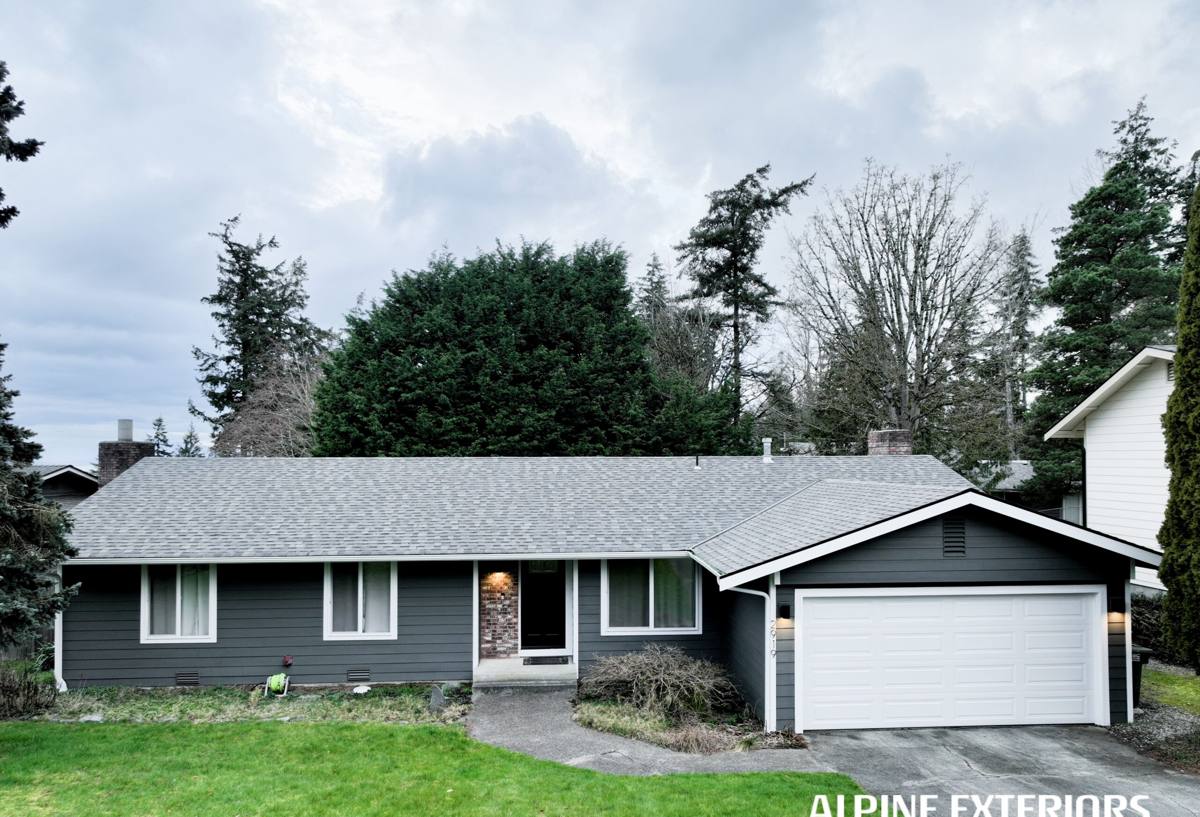
What Siding Actually Needs to Do in This Climate
For a Bellevue home, siding has one real job beyond looks: manage moisture without absorbing it, swelling, or feeding mold and moss growth. That means the material itself has to resist water intrusion, the finish has to hold up under UV and damp cycling without cracking, and the installation has to get water off the wall instead of trapping it behind the cladding.
Why This Matters More on Shaded, Wooded Lots
A lot of Bellevue properties sit under mature trees, which is great for privacy and curb appeal but terrible for siding that can't shed moisture efficiently. Shaded walls dry slower, stay damp longer, and are the first place moss and mildew take hold. Siding material and installation quality matter more here than they would on a sun-exposed, wind-swept lot.
Why We Only Install James Hardie Fiber Cement
We standardized on James Hardie fiber cement siding for every home we side, including here in Bellevue, and we don't install vinyl, LP SmartSide, cedar, primed spruce, or other fiber cement brands. That's not a marketing position — it's a decision based on how those products actually perform in a wet, moss-prone climate over the long run.
Wood siding, even quality cedar, needs consistent refinishing to keep moisture out, and in a shaded, humid environment that maintenance window shrinks fast. Vinyl sheds water on the surface but the seams and fastening system can allow moisture behind the panels, and it has no real fire resistance. Fiber cement products in general are a step up, but James Hardie's ColorPlus factory-applied finish, HZ5 climate-engineered formulation, and long transferable warranty are specifically built around exactly the conditions this region produces — sustained dampness, temperature swings, and UV exposure without the baking heat that some other climates get. That's why it's the one product we stand behind on every job.
What Correct Installation Involves
Fiber cement siding is only as good as the installation underneath it. Most of the siding failures we see on older homes in this area trace back to installation shortcuts, not the material itself.
Weather Barrier and Drainage Plane
A correctly installed water-resistive barrier with a drainage gap behind the siding is what actually keeps a wall assembly dry in a climate like this. Fiber cement siding face-nailed directly against a wall with no drainage space traps whatever moisture gets past the outer surface, which is exactly the setup that leads to rot behind the siding years later.
Flashing at Every Penetration
Windows, doors, deck ledgers, hose bibs, and vents all need proper flashing integrated with the weather barrier before siding goes on. In a region that gets sustained rain events rather than short downpours, a missed flashing detail eventually finds its way to the sheathing.
Fastening and Gaps to Manufacturer Spec
James Hardie publishes specific fastening patterns, clearances, and caulking requirements, and they exist for a reason — improper nailing or tight butt joints cause cracking and buckling as the material expands and contracts with moisture and temperature. We install to those specifications, not to whatever is fastest.
Trim, Caulking, and Paint Line Details
Where siding meets trim, corners, and foundation lines, gaps and sealant choices determine whether water sheds away from the wall or pools against it. This is detail work, and it's where a lot of corner-cutting happens on lower-bid jobs.
Our Process for Bellevue Homeowners
We walk every Bellevue job through the same sequence, adjusted for the specific house and lot.
- On-site assessment — we look at existing siding condition, moisture staining, moss buildup, tree cover and shade patterns, and any rot at trim, corners, or penetrations.
- Scope and product plan — we determine which James Hardie plank profile, exposure, and color line fits the home and confirm the underlying wall assembly needs (barrier, flashing, drainage).
- Tear-off and sheathing check — old siding comes off and we inspect sheathing for hidden rot before anything new goes up. This step catches problems that aren't visible from the outside.
- Barrier, flashing, and siding installation — installed to manufacturer spec, with attention to every window, door, and penetration.
- Trim, caulking, and final detailing — the finish work that determines how the wall performs over the next 20-plus years.
- Walkthrough and cleanup — we review the finished work with the homeowner and clear the site.
Signs Bellevue Homeowners Should Watch For
Because moisture damage in this climate develops slowly, it's easy to miss until it's serious. Watch for:
- Dark streaking or green/black staining, especially on shaded or north-facing walls
- Moss or algae buildup that keeps coming back even after cleaning
- Soft or spongy spots when you press on siding near the bottom edge or around trim
- Paint that's peeling, bubbling, or chalking faster than expected
- Visible warping, buckling, or gaps opening up at seams and corners
- Musty smells or interior wall staining near exterior walls
Any one of these on its own might be minor. Several together usually means moisture has been getting behind the siding for a while.
How Siding Materials Compare in This Climate
| Factor | James Hardie Fiber Cement | Vinyl | Cedar / Wood |
|---|---|---|---|
| Moisture resistance | High — engineered for wet climates | Sheds surface water, seams can leak | Absorbs moisture without upkeep |
| Moss/mildew resistance | Factory finish resists growth | Growth on surface is common in shade | Prone to moss and rot in damp shade |
| Maintenance | Occasional wash, no refinishing | Low, but seams/panels degrade over time | Regular refinishing required |
| Fire resistance | Non-combustible | Melts/deforms under heat | Combustible |
| Typical lifespan when properly installed | Decades, with strong transferable warranty | Variable, shorter in harsh exposure | Shorter without consistent upkeep |
What Affects the Cost of a Bellevue Siding Job
Every home is different, but a few things consistently move the price on fiber cement siding projects in this area:
- Amount of hidden rot found once old siding and sheathing are exposed
- Home size, wall complexity, and number of stories
- Trim detail, corner treatments, and number of window/door penetrations
- Plank profile and ColorPlus color selection
- Access — steep lots, tight side yards, and mature landscaping common on Bellevue properties can add labor time
We give a firm, itemized estimate after the on-site assessment rather than a rough number over the phone, because hidden sheathing condition is the single biggest cost variable on older homes.
Maintenance After Installation
James Hardie siding, properly installed, needs far less upkeep than wood, but "less" isn't "none" in a climate this wet. A periodic rinse to clear pollen, moss spores, and debris — especially on shaded walls — keeps the factory finish looking right and prevents organic buildup from taking hold. Keeping gutters clear and vegetation trimmed back from walls also matters more here than in drier climates, since standing moisture and constant shade are what actually cause problems over time.
Why Local Installation Experience Matters
A crew that already works Bellevue and the surrounding Eastside knows which walls on a given lot orientation take the worst of the rain, where tree cover creates chronic damp spots, and how King County's inspection and permitting process works for siding replacement. That local pattern recognition is what catches problems — like a flashing detail that's failed on similar homes nearby — before they become expensive repairs.
If you're dealing with aging siding, visible moss, or you're just planning ahead for a home in Bellevue, we're happy to take a look and give you a straightforward, no-pressure estimate. Use the form below to get started.