 Seattle Exterior
 Asphalt Shingle Roofing Built for Capitol Hill's Weather
Capitol Hill homes take a beating that's easy to underestimate. The neighborhood's mature street trees drop needles and leaves onto roofs year-round, Seattle's marine air keeps everything damp for months at a stretch, and the driving rain that comes off the Sound doesn't just fall straight down — wind-driven rain finds every gap in flashing and underlayment that a calmer climate would never expose. Add in a long moss season that can run from October through May, and an asphalt shingle roof here needs more than a standard installation. It needs a crew that understands what King County's climate actually does to a roof over ten, fifteen, twenty years, not just what looks good on installation day.
This page covers what asphalt shingle roofing work looks like specifically for Capitol Hill: the climate factors that matter, what a correct installation involves, how we handle the neighborhood's older housing stock and tight lots, and what ongoing maintenance actually requires here versus a drier part of the country.
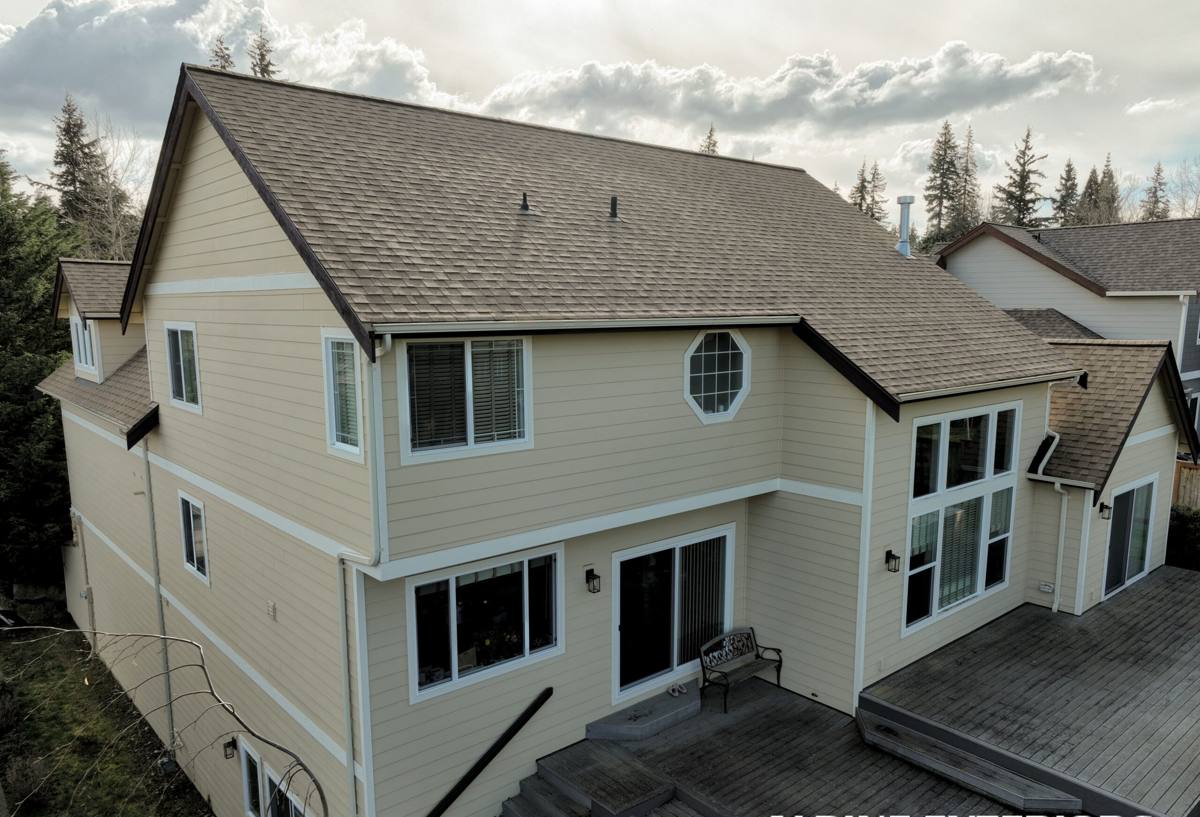
What Seattle's Climate Does to Asphalt Shingles
Moss and Organic Growth
Moss doesn't just sit on top of shingles looking bad — it works its way under the shingle tabs, holds moisture against the mat, and lifts the shingle edges over time. On a roof with any shade from the tree canopy that's common throughout Capitol Hill, moss can establish within a couple of seasons if the roof isn't treated or cleaned. Left unchecked, it shortens the life of an otherwise sound roof by trapping water exactly where it shouldn't be.
Driving Rain and Wind
Seattle rain is rarely a hard downpour, but it's frequent, sustained, and often pushed sideways by wind off Puget Sound. That matters for roofing because it's not just the field of the roof that takes the abuse — it's the valleys, the flashing around chimneys and skylights, and the edges where wind can get underneath a shingle tab that wasn't sealed properly. A roof that would hold up fine in a drier, calmer climate can leak here if the details weren't done right the first time.
Salt Air and Humidity
Being close to the water means everything on a Capitol Hill roof — nails, flashing, vents — is exposed to salt-laden, humid air more consistently than roofs further inland. Lower-grade fasteners and flashing corrode faster under these conditions, which is one of the reasons material choice on this job matters as much as workmanship.
Temperature Swings and UV
King County doesn't get brutal heat, but shingles still go through repeated wet-to-dry and warm-to-cool cycles across the year. Combined with UV exposure during the drier summer stretch, this slowly breaks down the asphalt and granules on lower-quality shingles faster than homeowners expect from a "mild" climate.
Signs a Capitol Hill Roof Needs Attention
Because Capitol Hill homes are often close together with mature landscaping, roof problems aren't always easy to spot from the ground. Here's what we tell homeowners to watch for:
- Green or black streaking, or visible moss patches, especially on the north-facing slope or any section shaded by trees
- Granules collecting in gutters or at the base of downspouts — a sign the shingle surface is wearing down
- Shingle tabs that look lifted, curled, or cupped, particularly along roof edges and ridges
- Daylight or water stains visible in the attic, especially near chimneys, skylights, or where two roof planes meet
- Sagging in the roofline, which can indicate moisture damage to the decking underneath, not just the shingles themselves
- Missing or damaged shingles after a windstorm — common along exposed Capitol Hill blocks with less tree cover
- Moss growth in the same spot as a prior roof, even after cleaning — usually a sign of persistent shade and poor drainage in that area
Any one of these on its own might not mean an emergency, but a combination of two or three is worth a professional look before the next wet season.
What a Correct Asphalt Shingle Installation Involves
A shingle roof is only as good as the layers underneath it, and this is where a lot of the difference between a roof that lasts and one that fails early actually shows up.
Tear-Off and Deck Inspection
We remove the old roofing down to the deck rather than layering over it. That lets us actually see the plywood or plank decking underneath — soft spots, delamination, or old water damage don't show up until the shingles are off, and covering them up just hides a problem that will resurface later.
Ice and Water Barrier at Vulnerable Points
Given how much wind-driven rain this area sees, we pay close attention to self-adhering underlayment at eaves, valleys, and around any roof penetration — chimneys, skylights, pipe boots. These are the spots where standard felt underlayment alone isn't enough insurance against Seattle's weather.
Flashing
Step flashing at walls, counter-flashing at chimneys, and properly lapped valley flashing matter more here than in drier climates, because the roof simply sees more total hours of rain contact per year. Reused old flashing is a common shortcut we don't take — it's one of the most frequent causes of slow, hard-to-trace leaks we get called out to fix on other contractors' work.
Nailing Pattern and Wind Rating
Manufacturer nailing specifications exist for a reason, and skipping a nail or two per shingle is one of the most common ways installers cut time on a job. Correct nail placement and count is what actually gives a shingle its rated wind resistance — the shingle package's wind rating is meaningless if the installation doesn't match it.
Attic Ventilation
Proper intake and exhaust ventilation keeps moisture from building up under the deck, which matters in a climate where the air outside is often nearly as humid as the air you're trying to vent from the attic. Poor ventilation shortens shingle life from underneath, independent of anything happening on the surface.
Choosing the Right Shingle for This Neighborhood
Not every asphalt shingle product is a good fit for a shaded, damp, tree-canopy neighborhood like Capitol Hill. Here's how the common options compare for this specific setting:
| Shingle Type | Moss/Algae Resistance | Typical Lifespan Here | Best Fit For |
|---|---|---|---|
| Standard 3-tab | Lower — no algae-resistant granules | Shorter under heavy tree cover | Budget re-roofs on sunnier, less-shaded lots |
| Algae-resistant architectural | Higher — copper or zinc-infused granules | Longer under shade and moss pressure | Most Capitol Hill homes with any tree canopy |
| Impact-rated architectural | Higher, same algae-resistant option available | Comparable to standard architectural, more durable surface | Homes wanting extra durability against debris and hail |
| Premium/designer laminate | Higher, thicker mat and granule layer | Longest of the asphalt options | Historic-character homes wanting a heavier, dimensional look |
For most Capitol Hill properties, we steer homeowners toward algae-resistant architectural shingles as the baseline, simply because standard 3-tab products tend to show moss and staining faster under the neighborhood's tree cover. That's a maintenance and appearance trade-off we're upfront about, not a claim that 3-tab shingles are defective — they're just not built with this climate's moss pressure in mind.
Older Homes, Steep Pitches, and Tight Lots
Capitol Hill's housing stock skews older than a lot of newer Seattle-area suburbs, with a mix of Craftsman bungalows, older multi-family buildings, and homes with steeper, more complex rooflines than a typical modern build. That creates a few practical challenges on re-roofs here:
Steep pitches take longer to safely tear off and re-shingle, and require different fall-protection and staging than a low-slope roof — we plan for that in scheduling and pricing rather than treating every roof as a standard job.
Close-set lots mean limited space for material staging, dumpsters, and ladder access. We plan delivery and debris removal around the realities of a dense urban block, including coordinating with neighbors when equipment needs to sit close to a shared property line.
Older decking on original-construction homes sometimes doesn't meet current spacing or thickness standards once we open it up. We flag this during tear-off rather than after the fact, so homeowners aren't surprised by a decking repair line item mid-project.
Permitting through Seattle's Department of Construction and Inspections applies to reroofing work depending on scope, and homes in or near designated historic districts can have additional review layers. We handle what's required for the job rather than leaving homeowners to sort that out themselves.
Our Process, Start to Finish
- On-site inspection: We walk the roof and attic, not just look from the ground, and document the actual condition of decking, flashing, and ventilation.
- Written estimate: A clear scope of work and price, with any decking or structural concerns called out as a separate, honest line item rather than buried in the total.
- Material selection: We walk through shingle options with the moss, shade, and exposure of your specific roof in mind, not a one-size-fits-all recommendation.
- Scheduling around weather: Tear-off exposes the deck to the elements, so we plan the work window with Seattle's rain patterns in mind and keep the roof protected if weather moves in mid-project.
- Tear-off and deck repair: Full removal of old roofing, inspection and repair of the decking underneath before anything new goes down.
- Underlayment, flashing, and shingle installation: Done to manufacturer specification, with extra attention to the valleys, eaves, and penetrations most exposed to wind-driven rain.
- Cleanup and magnetic sweep: Full site cleanup, including a nail sweep of the yard and driveway, before we call the job done.
- Final walkthrough: We go over the finished roof with the homeowner, including basic maintenance guidance specific to the property's shade and drainage conditions.
Maintenance in a Moss-Prone, Tree-Canopy Neighborhood
Even a well-installed roof needs periodic attention in this climate. A few habits go a long way toward protecting the investment:
- Keep gutters clear of leaves and needles, especially heading into the wetter fall and winter months, so water isn't backing up under the shingle edge
- Have moss treated or gently removed before it spreads across a full slope, rather than waiting until it's visibly thick
- Trim back overhanging branches where practical to reduce shade, debris, and physical abrasion on the roof surface
- Schedule a roof check after major windstorms, since lifted or missing shingles aren't always visible from the ground
- Avoid pressure washing shingles — it strips granules and does more damage than the moss or grime it's removing
Why Local Experience in Capitol Hill Matters
A roofing crew that mostly works in drier, more open parts of the country — or even in less shaded parts of the greater Seattle area — doesn't always plan for what a Capitol Hill roof actually deals with: sustained shade, tight urban lots, older framing, and a moss season that outlasts most other regions' entire rainy stretch. Choosing a crew that already works this specific neighborhood means the estimate accounts for the real access constraints on your block, the material recommendation accounts for how much shade your particular roof actually gets, and the installation details — flashing, underlayment, ventilation — are built around what King County's weather does over years, not just what passes inspection on day one.
It also means having someone who understands the practical side of working in a dense residential neighborhood: coordinating equipment and dumpster placement on a narrow street, being mindful of neighboring properties during tear-off, and scheduling around the realities of Seattle's wet season instead of fighting it.
Get a Straightforward Estimate
If your Capitol Hill home needs a roof inspection, a repair, or a full asphalt shingle replacement, we're happy to take a look and give you an honest assessment of what it actually needs — no pressure, no inflated scope. Use the form below to request a free estimate and we'll go from there.