 Seattle Exterior
 Capitol Hill's Climate Is Tougher on Siding Than It Looks
Capitol Hill sits above much of the rest of Seattle, which means it catches wind and driving rain that lower, more sheltered neighborhoods rarely see in the same way. Add in the salt air drifting up from Puget Sound and the long, damp moss season that runs from fall through spring, and you have a climate that is genuinely hard on exterior building materials. Wood siding cups, checks, and rots. Vinyl fades, warps at the seams, and never really seals the gaps where wind-driven rain gets pushed sideways into a wall. Cheaper fiber cement products that were not engineered for this climate can absorb moisture at the cut edges and fail years before they should have.
Homes on Capitol Hill also tend to be older — a mix of early-1900s Craftsman and Victorian-era houses, postwar infill, and multi-unit buildings — and many have already been re-sided once or twice. That history matters. It usually means there is already moisture damage hiding behind the old siding, previous repairs that were not done to code, or a wall assembly that was never given a proper drainage plane in the first place. A siding job here is not just a cosmetic swap; it is a chance to fix what is underneath before it gets covered up again for another twenty or thirty years.
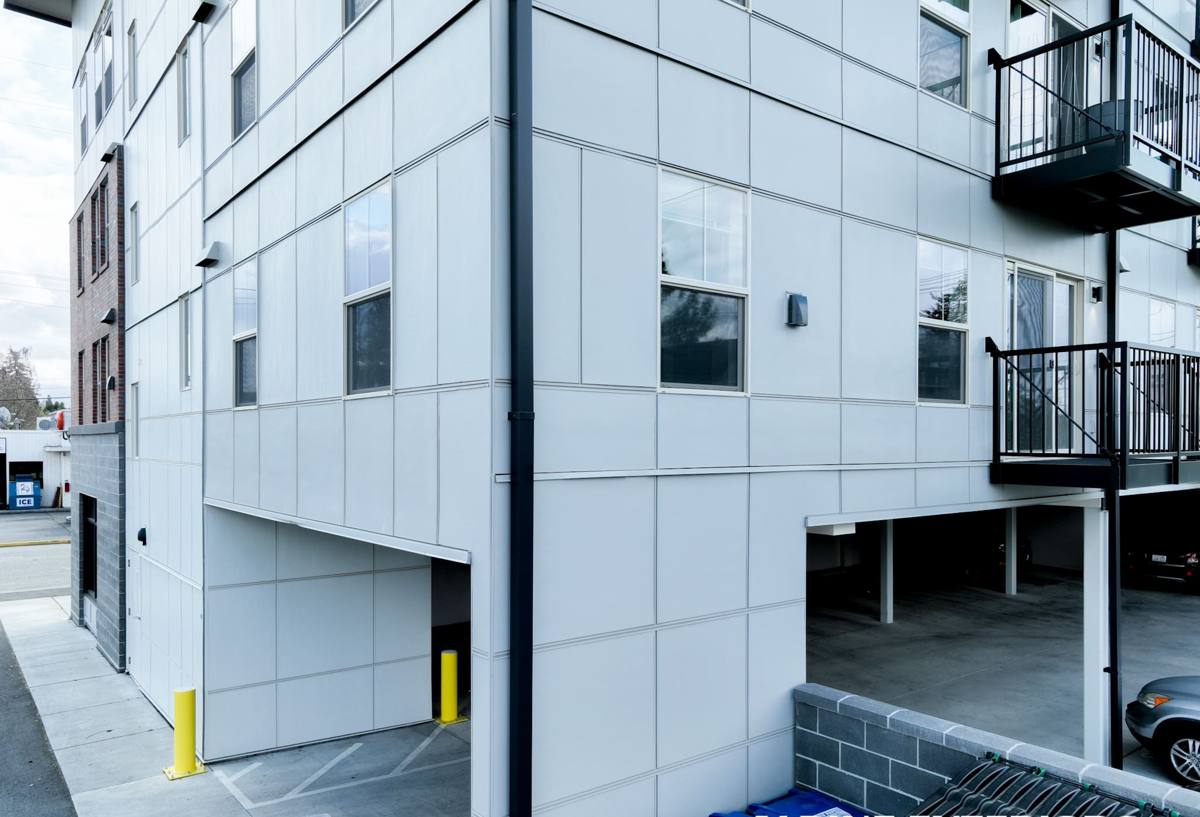
Why We Only Install James Hardie Siding in Capitol Hill
We install James Hardie fiber cement siding exclusively. We do not offer LP SmartSide, vinyl, Cemplank, Allura, primed spruce, or cedar, and that is a deliberate professional standard, not a sales preference. In a marine climate like ours, siding has to handle constant moisture cycling, wind-driven rain, and a long stretch of the year when surfaces barely get a chance to fully dry out between storms. James Hardie's fiber cement is non-combustible, dimensionally stable, and — critically for this region — manufactured with an HZ formulation engineered specifically for the wetter, cooler climate zones that include the Pacific Northwest. That is not marketing language; it changes how the board is formulated and how it performs over decades.
The factory-applied ColorPlus finish is the other half of the equation. It is baked on under controlled conditions with a finish designed to resist fading, chipping, and cracking, which matters a lot on a hill exposed to sun, salt air, and driving rain in the same week. Field-painted siding depends heavily on the weather conditions on the day it is painted; a factory finish does not carry that variable. For a neighborhood where a lot of homes only get re-sided once every few decades, that consistency is worth a great deal, and it is a core reason James Hardie is the only product we put on a Capitol Hill wall.
Backing all of this is a transferable materials warranty and a separate ColorPlus finish warranty from James Hardie itself, not just a verbal promise from the crew that installed it. That matters in a neighborhood with as much home turnover as Capitol Hill, since a documented, manufacturer-backed warranty can transfer to the next owner. It is also conditional on correct installation, which is one more reason the details below are not optional.
Choosing the Right Hardie Product for a Capitol Hill Home
James Hardie makes several distinct product lines, and picking the right one depends on the home's age, architectural style, and how it sits on the lot.
HardiePlank Lap Siding
The most common choice for Craftsman and traditional homes in this neighborhood. It comes in several exposure widths and profiles, smooth or cedar-textured, and gives a clean, classic horizontal line that usually matches what was likely on the house originally.
HardieShingle Siding
Used on gables, dormers, and accent areas where a home's original character called for shingle detailing. It is a common pairing with lap siding on Craftsman-style houses, preserving the mixed-material look those homes were designed with.
HardiePanel Vertical Siding
Occasionally used on additions, garages, or contemporary remodels where a cleaner, more modern look is wanted alongside traditional lap siding on the main structure.
Color and Trim
ColorPlus finishes are available in a range of factory colors, and Hardie trim boards are typically paired with the field siding for corners, fascia, and window casing so the whole exterior reads as one coordinated system instead of mismatched materials patched together over the years.
What a Correct Installation Actually Involves
Most siding failures we get called out to inspect on Capitol Hill are not a problem with the Hardie product itself — they are a problem with how a prior crew installed it. Fiber cement is unforgiving of shortcuts in a wet climate, and the details below are exactly where corners tend to get cut.
The Rainscreen Gap
James Hardie's own installation guidance calls for a drainage gap — a rainscreen — between the back of the siding and the weather-resistive barrier, particularly on exposed or high-moisture walls. That gap lets bulk water that gets past the siding drain freely and lets the wall assembly dry out between storms. Skipping it is one of the most common shortcuts we find on prior installs around Capitol Hill, and it is a major reason siding that still looks fine from the curb can be quietly rotting the sheathing behind it.
Flashing and Joint Treatment
Every window, door, and penetration needs proper flashing integrated with the weather-resistive barrier before a single piece of siding goes up. Butt joints need to be treated and, where possible, backed with flashing rather than just caulked and left to hope for the best. On a hill that takes wind-driven rain from multiple directions over the course of a year, these details are what actually keep water out of the wall — not the siding surface itself.
Fastening
Hardie specifies fastener type, placement, and spacing for a reason. Get it wrong and you can crack boards, void the manufacturer warranty, or leave small gaps that let water track in behind the plank. We follow Hardie's published fastening schedules to the letter, adjusted for exposure category, which on an elevated, wind-exposed site like Capitol Hill is often more demanding than a typical sheltered Seattle lot.
Our Process, Start to Finish
We keep the process straightforward and communicate clearly at every stage, especially since Capitol Hill's narrow lots, shared walls, and limited parking or alley access can complicate scheduling and staging in ways a suburban job never sees.
- Site assessment and tear-off plan. We inspect the existing siding, sheathing, and trim, and check for moisture damage before ever quoting the job.
- Removal and sheathing repair. Old siding comes off, damaged sheathing gets replaced, and we address any rot found underneath — this is where hidden problems from prior installs usually surface.
- Weather-resistive barrier and flashing. A new barrier goes on with properly integrated flashing at every window, door, and penetration before any siding is installed.
- Rainscreen and siding installation. Furring strips or a rainscreen product create the drainage gap, then Hardie siding, trim, and accents go up to Hardie's published fastening specifications.
- Final detail and cleanup. Caulking, touch-up, site cleanup, and a walkthrough so you know exactly what was done and why it was done that way.
Cost Factors on a Capitol Hill Siding Project
Every home is different, so we do not quote broad numbers before seeing the house in person, but these are the factors that most often move a Capitol Hill project's price up or down.
| Factor | Why It Matters Here |
|---|---|
| Sheathing and framing condition | Older Capitol Hill homes often have hidden moisture damage from a prior siding job installed without a rainscreen; repairs get priced once the walls are opened up. |
| Access and staging | Narrow lots, shared driveways, and limited street parking common on the Hill can affect scaffolding, dumpster placement, and daily labor time. |
| Number of stories and roof lines | Multi-story homes and complex rooflines mean more staging, more flashing detail, and more cutting around dormers and gables. |
| Product mix | Combining HardiePlank with HardieShingle accents to match a Craftsman or Victorian facade costs more than a single, uniform product run. |
| Trim and architectural detail | Original window casings, corner boards, and porch detailing on older homes often need custom trim work to match, not just standard corner posts. |
Living With Hardie Siding in a Marine Climate
Once it is installed correctly, James Hardie siding is genuinely low-maintenance compared to wood or older fiber cement products, but low-maintenance does not mean no maintenance, especially with a moss season as long as ours.
- Rinse siding down once or twice a year to clear pollen, road grime, and the organic buildup that salt air and shade tend to encourage.
- Keep gutters clear so overflow does not run down the face of the siding and feed moss or mildew growth below the roofline.
- Trim back shrubs and trees that keep siding shaded and damp — moss and algae take hold fastest where surfaces do not get sun or airflow.
- Re-caulk joints and around trim as needed over the years; caulk fails long before the siding itself does.
- Watch north-facing and heavily shaded walls first — they are where moss and mildew show up earliest on almost any Seattle-area home.
None of this requires repainting. The ColorPlus finish is what makes that possible — it is engineered to hold its color and integrity for years longer than a field-applied paint job would survive in a climate this wet.
Why Local Experience on Capitol Hill Matters
A crew that regularly works this neighborhood already understands its parking and access constraints, its mix of older and newer construction, and the way permitting for exterior work on established homes typically gets handled locally. That is not something you can fully substitute with general experience gained elsewhere in the greater Seattle area — every neighborhood has its own quirks, and Capitol Hill's dense, hilly, older housing stock has plenty of them. We also know what to look for behind the siding on homes of this era, because we have opened up enough walls here to know what a rushed prior job looks like versus one that was actually done right the first time.
Start With a Free, No-Pressure Estimate
If your Capitol Hill home's siding is aging, showing moss and staining that will not rinse off, or you are simply planning ahead for a replacement, we are glad to take a look and walk you through exactly what we find — no pressure, no obligation. Use the form below to request a free estimate.