 Seattle Exterior
 Decking in Magnolia Has to Deal With Water From Every Direction
Magnolia sits on a bluff surrounded by Puget Sound on three sides, and that location shapes what a deck actually has to survive here. It's not just Seattle rain — it's salt-laden air coming off the water, wind-driven moisture that gets up under railings and through gaps, and a shoulder season that can stay damp for weeks at a time. A deck built without that in mind might look fine for a year or two, then start showing problems that are expensive to unwind: soft framing, streaking boards, slick surfaces, and fasteners that give out early.
Composite decking is a good match for this environment when it's specified and installed correctly. It doesn't rot, it doesn't need annual staining, and modern capped composites resist the moss and mildew that plague wood decks in King County's wet months. But composite isn't maintenance-free or mistake-proof — it still needs the right substructure, the right ventilation, and the right hardware, or it will fail in ways that are specific to composite, not wood.
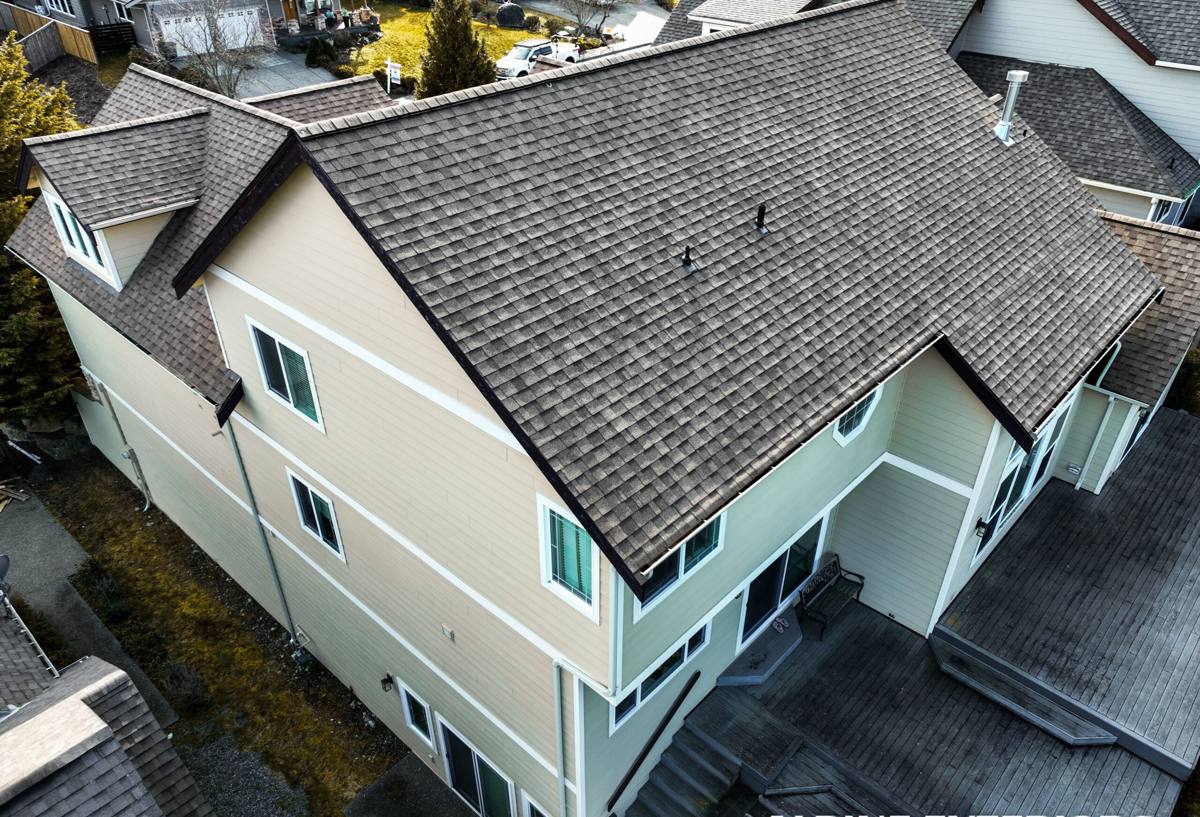
What Magnolia's Climate Actually Does to a Deck
Salt Air and Coastal Exposure
Homes closer to the bluffs and shoreline take on more airborne salt than homes further inland in Seattle. Salt accelerates corrosion on any exposed metal — screw heads, joist hangers, railing brackets, post bases. Over a few seasons, corroding fasteners can loosen board fastening systems or streak the decking surface with rust stains that are very hard to remove from a composite cap.
Driving Rain and Wind-Driven Moisture
Storms off the Sound don't just fall straight down — wind pushes rain sideways, under railings, and into any gap in the decking or fascia that isn't properly flashed. That moisture has to have somewhere to go. If the substructure traps it instead of shedding it, you get a wet, slow-drying frame sitting under boards that look dry on top.
Moss, Algae, and a Long Damp Season
King County's decking season for growth runs long — shaded, north-facing, or tree-covered decks in Magnolia can stay damp well into what should be a dry stretch. Moss and algae need moisture and organic debris to take hold, and they'll grow on composite just as readily as wood if a deck isn't detailed to drain and dry between rains.
What a Correct Composite Deck Build Actually Involves
A lot of composite decking problems trace back to substructure and drainage decisions made before the first board goes down, not the decking material itself. Here's what we treat as non-negotiable on Magnolia jobs.
Framing and Ledger Attachment
The ledger board — where the deck attaches to the house — is the single most common source of hidden rot on any deck near water. It needs proper flashing that directs water away from the house band board, not just a bead of caulk. We also use joist tape or an equivalent moisture barrier on top of every joist, since composite boards trap moisture against the frame differently than wood does.
Fasteners and Hardware
Given the salt exposure in Magnolia, we specify stainless steel or heavily coated fasteners and hardware rated for coastal or high-corrosion environments, not standard galvanized. This matters more here than it would on a deck built ten miles inland, and it's one of the details that's invisible once the deck is finished but shows up as a problem within a few years if it's skipped.
Airflow Underneath
Composite decking needs air movement underneath to dry out after rain. Low-clearance decks, decks built tight against a foundation wall, or decks enclosed with solid skirting without vents are far more prone to prolonged dampness, mold on the underside of boards, and slower drying between storms. We build in ventilation gaps and, where skirting is wanted for looks, use vented skirting rather than solid panels.
Board Spacing and Drainage Slope
Boards need consistent gapping for water to drain through rather than pooling on the surface, and the whole deck needs a slight slope away from the house. On a flat or reverse-sloped deck, standing water sits longer, which is exactly the condition moss and algae need.
Choosing the Right Composite Product for This Environment
Not all composite decking performs the same way in a wet, salty coastal microclimate. We steer homeowners toward fully capped composite boards — where a protective polymer shell wraps the entire board — rather than uncapped or cap-stock-only products, because full encapsulation resists moisture absorption and staining better over the long run. It's a matter of matching the product to the exposure, not a knock on any one manufacturer.
| Factor | What to Look For in Magnolia's Climate |
|---|---|
| Moisture resistance | Fully capped composite (all four sides), not just a capped top surface |
| Surface texture | A slip-resistant, textured finish — smooth caps get slick fast in Seattle's wet months |
| Color | Mid-tone or variegated colors hide water spotting and pollen film better than solid dark or light tones |
| Warranty structure | Look for stain-and-fade coverage specific to marine/coastal exposure, not just a generic residential warranty |
| Hardware compatibility | Hidden fastener systems rated for the specific board profile, in corrosion-resistant hardware |
We also talk homeowners through color choice honestly. Very dark composite boards absorb more heat and can feel hot underfoot on the rare sunny stretch, while very light boards show water spotting, pollen, and organic staining faster in a shaded, damp yard. Mid-tone, streaked, or wood-grain finishes tend to hold up visually with the least fuss.
Our Process for a Magnolia Composite Deck
- On-site assessment — we look at sun/shade exposure, wind exposure toward the water, existing drainage patterns, and the condition of any existing structure being replaced.
- Design and product selection — board profile, color, railing style, and layout, matched to how exposed the specific lot is to wind and salt air.
- Permitting — most deck rebuilds and new decks in Seattle require a permit; we handle the paperwork and inspection scheduling so it isn't on you.
- Demo and framing — old decking and, if needed, old framing removed; new framing built or reinforced with coastal-grade fasteners and proper ledger flashing.
- Decking installation — boards installed with correct spacing, hidden fastener systems, and attention to slope and airflow underneath.
- Railings, stairs, and trim — finished out to match the product line and code requirements for guard height and baluster spacing.
- Final walkthrough — we go over care basics with you before we consider the job done.
Living With a Composite Deck in Seattle's Climate
Composite decking cuts down on maintenance dramatically compared to wood, but "low-maintenance" isn't "no-maintenance" — especially with Magnolia's moss season and salt exposure.
- Sweep off leaves, needles, and organic debris regularly — trapped debris holds moisture against the board and feeds moss growth.
- Rinse the deck a few times a year, more often under trees or in shaded areas, to clear pollen film and early algae before it sets in.
- Hose off railings and hardware periodically if the deck is close to the water, since salt residue builds up on metal even when it's not visibly wet.
- Keep gutters and downspouts near the deck clear so runoff isn't dumping extra water onto the decking surface or substructure.
- Check railing posts and stair connections once a year for any looseness — a quick tightening beats a bigger repair later.
- Avoid pressure-washing at close range or high pressure directly on the cap surface; it can dull the finish over time.
Why Hire a Crew That Already Works in Magnolia
A composite deck built to a generic spec sheet, without accounting for wind direction off the Sound, shade patterns from mature trees, or how a specific lot drains, is more likely to develop problems that are hard to trace back to their cause. A crew that already works this part of Seattle knows which corners of a property tend to stay damp longest, where wind-driven rain tends to concentrate, and which hardware and detailing choices actually hold up here versus on paper. That local pattern recognition is worth more than any single product spec.
We also stand behind our own workmanship separately from the manufacturer's material warranty — if something about our installation isn't right, that's on us to fix, not a warranty claim you have to chase down on your own.
Get a Straight Answer for Your Property
Every lot in Magnolia handles wind, shade, and drainage a little differently, and the right composite deck build reflects that instead of a one-size-fits-all approach. If you're planning a new deck or replacing an aging one, we're happy to walk your property, look at what your specific site is dealing with, and give you a straightforward, no-pressure estimate — just fill out the form below to get started.