 Seattle Exterior
 Why Ballard Homes Need Siding Built for This Exact Climate
Ballard sits close enough to Puget Sound and Salmon Bay that salt-laden air is a real factor in how exterior materials age here, not just a coastal-town cliché. Add King County's long wet season, wind-driven rain off the water, and the deep shade many Ballard lots get from mature trees and tight lot lines, and you have a set of conditions that punishes siding that isn't built for moisture. Paint fails faster in salt air. Wood rots faster in shade that never fully dries out. And moss doesn't just grow on roofs here — it colonizes north-facing siding, fence lines, and anything that stays damp for long stretches between fall and spring.
None of that means Ballard is an unusually hostile place to own a house. It means the siding on that house has to actually be engineered for a wet, salt-touched, moss-prone climate rather than just tolerated in one. That's the standard we hold every fiber cement job to in this neighborhood.
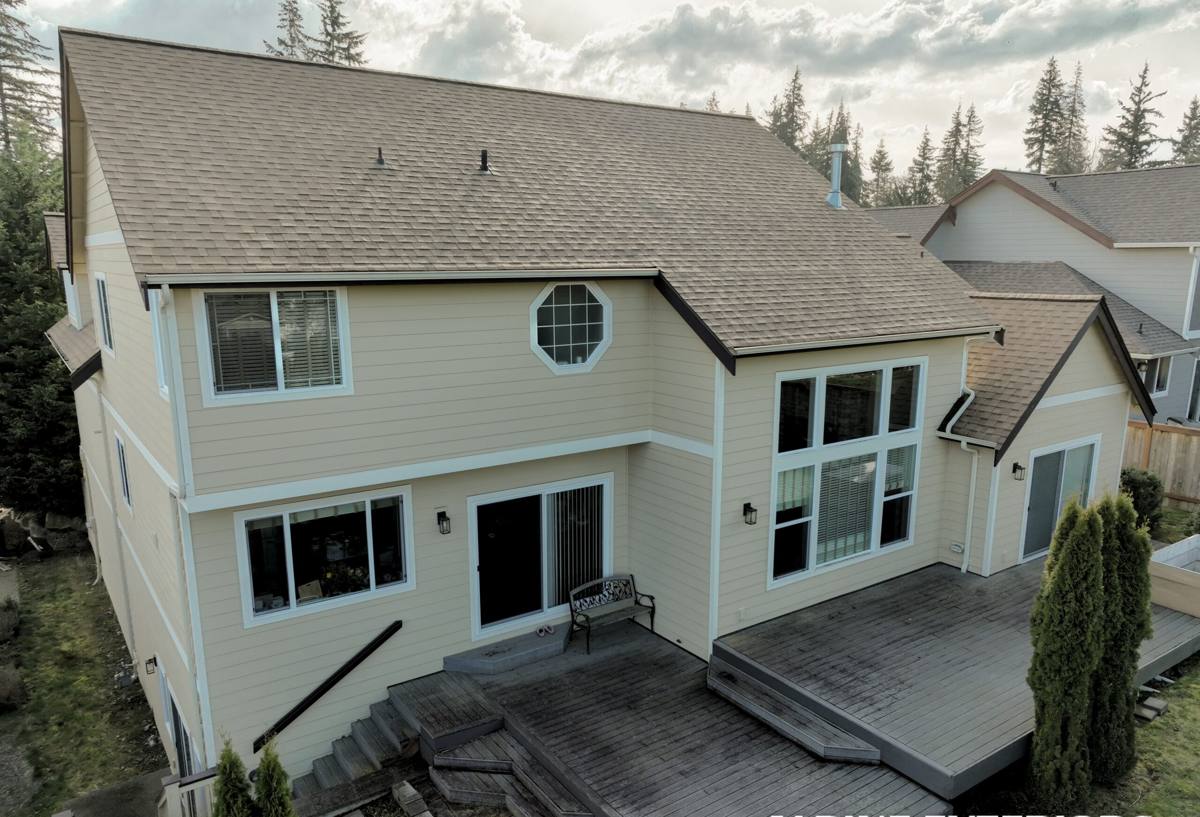
What "Correct" Fiber Cement Installation Actually Involves
Fiber cement siding has an excellent track record in the Pacific Northwest, but that track record depends entirely on installation quality. A misinstalled board behaves nothing like a correctly installed one, and the failures that show up five or ten years later are almost always installation problems, not product problems.
The Water Management Layer Comes First
Siding is the visible layer, but the water-resistive barrier underneath it is what actually keeps a Ballard home dry through a wet winter. That means a continuous weather-resistant barrier, correctly lapped house wrap or building paper, and flashing integrated at every window, door, and roofline intersection so water is directed out and down rather than trapped behind the cladding.
Clearances and Fastening Matter More Here Than in Drier Climates
James Hardie specifies minimum clearances from grade, roof lines, decks, and other horizontal surfaces for a reason: those gaps let water drain and air circulate instead of wicking up into the bottom edge of the siding. In a climate with as much standing wet weather as King County gets, skipping those clearances to save a few inches of exposed foundation is one of the most common shortcuts that shows up later as swelling or paint failure at the bottom courses. Fastener pattern, nail spacing, and butt-joint treatment matter just as much — done wrong, they create dozens of small entry points for exactly the moisture the siding is supposed to keep out.
Why We Install James Hardie and Nothing Else
We standardized on James Hardie fiber cement products company-wide, and we don't install vinyl, LP SmartSide, primed spruce or cedar, or other fiber cement brands. That's a deliberate professional standard, not a sales position.
Hardie's fiber cement is non-combustible, holds paint and factory finish far longer than wood, and is manufactured in HZ5 formulations engineered specifically for climates like ours — freeze-thaw cycles, sustained moisture, and the kind of year-round dampness Ballard sees. Vinyl siding can warp and fade, and its seams and expansion joints give water a path inward over time. Wood and engineered wood products need consistent maintenance to resist the rot and moss growth that this climate accelerates, and even well-maintained wood siding has a shorter realistic service life here than fiber cement installed to spec. Hardie's ColorPlus factory finish is baked on under controlled conditions rather than field-applied, which means better adhesion and color retention through the kind of UV and moisture cycling Seattle winters and summers both bring. Backed by a strong transferable warranty, it's the product we're willing to put our name behind on every job.
The James Hardie Product Lines We Use in Ballard
Most Ballard homes fall into a handful of common styles — craftsman bungalows, older Seattle foursquares, and a growing number of modern infill builds — and Hardie's lineup covers all of them without forcing a homeowner into a look that doesn't fit the house.
- HardiePlank lap siding — the standard horizontal siding for most craftsman and traditional homes, available in multiple exposure widths and textures.
- HardieShingle siding — a straight or staggered shingle profile for homes where a cottage or craftsman shingle look is part of the original character.
- HardiePanel vertical siding — often used as an accent on gables, dormers, or modern-style additions.
- HardieTrim boards — used around windows, corners, and fascia so the trim ages at the same rate and in the same way as the field siding.
All of it comes in Hardie's ColorPlus factory-finish palette, which matters in a climate where field-applied paint is fighting rain for half the year to properly cure.
How Fiber Cement Compares to the Alternatives in This Climate
Homeowners comparing bids often get quotes across several different siding materials. Here's how the honest trade-offs stack up for a home in Ballard's specific conditions.
| Material | Behavior in salt air & driving rain | Moss/algae resistance | Realistic maintenance |
|---|---|---|---|
| James Hardie fiber cement | Non-combustible, dimensionally stable, holds factory finish well | Resists moisture absorption; surface can still need periodic cleaning | Low — occasional wash, repaint on a much longer cycle than wood |
| Vinyl siding | Can warp with temperature swings; seams are potential water entry points | Moss and algae can grow on the surface texture | Low upfront, but limited repair options if damaged or faded |
| Cedar / primed spruce | Absorbs moisture; salt air accelerates finish breakdown | Most susceptible — organic material moss actively colonizes | High — regular refinishing and rot inspection required |
| LP SmartSide (engineered wood) | Better than raw wood but still moisture-sensitive at cut edges and joints | Moderate — depends heavily on coating maintenance | Moderate — edge sealing and repainting on a shorter cycle than fiber cement |
Our Installation Process on a Ballard Home
The process is the same discipline on every job, whether it's a full re-side or a targeted repair section.
1. Inspection and Tear-Off
We start by inspecting the existing sheathing and framing once the old siding is off — this is often the first real look anyone's had at moisture damage that's been hiding behind the old cladding, which is common on older Ballard homes that have had one or two prior siding layers.
2. Sheathing Repair and Water-Resistive Barrier
Any soft or rotted sheathing gets replaced before anything else happens. Then the weather-resistive barrier goes on continuous and correctly lapped, shingle-style, so every layer sheds water onto the layer below it.
3. Flashing at Every Penetration
Windows, doors, hose bibs, vents, and roof-to-wall intersections all get proper flashing integrated into the water-resistive barrier before siding goes up — this is the step that determines whether a home stays dry through a real Puget Sound winter.
4. Hardie Installation to Manufacturer Spec
Correct clearances from grade and roofing, proper fastener spacing, and factory-finished cut edges treated per Hardie's specifications.
5. Trim, Caulking, and Final Detail
HardieTrim goes in around all openings and corners, joints are sealed with a quality exterior sealant rated for this climate, and the job gets a final walk-through before we call it done.
Living With Fiber Cement Siding Through Ballard's Wet Season
Fiber cement is low-maintenance compared to wood, but "low-maintenance" doesn't mean "no maintenance," especially in a climate that grows moss on almost anything that stays shaded and damp long enough.
- Rinse siding annually, focusing on north-facing walls and areas under tree cover where moss and algae are most likely to start.
- Keep gutters clear so overflow doesn't run down the face of the siding during heavy rain events.
- Trim back shrubs and trees so siding gets airflow and at least some seasonal sun exposure.
- Inspect caulking at trim joints and penetrations every year or two, since caulk fails before the siding itself does.
- Address any moss or algae growth promptly with a gentle wash rather than pressure-washing, which can force water behind the boards.
- Watch the bottom courses near grade and any deck or patio connections — these are the areas most exposed to splash-back and standing moisture.
Signs Your Ballard Home's Siding Needs Attention
Because siding failure is often gradual, it helps to know what to watch for before a small issue becomes a sheathing repair.
| What you see | What it usually means |
|---|---|
| Persistent moss or dark streaking that returns quickly after cleaning | Moisture is staying on the surface longer than it should — could be shade, clearance, or drainage related |
| Soft spots or visible warping in wood or engineered wood siding | Moisture has penetrated the material itself, not just the surface |
| Paint peeling in sheets rather than fading evenly | Moisture trapped behind the finish, common on field-painted wood after a wet winter |
| Gaps opening at trim joints or corner boards | Caulk failure or material movement — an easy fix if caught early |
| Cracking near the bottom courses close to grade or a deck | Often a clearance or drainage issue rather than a material defect |
Why a Ballard-Familiar Crew Makes a Real Difference
Siding work in an established Seattle neighborhood like Ballard comes with practical considerations that don't show up on a spec sheet: navigating tight lot setbacks, working around mature landscaping, coordinating with neighbors on shared property lines, and understanding King County permitting requirements for exterior work on older housing stock. A crew that already works this neighborhood regularly isn't guessing at any of that — they've already worked through the access, scheduling, and code questions that come up on homes of this era and density. That familiarity translates into fewer surprises mid-project and a cleaner, more predictable timeline for the homeowner.
What Drives the Cost of a Fiber Cement Siding Project
Every home is different, but the same handful of factors drive most of the cost variation on Ballard siding jobs.
| Cost factor | Why it matters |
|---|---|
| Tear-off and disposal of existing siding | Multiple old layers or hazardous materials like old paint add labor and disposal cost |
| Sheathing or framing repair | Hidden moisture damage discovered during tear-off can add scope |
| Home size and wall complexity | More corners, gables, and dormers mean more cutting, trim, and labor time |
| Siding profile and trim package | Shingle accents, wide trim boards, and custom detailing cost more than a straightforward lap-siding field |
| Access and site conditions | Tight Ballard lots, mature landscaping, or limited staging space can affect labor time |
We provide straightforward, itemized estimates so homeowners can see exactly what's driving the number rather than a single lump-sum figure.
If your Ballard home's siding is showing wear from another wet Seattle season, we're happy to take a look and walk you through what correct James Hardie installation would involve for your specific house — no pressure, no obligation. Request a free estimate below and we'll schedule a time to come out.