 Seattle Exterior
 New Roof Installation for Kirkland Homes
Kirkland sits in one of the more demanding roofing climates in King County. Homes here deal with long, wet winters, a marine air mass rolling in off Puget Sound, and heavy tree canopy around many neighborhoods and Lake Washington-adjacent streets that keeps roofs shaded and damp for months at a time. A new roof installed the right way accounts for all of that from the start — not just the shingle color, but the decking underneath it, the flashing details, and how the whole system sheds water and dries out between storms. This page covers what a correct new roof installation looks like for a Kirkland home, how our process works, and what actually drives the cost.
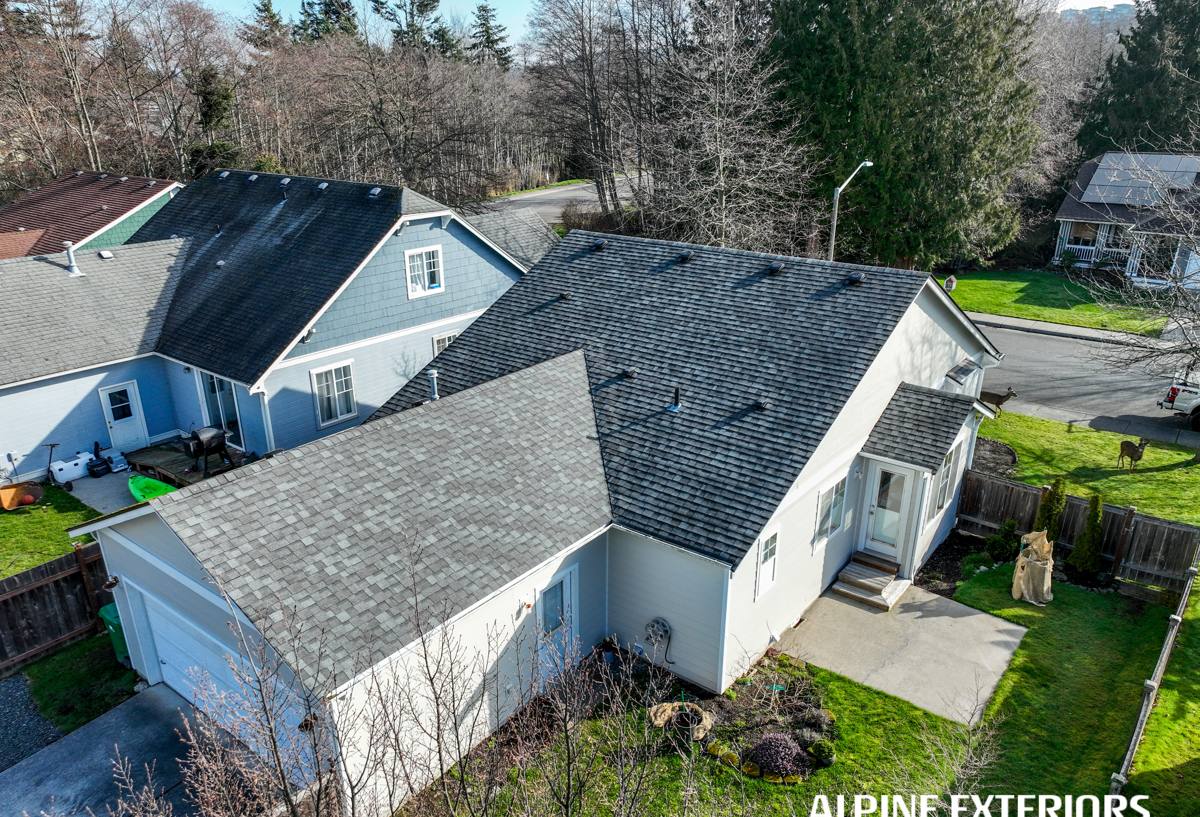
How Kirkland's Climate Wears Down a Roof
Roofs in this part of Washington don't usually fail because of one dramatic event. They fail slowly, from repeated exposure to conditions that are mild individually but relentless over a Pacific Northwest year.
Moss and Organic Growth
King County's moss season runs long — often eight months or more in shaded, tree-covered yards, which describes a large share of Kirkland's residential streets. Moss holds moisture directly against the shingle surface, works into the granule layer, and can lift shingle edges over time. Left unchecked for years, moss growth shortens the effective life of a roof regardless of the material underneath it.
Driving Rain and Wind-Driven Water
Storms coming off Puget Sound frequently arrive with sustained wind, which pushes rain sideways into laps, valleys, and flashing points that a calm-weather roof would never have to handle. This is why flashing quality and underlayment coverage matter more here than in drier climates — a roof only needs to fail at wind-driven water in one spot to start a slow leak that isn't obvious from inside the attic for months.
Marine Air and Slow Material Fatigue
The salt-tinged marine air common to the greater Puget Sound region accelerates the breakdown of exposed metal fasteners, flashing, and vent components faster than it does in inland climates. It's a gradual effect, not a dramatic one, but it's part of why we spec corrosion-resistant metal and fasteners as standard on Kirkland installs rather than treating it as an upgrade.
Temperature Swings and Freeze-Thaw
Kirkland doesn't see the deep freezes that damage roofs in colder states, but it does get enough freeze-thaw cycling in winter, combined with near-constant dampness, to stress any roofing material that wasn't installed with proper ventilation and drainage. A roof that stays wet longer than it should is a roof that ages faster than it should.
Signs Your Kirkland Roof Needs Replacing
Not every roofing problem calls for full replacement — some are legitimately repair jobs. But certain signs, especially in combination, point toward a roof that's past the point where patching makes sense.
- Granules collecting in gutters or at downspout outlets in noticeable amounts
- Shingles that are curling, cupping, or visibly bald in patches
- Persistent moss or moss "shadows" across large sections of the roof, not just isolated spots
- Daylight visible through the roof deck from inside the attic
- Soft or spongy decking underfoot when walked (a sign of trapped moisture)
- Leaks that recur in the same area after repair attempts
- A roof that is at or past the expected service life of its material
- Sagging rooflines or valleys, which can indicate deck or structural issues
If you're seeing two or more of these, it's worth getting an honest look before another wet season passes.
Choosing a Roofing System for the Pacific Northwest
There isn't one "best" roofing material for every Kirkland home — it depends on the roof's pitch, the home's style, budget, and how much maintenance the homeowner wants to take on. Here's how the common options compare specifically for this climate.
| Material | Moss & Moisture Resistance | Typical Lifespan Here | Maintenance Needs |
|---|---|---|---|
| Standard 3-tab asphalt | Moderate — flatter profile holds debris | 15–20 years | Regular moss and debris clearing recommended |
| Architectural / dimensional asphalt | Good — thicker profile sheds water and debris better | 25–30 years | Periodic moss treatment, less frequent than 3-tab |
| Standing seam metal | Excellent — smooth surface resists moss growth | 40–50+ years | Low; occasional gutter and fastener checks |
| Composite / synthetic slate or shake | Good, product-dependent | 30–50 years | Low to moderate depending on manufacturer |
Cedar shake is still requested occasionally, and we're happy to discuss it honestly: it can look great, but in a climate with this much sustained moisture and moss pressure, it carries a meaningfully higher maintenance burden than the alternatives above, and we want homeowners to go in with that trade-off clear rather than find out later.
What a Correct New Roof Installation Involves
A new roof is more than shingles nailed to plywood. Every layer underneath the visible surface is doing work, and in a climate like Kirkland's, cutting corners on any one of them shows up as a problem within a few wet seasons.
Tear-Off and Deck Inspection
We remove the old roofing down to the deck rather than layering over it, which lets us actually see and address any rot, delamination, or soft spots before they're sealed under a new roof. Deck repairs are priced honestly and shown to the homeowner, not buried in the estimate.
Underlayment and Ice-and-Water Protection
A synthetic underlayment goes down across the full deck as the roof's secondary water barrier. In vulnerable areas — eaves, valleys, and around penetrations — we install a self-adhering ice-and-water membrane, which matters here less for snow and more because those are exactly the spots where wind-driven rain finds its way in first.
Flashing at Every Transition
Chimneys, skylights, wall intersections, and valleys all get new metal flashing, not reused flashing from the old roof. This is one of the most common places a lower-quality install fails in this climate, because it's also where wind-driven rain concentrates.
Ventilation That Actually Balances
Proper intake at the eaves paired with exhaust at the ridge lets the attic space dry out between storms instead of holding humidity. In a region with as much sustained dampness as ours, unbalanced ventilation is one of the quiet reasons roofs and decking fail early even when the shingles themselves look fine.
Our Installation Process, Step by Step
- Inspection and estimate — We assess the current roof, deck condition, ventilation, and any problem areas, and provide a clear, itemized estimate.
- Material selection — We walk through the options in the table above based on your home, budget, and how much upkeep you want going forward.
- Scheduling around weather — Kirkland's wet season means timing matters; we plan installs to minimize the roof's exposure to open weather.
- Tear-off and deck repair — Old roofing removed, deck inspected, and any needed repairs completed and documented.
- Underlayment, flashing, and ventilation install — The full water-management system goes in before a single shingle is laid.
- New roofing installation — Installed to manufacturer specification, which is what keeps material warranties valid.
- Cleanup and magnetic sweep — Site cleared of debris and swept for stray fasteners.
- Final walkthrough — We go over the finished roof with the homeowner before calling the job complete.
What Affects the Cost of a New Roof
Every roof is priced individually, but the same handful of factors drive most of the variation between jobs. Being upfront about these helps homeowners understand their estimate instead of just seeing a number.
| Factor | Why It Matters |
|---|---|
| Roof size and pitch | Steeper roofs take longer, need more safety setup, and use more material per square foot of coverage |
| Number of layers to remove | Tear-off of multiple old layers takes more labor and disposal capacity |
| Deck condition | Rotted or soft decking sections need replacement before new roofing can go down |
| Material choice | Asphalt, metal, and composite products vary significantly in material cost and install labor |
| Roof complexity | Valleys, dormers, skylights, and chimneys each add flashing work and time |
| Access and site conditions | Tree cover, steep lots, or limited staging space common in some Kirkland neighborhoods can affect setup time |
Permits, Codes, and Warranties in King County
Full roof replacements in Kirkland generally require a building permit, and inspections confirm the work meets current code, including ventilation and fastening requirements. We handle the permitting process as part of the job rather than leaving homeowners to navigate it separately. It's also worth understanding that a roof carries two distinct warranties: a manufacturer's warranty on the material itself, and a workmanship warranty from the installing contractor covering the labor. Both matter — a great shingle installed poorly is still a roof that can leak, and manufacturer warranties are frequently voided by improper installation, which is one more reason installation quality and adherence to manufacturer specification aren't optional details.
Why Hire a Crew That Already Works in Kirkland
A roofing crew that regularly works Kirkland and the surrounding King County area has already seen how local moss patterns behave under mature tree canopy, how wind-driven rain off Puget Sound tends to find weak flashing, and which ventilation setups actually hold up through a full Pacific Northwest wet season rather than just looking good on installation day. That experience shows up in the small decisions made on-site — where extra ice-and-water membrane is worth adding, how flashing gets detailed around a tricky valley, how a deck repair is handled honestly instead of hidden. It's the difference between a roof that's built to spec and a roof that's built for where it actually sits.
If your roof is showing its age or you're planning ahead of the next wet season, we're glad to take a look and put together a straightforward estimate — no pressure, no obligation. Use the form below to request a free roof assessment for your Kirkland home.