 Seattle Exterior
 Ravenna's Housing Stock and What Its Siding Has to Handle
Ravenna is one of Seattle's older, more established neighborhoods — full of craftsman bungalows, early-1900s foundations, and a tree canopy that shades entire blocks for much of the year. That combination is charming to live under and hard on exterior siding. Mature trees mean shaded, slow-drying wall faces. Older homes mean siding that's often been replaced or patched at least once already, sometimes with materials that were never really matched to this climate in the first place. And being inside the greater Seattle basin, close enough to Puget Sound and Lake Washington to pick up salt-laden air on a regular basis, means the siding on a Ravenna home is dealing with more than just rain.
Three conditions do most of the damage here: salt air that speeds up corrosion on exposed fasteners and trim, driving rain that comes in sideways during a fall or winter frontal system and works its way behind loose seams rather than running straight off a wall, and a moss season that can run from October well into spring on the shaded, north-facing sides of a lot. None of this shows up as a single dramatic failure. It's slow — a little more moisture held against the wall each wet season, a little more fading each summer, until a homeowner is looking at a siding job that's failing years before it reasonably should.
Why We Install Only James Hardie Fiber Cement Here
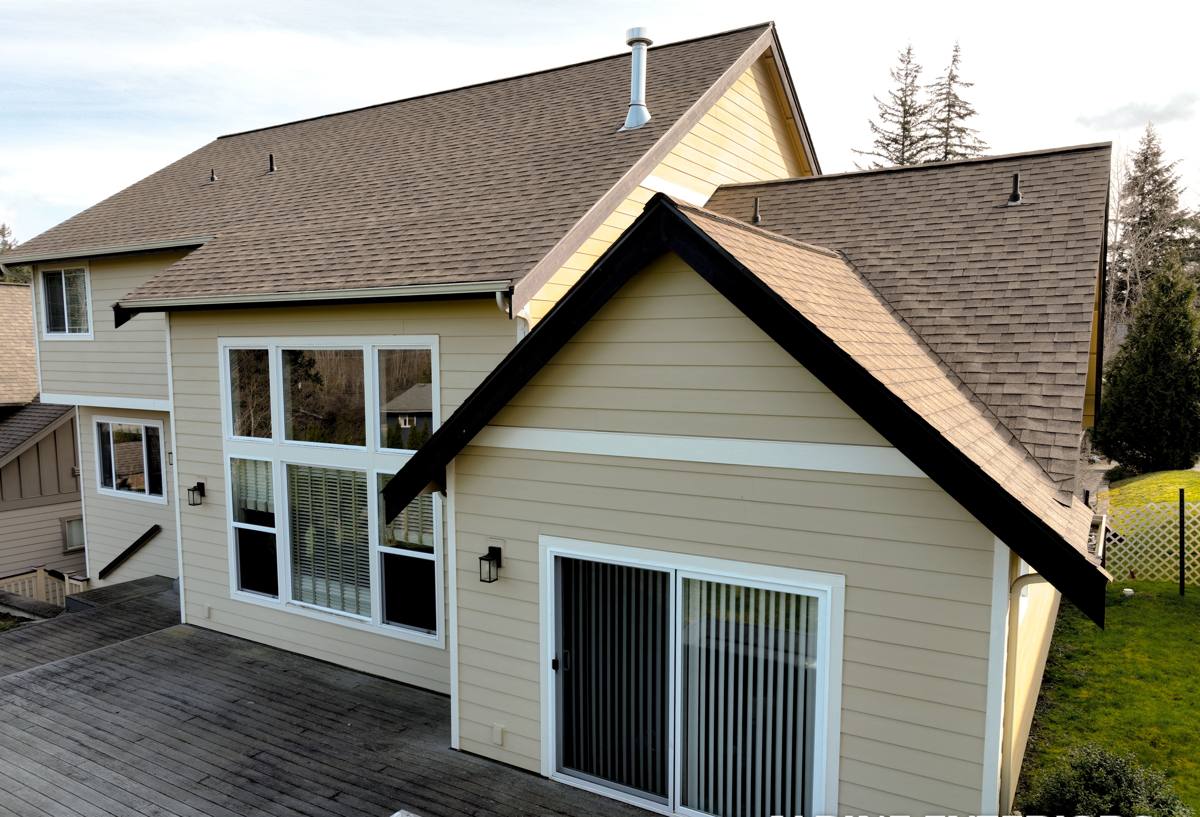
We install one siding product on every home we work on in Ravenna and across King County: James Hardie fiber cement. We don't offer vinyl, LP SmartSide, Cemplank, Allura, primed spruce, or cedar. That's a deliberate professional standard, not a limited catalog, and it comes from years of pulling old siding off Seattle-area homes and seeing firsthand what each of those materials does — or doesn't do — once it's spent a decade absorbing this exact climate.
Each alternative gets something right. Vinyl is inexpensive and needs no repainting. Engineered wood products go up fast and take paint well. Cedar has real natural character that a lot of Ravenna's older homes were originally built with. But each one also carries a trade-off that matters more here than the sales literature admits: vinyl's seams and J-channels are exactly where wind-driven rain gets behind the panel, engineered wood depends on flawless field sealing at every cut edge to keep an organic core dry, and cedar asks for ongoing refinishing and moss control that a shaded Ravenna lot makes harder to keep up with, not easier.
Fiber cement sidesteps the core problem because it isn't organic. There's no wood substrate for trapped moisture to break down, and it doesn't feed mildew and moss growth the way wood-based siding can. James Hardie also engineers climate-specific HZ product lines rather than selling one generic formulation nationwide, and the HZ5 line in particular is built around the kind of sustained moisture and coastal exposure a King County home actually sees.
What Correct Installation Actually Involves
Fiber cement is only as good as the crew that hangs it. On a Ravenna project, correct installation means a specific set of details done the same way on every wall, every time — not a general sense of "siding experience."
The Details That Actually Matter
- Proper clearance from grade, decks, and roof lines so the bottom edge of the siding never sits in standing moisture
- Flashing integrated at every window, door, and roof-to-wall transition — not caulked over after the panels are already up
- Fastener spacing and placement matched to the specific Hardie product line, not a one-size-fits-all pattern
- Joint and seam treatment that accounts for which walls sit in shade under Ravenna's tree canopy and which get real sun exposure
- A correctly lapped water-resistive barrier behind the siding, since the board itself is only one part of the moisture system
- Factory-finished color matched cleanly at trim and touch-up points instead of a mismatched field repaint
Skip any one of these and the failure usually doesn't show up right away. It shows up two or three wet seasons later, as a soft spot at a butt joint or a streak of trapped moisture behind a poorly flashed window — the kind of callback that traces straight back to an installation shortcut, not a material defect.
How Our Process Works
Assessment and Tear-Off
We start by walking the exterior with the homeowner and pulling back enough of the existing siding to see what's actually happening underneath — sheathing condition, existing flashing, and any moisture damage that's accumulated on shaded or exposed walls. On an older Ravenna home, this step matters more than it does on newer construction, since previous siding or trim work may not have been sealed correctly the first time around.
Prep and Water Management
Before any Hardie board goes up, we correct the water-resistive barrier and flashing at every penetration — windows, doors, hose bibs, light fixtures, and roof transitions. This is the layer that actually keeps a wall dry, and it's also the layer that's easiest to shortcut and hardest to inspect once the siding is on. We treat it as the most important part of the job, not a step to move through quickly on the way to the visible work.
Installation to Manufacturer Spec
We install to James Hardie's published specifications for clearance, fastening, and joint treatment, adjusted wall by wall for sun and shade exposure. That means a shaded north wall under mature trees may get different joint and moisture detailing than a south-facing wall that dries out faster after a storm.
Finish and Walkthrough
Once the siding is up, we walk the finished exterior with the homeowner, cover what routine maintenance actually looks like on their specific house, and go over warranty coverage on both the board and the factory finish.
Matching Hardie Product Lines to Ravenna's Architecture
James Hardie makes several distinct siding profiles, and the right one depends on the home's existing architecture as much as personal preference. HardiePlank lap siding is the closest match to the traditional lap-sided look common on Ravenna's older craftsman and bungalow homes. HardieShingle gives a shingle-style profile that suits homes with more traditional detailing. HardiePanel offers a vertical option for accent walls or more modern additions. All of these are available in the HZ5 formulation engineered for cold, wet climate zones like ours, and most carry the factory-applied ColorPlus finish — baked on under controlled conditions rather than painted on-site, which matters in a climate that doesn't offer many reliably dry stretches for field paint to cure properly.
Fiber Cement Compared to What It's Usually Replacing
Most of the fiber cement siding jobs we take on in Ravenna are replacing aging wood siding or vinyl that's reached the end of its practical life. Here's how the materials compare directly:
| Factor | Aging Wood or Vinyl Siding | James Hardie Fiber Cement |
|---|---|---|
| Core material | Organic wood substrate or PVC plastic | Cement, sand, and cellulose fiber |
| Moisture behavior | Wood absorbs and traps moisture; vinyl hides it behind loose seams | Inorganic core doesn't wick or trap moisture |
| Moss and algae exposure | Feeds growth on shaded, damp wall faces | Doesn't feed growth; still needs periodic washing |
| Finish durability | Field paint or molded-through color, fades and chalks over time | Factory ColorPlus finish holds color longer |
| Combustibility | Wood burns; vinyl softens and deforms under heat | Non-combustible |
| Typical service life | 15-25 years before major failure | 30-50+ years when installed to spec |
Cost Factors on a Ravenna Fiber Cement Project
We don't publish blanket per-square-foot pricing because it wouldn't be an honest number — every home's condition, layout, and access are different. What we can lay out plainly are the factors that actually move a project's cost:
| Factor | How It Affects the Job |
|---|---|
| Existing wall condition | Hidden rot or moisture damage found during tear-off adds repair scope before new siding goes up |
| Home size and wall complexity | More corners, gables, and dormers mean more cuts, flashing, and labor hours |
| Siding profile chosen | Shingle-style or accent panel work typically runs higher than standard lap siding |
| Tree cover and site access | Mature trees and tight lot lines common in Ravenna can affect staging and cleanup time |
| Trim and detail package | Custom trim to match an older home's original character adds material and labor |
Maintaining Fiber Cement Siding Once It's Installed
Correctly installed Hardie siding is low-maintenance, not no-maintenance. A little seasonal attention keeps it performing for decades rather than years.
- Check shaded, north-facing walls under tree cover for early moss growth and wash it off before it spreads
- Keep gutters clear ahead of the wet season so overflow doesn't run down and soak siding at the eaves
- Inspect caulked joints at trim, window, and door penetrations every year or two for early gaps
- Rinse dirt and salt film off the siding periodically, especially on walls that face open exposure toward the water
- Address any impact damage or cracked caulk promptly rather than letting a small gap become a moisture entry point
Why Hiring a Crew That Already Works Ravenna Matters
A contractor who works this neighborhood regularly knows which walls sit in shade most of the day, which lots hold moisture longer because of tree cover, and how an older Ravenna foundation typically sits relative to grade — details that change how flashing and clearance should actually be handled on a given house. That kind of judgment comes from repetition in this specific setting, not from a general specification sheet written for the whole country. It also means someone is still around locally if a warranty question comes up years down the road, rather than chasing down a crew that's moved on.
If you're weighing a siding project on a Ravenna home, we're glad to walk the exterior with you, point out what your specific walls are dealing with, and put together a straightforward, no-pressure estimate for a correctly installed James Hardie system.