 Seattle Exterior
 Redmond's Climate Is Harder on a Roof Than It Looks
From the street, Redmond looks like an easy place to own a roof. There's no hail, no hurricanes, no heavy snow load most winters. But the Eastside's real challenge is patience — the roof takes a slow, steady beating from moisture that never fully lets up. Long stretches of driving rain off Puget Sound, humid air that carries salt and moisture inland, and a mild climate that never gets cold or dry enough to fully halt moss and algae growth all work against asphalt shingles year-round. A roof here doesn't usually fail from one dramatic event. It fails gradually, from granule loss, trapped moisture, and organic growth that homeowners don't notice until it's already done damage underneath.
That's the backdrop for every asphalt shingle job we do in Redmond. It changes which products we recommend, how we detail flashing and ventilation, and how often a roof actually needs a look from someone who knows what they're looking at.
What Redmond Homes Need From an Asphalt Shingle Roof
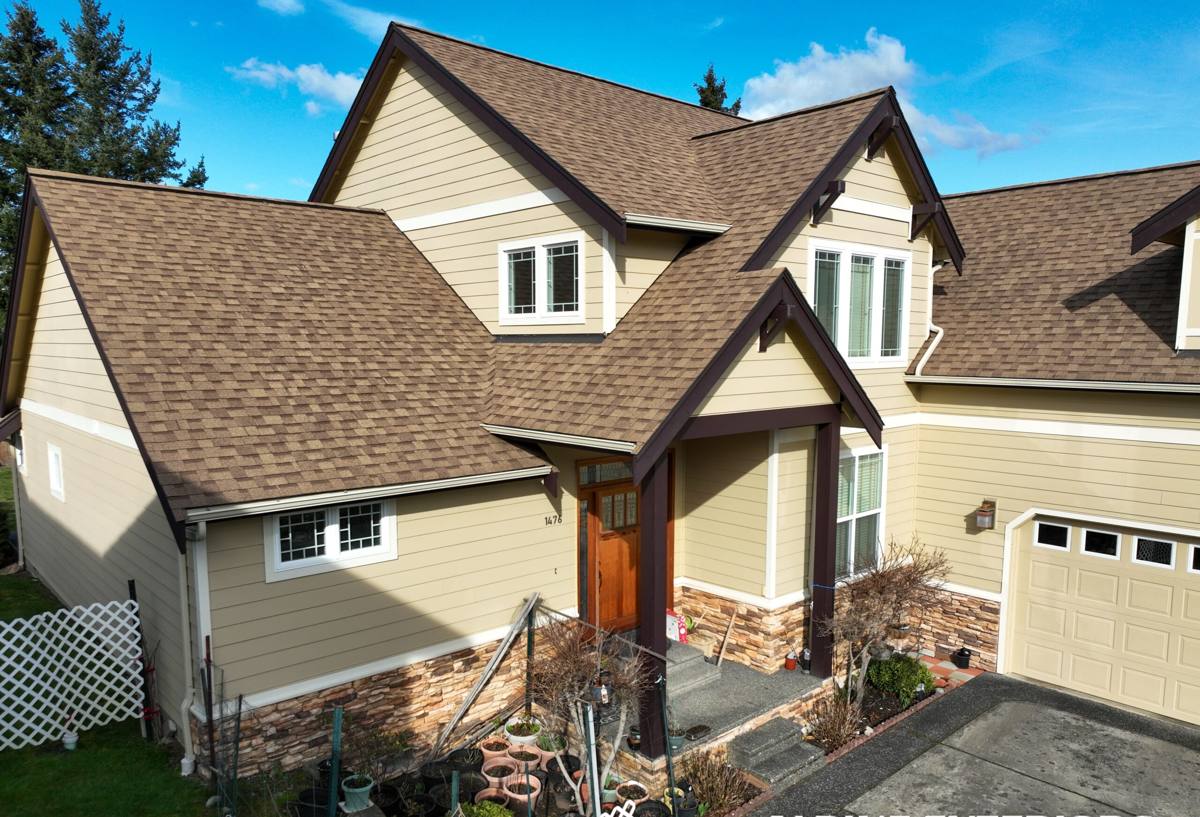
Asphalt shingles remain the most practical roofing material for the vast majority of Redmond homes — they're cost-effective, proven, and available in styles that suit everything from older ramblers to newer Eastside builds. But "asphalt shingle roof" covers a wide range of quality outcomes, and in this climate the gap between a correctly installed roof and a rushed one shows up fast.
Moisture Management Comes First
In a drier climate, a roofing crew can get away with sloppy underlayment or minimal flashing and the roof will still hold up for years. Not here. With King County's rainfall pattern, water finds every gap, every under-lapped shingle, and every corner where flashing was skipped to save time. A correctly built roof assumes water will reach the deck at some point and is designed to shed it anyway — that's the difference between an underlayment system that's an afterthought and one that's actually doing its job.
Airflow Prevents Slow Rot
Trapped attic moisture is one of the most common — and least visible — problems we find on Redmond roofs. Warm, moist air rising from the living space meets a cold roof deck in winter, condenses, and slowly rots sheathing and rafters from the inside. A shingle roof can look fine from the ground while the attic underneath is quietly deteriorating. Proper intake and exhaust ventilation isn't optional trim — it's part of what makes the shingles above last their full service life.
What a Correct Asphalt Shingle Installation Actually Involves
A roof is a system, not a layer of shingles nailed to plywood. Here's what we consider non-negotiable on every tear-off and re-roof:
- Deck inspection and repair of any soft, delaminated, or water-damaged sheathing before anything new goes down
- Ice-and-water shield or self-adhering membrane at eaves, valleys, and around every roof penetration — the spots most prone to wind-driven rain intrusion
- Synthetic underlayment across the full field, correctly lapped so every course sheds water into the one below it
- New flashing at chimneys, skylights, walls, and roof-to-wall transitions rather than reusing old, rusted, or bent flashing
- Balanced intake and exhaust ventilation sized to the attic space, not just whatever vent happened to be there before
- Manufacturer-specified nailing pattern and fastener count — under-nailing is one of the most common causes of early shingle blow-off in wind events
- Starter strip and ridge cap products matched to the field shingle, not generic substitutes
Skip any one of these and the shingles themselves — even a premium product — will underperform. Most of the roof failures we get called out for aren't shingle failures at all. They're installation shortcuts that showed up years later.
Choosing Shingles for This Climate
Not every asphalt shingle product is built the same way, and in a wet, moss-prone climate like Redmond's, the differences matter more than they would somewhere drier. The biggest factor we weigh with homeowners is algae resistance — standard shingles will develop dark streaking from algae growth within a few years in this climate, while shingles with copper- or zinc-infused granules resist it far longer. We also look at wind rating, since exposed lots and tree-lined properties both create their own wind stress on a roof, just from different directions.
| Shingle Type | Typical Lifespan | Best Fit For |
|---|---|---|
| 3-Tab Asphalt | 15–20 years | Budget-conscious re-roofs, simple roof lines |
| Architectural (Laminate) | 25–30 years | Most Redmond homes — better wind rating, dimensional look |
| Algae-Resistant Architectural | 25–30 years | Shaded lots, north-facing slopes, tree cover |
| Premium/Designer Asphalt | 30+ years | Homes prioritizing curb appeal and longer warranty coverage |
We work with established manufacturers — brands like GAF, CertainTeed, and Owens Corning all make solid products — and we base the recommendation on the specific roof, not a one-size-fits-all default. A steep, heavily shaded roof under mature trees gets a different conversation than an open, sun-exposed roof on a newer lot.
Moss, Algae, and Debris: The Ongoing Reality
Redmond's tree cover and long damp season mean moss isn't a one-time problem to solve during installation — it's an ongoing condition to manage. Moss holds moisture against the shingle surface, works its way under tabs as it grows, and can lift shingles enough to let water in even when the shingles themselves aren't worn out. Left unaddressed for years, moss growth shortens a roof's usable life significantly regardless of how good the original installation was.
What Homeowners Can Do Between Professional Visits
- Keep gutters and valleys clear of needles and leaf debris, especially going into fall and winter rains
- Trim back overhanging branches to reduce shade and debris load on the roof
- Look for dark streaking or green growth on north-facing slopes each spring — the first sign algae or moss is establishing
- Never pressure-wash shingles directly — it strips protective granules and shortens shingle life
- Have moss physically removed by a professional rather than relying on chemical treatments alone
We install zinc or copper strips near the ridge on roofs with heavy moss history, which lets rain carry trace metal down the roof slope and slow regrowth over time. It's a small addition during installation that pays off for years afterward.
How Our Process Works
We keep the process straightforward because homeowners deserve to know what's happening on their own roof.
1. On-Site Assessment
We get on the roof, not just look at it from the driveway. That means checking the deck condition where accessible, evaluating existing ventilation, and identifying trouble spots like valleys, chimney flashing, and any areas showing granule loss or soft spots.
2. Honest Scope and Estimate
We walk through what the roof actually needs — full replacement, partial repair, or targeted maintenance — and explain the reasoning in plain terms. If a roof has years of life left, we'll say so rather than push a replacement it doesn't need yet.
3. Correct Installation
Tear-off, deck repair as needed, underlayment, flashing, shingles, and ventilation — done in the sequence and to the standard outlined earlier in this page, not shortcuts to hit a lower number.
4. Cleanup and Walkthrough
Magnetic sweep for stray nails, full debris removal, and a walkthrough so you know exactly what was done and what to watch for going forward.
What Affects the Cost of a Redmond Re-Roof
Every roof is different, and we won't quote a number without seeing the roof, but these are the main factors that move the price up or down:
| Factor | Why It Matters |
|---|---|
| Roof size and pitch | Steeper roofs take longer and need more safety setup, increasing labor |
| Number of layers to remove | Tear-off of multiple old layers adds disposal cost and labor time |
| Deck condition | Rotted or delaminated sheathing needs replacement before new shingles go down |
| Roof complexity | Valleys, dormers, skylights, and chimneys each add flashing detail work |
| Shingle grade selected | Standard 3-tab vs. architectural vs. algae-resistant premium products |
| Ventilation upgrades | Adding or correcting intake/exhaust vents where the existing system is inadequate |
We'd rather walk a homeowner through these factors honestly than give a vague ballpark that doesn't hold up once we're actually on the roof.
Why It Matters That We Already Work in Redmond
A crew that works Redmond regularly already understands the roofing conditions specific to this part of King County — the tree cover, the moisture patterns, the way certain neighborhoods sit more exposed to wind while others stay shaded and damp longer into the season. That local familiarity shows up in small decisions: where we pay extra attention to flashing, which roofs are candidates for algae-resistant shingles versus standard, and how aggressively we recommend addressing moss based on a property's tree exposure. It also means we're accountable locally — we're not passing through, and a roof we install is one we expect to stand behind for years, not just for the day the crew leaves.
Signs It's Time to Have Your Roof Looked At
You don't need to wait for an active leak to get a roof evaluated. Common early indicators worth a professional look include granules collecting in gutters, curling or cupping shingle edges, dark streaking across the roof face, visible moss buildup, daylight visible through the attic roof deck, or higher heating and cooling bills that suggest ventilation or insulation issues tied to the roof system. Catching these early is almost always cheaper than waiting for a leak to show up on a ceiling.
If you're in Redmond and want a straightforward, no-pressure look at your roof, use the form below to request a free estimate. We'll tell you honestly what your roof needs — nothing more, nothing less.