 Seattle Exterior
 Redmond's Climate Is Harder on Siding Than It Looks
Redmond doesn't get hurricanes or hard freezes, and that fools a lot of homeowners into thinking their siding has an easy job. It doesn't. King County's marine climate means Redmond spends a large part of the year under a steady, low-intensity soak rather than short, hard downpours — and that kind of moisture is actually tougher on a building envelope because it has more time to find every gap, seam, and nail hole.
Three things stand out for homes in this area:
- Driving rain during fall and winter windstorms. When wind pushes rain sideways instead of straight down, it gets forced into laps, trim joints, and butt seams that would stay dry in a calm rain. This is when poorly flashed siding fails.
- A long moss and mildew season. Redmond's mature tree canopy — a big part of what makes the neighborhood attractive — also means a lot of shaded, slow-drying wall area. North-facing walls and anything tucked under overhangs or big maples can stay damp for days at a stretch, which is exactly what moss and mildew need to take hold.
- Marine air moving through the broader Puget Sound region. Redmond sits inland from the Sound, but the region's salt-tinged, moisture-laden air still contributes to faster corrosion of exposed fasteners and finishes over the life of a siding job, especially on homes with older or lower-grade materials.
None of this is dramatic on its own. It's cumulative — siding in this climate is judged by how it performs over 20 or 30 years of steady dampness, not how it looks the first summer after installation.
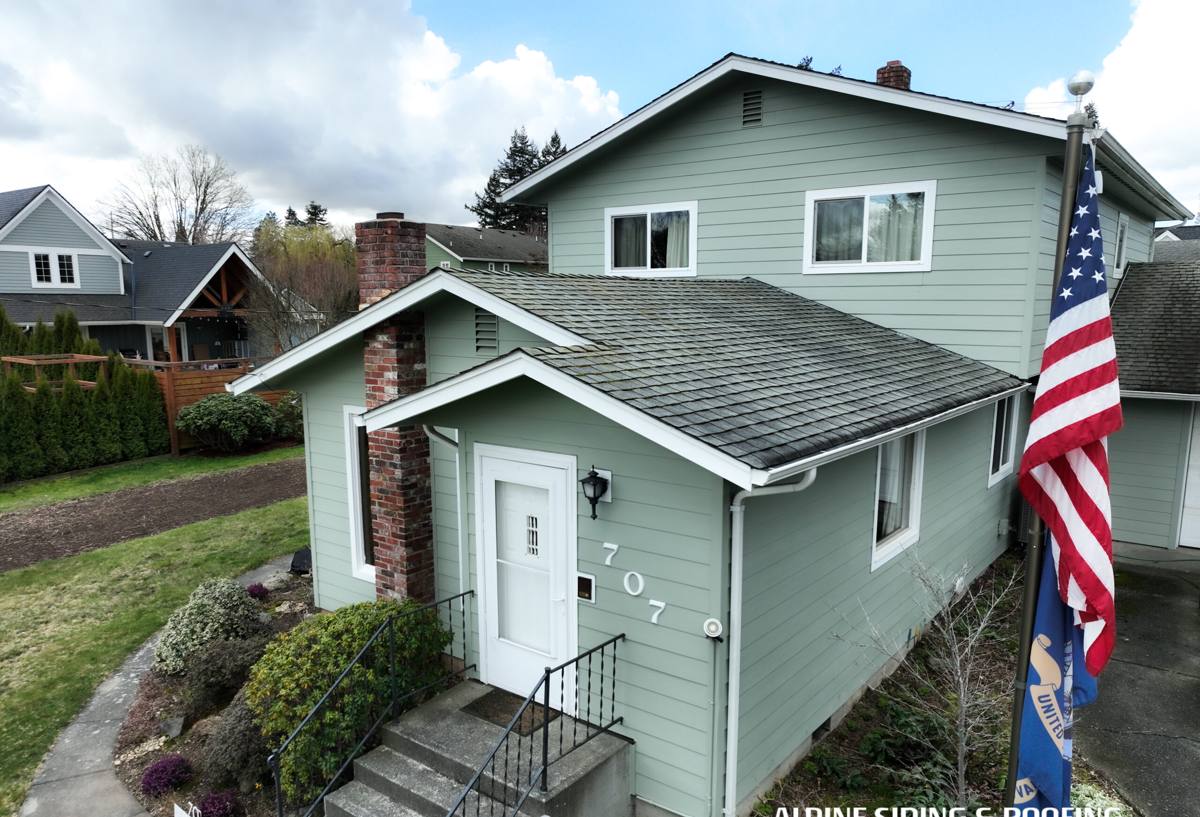
Why Fiber Cement Is the Right Call for This Climate
Every siding material has a moisture strategy, whether the manufacturer says so or not. In a climate like Redmond's, that strategy matters more than color or price.
Wood siding absorbs water directly into the material. Even with good paint, it swells and contracts through the wet season, and any crack in the finish becomes an entry point for rot. Vinyl siding doesn't absorb water, but it isn't rigid — it expands and contracts with temperature swings, its seams and laps rely on loose-fit engineering rather than a sealed system, and it doesn't do anything to resist moss or mildew growth on its surface. Thin vinyl also dents and can distort in direct sun on south- and west-facing walls.
Fiber cement takes a different approach. It's dimensionally stable — it doesn't swell, shrink, or warp with the seasons the way wood does — and it's dense enough that surface moss and mildew have a harder time getting a foothold compared to wood or vinyl. It's also non-combustible, which matters given how many Redmond properties border greenbelt, ravine, or heavily wooded lots. None of that makes fiber cement maintenance-free, but it removes the two biggest failure modes — moisture absorption and material movement — that cause the most siding problems in this region.
What a Correct Fiber Cement Installation Actually Involves
Fiber cement siding is only as good as the water management system behind it. A huge share of the siding failures we get called out to inspect in this area aren't material failures at all — they're installation shortcuts. A correct job includes:
A continuous water-resistive barrier
The house wrap or building paper behind the siding is the actual waterproofing layer. Siding is the weather shield, not the seal — every penetration, seam, and lap in the WRB has to be installed shingle-style so water sheds down and out, never behind.
Proper flashing at every transition
Windows, doors, roof-to-wall intersections, and deck ledgers are where driving rain finds a way in. Each of these needs dedicated flashing, not just caulk, which degrades and shrinks over time and isn't a substitute for physical water diversion.
Correct clearances
Siding needs a minimum gap above roof lines, decks, and patios, and clearance from grade at the bottom. Skipping these clearances is one of the most common corner-cuts we see, and it's a direct path to moisture wicking into the bottom courses.
Manufacturer-spec fastening
Fiber cement has a specific nailing pattern, fastener type, and embedment depth. Over- or under-driven nails crack the board or leave it loose enough to move, and movement opens joints to water over time.
Sealed cut ends and properly treated joints
Factory edges come primed or finished, but any field cut exposes raw material that has to be sealed before installation. Butt joints need to be treated per the manufacturer's system, not just butted and caulked.
Every one of these steps is invisible once the siding is up. That's exactly why they're the steps that get skipped by crews trying to move fast, and exactly why they matter most in a climate that gives water months, not minutes, to work its way in.
James Hardie: The Only Fiber Cement We Install
We install James Hardie products exclusively — not other fiber cement brands, not LP SmartSide, not vinyl, not raw cedar or primed spruce. That's a deliberate standard, not a sales preference.
Hardie's HZ product lines are formulated by climate zone, with a version engineered for the wetter, milder Pacific Northwest rather than a one-size-fits-all formula. The ColorPlus finish is baked on at the factory in a controlled environment, which gives more consistent, longer-lasting color adhesion than field-applied paint — a real advantage in a region where exterior paint jobs are fighting moisture almost year-round. Hardie also backs its siding with a strong, transferable product warranty, which matters to Redmond homeowners who may sell within the life of the siding.
Other fiber cement brands and engineered wood products like LP SmartSide have real strengths and legitimate uses. We simply don't install them. Our crews, our fastening schedules, our flashing details, and our warranty backing are all built around one system, installed correctly, every time — rather than switching specs from job to job.
Our Process on Redmond Homes
- Inspection first. Before we quote anything, we look at the existing siding, the sheathing underneath where accessible, and problem areas like shaded walls, roof-to-wall intersections, and anywhere trees overhang the structure.
- Full tear-off, not overlay. We don't install new siding over sheathing that's showing signs of rot or over old siding as a shortcut. Covering a moisture problem doesn't fix it — it hides it.
- Correct the water management layer. New WRB, flashing at every window, door, and transition, and correct clearances before a single piece of siding goes up.
- Install to Hardie's fastening and clearance spec. No shortcuts on nailing pattern, joint treatment, or cut-end sealing.
- Detail and clean up. Caulking where specified, touch-up on any field-cut edges, and a final walk-through so you know exactly what was done and why.
What Drives the Cost of a Fiber Cement Job
Every Redmond home is different, so we don't quote off square footage alone. These are the factors that actually move the price:
| Factor | Why It Matters |
|---|---|
| Tear-off vs. new construction | Removing and disposing of old siding, and repairing any sheathing found underneath, adds labor beyond the new material install |
| Home size and wall complexity | More corners, gables, and dormers mean more cuts, more flashing details, and more labor hours per square foot |
| Siding profile | Lap siding, shingle-style panels, and board-and-batten each install differently and carry different material and labor costs |
| Trim and accent work | Window and door trim, fascia, and accent bands add detail work beyond the flat wall area |
| Site accessibility | Steep lots, tight setbacks, and mature trees close to the structure — common on Redmond's wooded properties — can slow staging and installation |
| Existing damage | Rotted sheathing or framing found during tear-off requires repair before new siding can go on correctly |
Signs Your Redmond Home May Need New Siding
Most siding problems in this area show up gradually. Walk your exterior, especially shaded and north-facing walls, and look for:
- Persistent moss or dark streaking that comes back shortly after cleaning
- Soft or spongy spots when you press on wood siding or trim
- Visible warping, buckling, or gaps opening at seams and corners
- Paint that's peeling, bubbling, or failing faster than a normal repaint cycle
- Cracked or missing caulking around windows, doors, and trim joints
- Rising utility bills that suggest air and moisture are getting past the wall assembly
- Visible daylight or drafts around window and door trim from inside
Any one of these on its own isn't an emergency. Several together, especially on the shaded side of the house, usually means moisture has been getting behind the siding for a while.
Why It Matters That a Crew Already Works Redmond
Redmond's housing stock spans everything from older ramblers to newer Eastside construction, often on lots with significant tree cover and grade changes. A crew that already works this area knows to expect heavier moisture loads on shaded walls, plans for tree-heavy access constraints before the job starts, and is familiar with City of Redmond permitting requirements so the project doesn't stall waiting on paperwork a crew from outside the area didn't anticipate. That local familiarity shows up in fewer surprises mid-project, not in anything you'd notice from the curb.
If you're weighing your options for your Redmond home, we're happy to walk the property, look at what's actually happening with your current siding, and give you a straight assessment — no pressure, no obligation. Reach out below for a free estimate.