 Seattle Exterior
 New-Construction Windows in Ballard: A Different Job Than a Replacement
New-construction windows go in before a house has walls to hide behind. On a Ballard build — a new single-family home, a townhouse row, an addition, or an ADU — the windows are set into open stud framing while the sheathing and weather-resistive barrier are exposed, before siding closes everything up. That's a very different job from swapping an old window into an existing opening. There's no old frame to work around, but there's also no second chance once the siding crew shows up. Whatever water-management details go in around the window at this stage are permanent.
Ballard has seen a steady wave of new houses, infill townhomes, and additions on its narrow lots, so this is work we do regularly in the neighborhood rather than an occasional side job. Narrow-lot and zero-lot-line construction is common here, which often means more window openings per elevation and less roof overhang to shield them — both raise the stakes on getting each opening detailed correctly the first time.
Getting a new-construction window right the first time matters more here than in a lot of places, because Seattle's climate doesn't forgive a shortcut in the flashing.
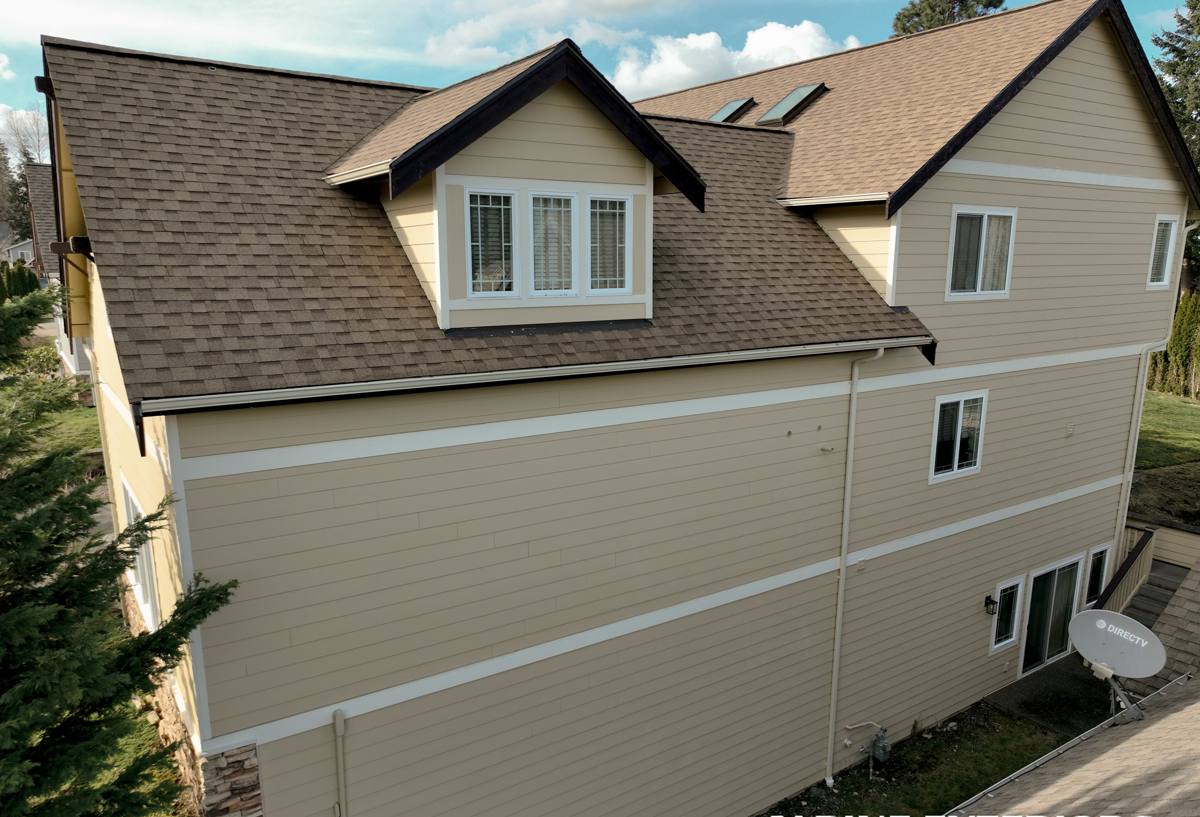
What Ballard's Climate Actually Does to a Window Opening
Ballard sits close to Salmon Bay, Shilshole Bay, and Puget Sound, which means salt-laden air is a real factor for window hardware, fasteners, and exposed trim — not just a coastal-town talking point. Add King County's long stretch of driving rain from fall through spring, plus a moss season that lingers on anything that stays damp too long, and you've got an environment that punishes any gap in the water-management chain around a window opening.
Three things matter most for a new-construction window in this climate:
- Wind-driven rain needs a sill pan and flashing sequence that sheds water outward, not a bead of caulk hoping to hold it back
- Salt air accelerates corrosion on unprotected fasteners, hinges, and lower-grade cladding — hardware and finish choices matter more here than inland
- Extended damp periods mean any trapped moisture behind a window has weeks, not days, to cause rot or support mold and moss before a dry spell shows up to help
None of this is exotic — it's standard Pacific Northwest marine-climate behavior. But it means a new-construction window installer working in Ballard has to treat every flashing detail as load-bearing, because the weather here will eventually find any weakness.
Getting the Flashing Sequence Right
Sill Pan First
Before a window ever goes into the rough opening, the sill needs a pan — a sloped, sealed base that catches any water that gets past the window itself and directs it back outside instead of into the framing. Skipping this step is one of the most common corner-cuts we see on new-construction jobs, and it's invisible until the drywall comes down years later with rot behind it.
Integrating with the Weather-Resistive Barrier
The window's nailing flange has to weave into the house wrap or weather-resistive barrier in the correct shingle-lap order: sill flashing first, then the WRB folded down over the jambs, then the window itself, then jamb flashing over the side flanges, then head flashing with a drip cap last, lapped over everything below it. Water always has to flow down and over the layer beneath it, never up underneath one. Get the order backwards and the assembly works like a funnel instead of a barrier.
Sealant in the Right Places — and Not in the Wrong Ones
Sealant belongs at the jambs and head to stop air and bulk water intrusion. It should generally be left out of the sill's weep path, so any water that does get behind the window has somewhere to drain back out rather than pooling against a fully sealed frame. A fully caulked sill looks tidy on install day and traps water for the life of the house.
Choosing a Window Product for a Ballard Build
Frame material is a real decision on new construction, not just a finish choice — it affects how the window performs against King County's rain and salt air over the next few decades. Every material below can work in Ballard; the right one depends on the building's exposure, budget, and how much upkeep the homeowner wants to take on.
| Frame Material | Upfront Cost | Maintenance | Moisture & Salt-Air Behavior |
|---|---|---|---|
| Vinyl | Lowest | Minimal — no painting | Won't rot or corrode; performance depends heavily on installation quality |
| Fiberglass | Mid to upper | Low — stable, paintable if desired | Dimensionally stable through temperature swings; strong option for exposed elevations |
| Wood-clad | Highest | Higher — cladding protects the wood, but seals and joints need periodic checks | Good performance when detailed correctly; more sensitive to installation errors near the coast |
Whatever material a homeowner or builder chooses, we look for hardware and finishes rated for coastal or marine exposure rather than a standard inland package — the extra cost up front is small compared to replacing corroded hardware or a failed seal a decade in.
Operable style matters too. Casement windows compress against their frame when latched, which tends to seal tighter against wind-driven rain than a slider or single-hung. That's not a reason to avoid double-hung or sliding windows on a Ballard build — they're common and can perform well — but it's worth weighing on the most rain-exposed elevations of a new home.
Our New-Construction Window Process
On a build or addition, windows aren't an isolated trade — they sit in the middle of the framing, weatherproofing, and siding sequence, so timing and coordination matter as much as the install itself.
- Takeoff and ordering: we measure rough openings from approved plans, or as-framed once framing is up, and place orders early. Window lead times can run several weeks to a couple of months depending on the product, and a late order stalls the whole dry-in schedule.
- Pre-install check: before setting anything, we confirm rough openings are square, correctly sized against the window schedule, and that the WRB is in place and ready to integrate.
- Sill pan and flashing: the water-management sequence described above goes in before the window is set, not patched around it afterward.
- Setting and shimming: windows are shimmed level, plumb, and square, and fastened per the manufacturer's schedule — not just nailed at the corners.
- Head flashing and final lap: the top of the sequence closes out the water path before house wrap or building paper continues up the wall.
- Walkthrough with the builder: we confirm every opening is sealed, flashed, and ready for siding before that crew starts, since siding covers these details for good.
Energy Code and Inspection Requirements
New-construction windows in Seattle and King County have to meet Washington's state energy code minimums for U-factor and performance, and the NFRC label on each unit is what the local building inspector checks against the approved plans. On a Ballard project this usually means selecting products rated for our marine climate rather than a generic national package, and making sure labels stay on the glass until inspection rather than getting stripped off during cleanup.
Condensation resistance is worth asking about too. Our winters combine cool exterior temperatures with warm, humid interiors, which is exactly the setup that causes condensation on lower-performing glass. A properly specified window for this climate keeps that moisture on the outside where it belongs. We coordinate the code paperwork and labeling as part of the job so it isn't a scramble at inspection time.
Working With Your Builder or General Contractor
Most new-construction window work in Ballard happens as part of a larger build, so we're used to working on someone else's schedule — showing up during the dry-in window, working around other trades, and communicating directly with a GC or project manager instead of only the homeowner. Ballard's narrow lots and alley-loaded lots also mean staging and access take some planning; we sort that out before crews and material show up rather than figuring it out on site. When punch-list items come up during final walkthrough, we handle them before the job is called done, not after the invoice is sent.
Before You Hire a New-Construction Window Contractor
A few questions separate a crew that treats window installation as a real trade from one that treats it as an afterthought before siding goes up:
- Do they install a sill pan on every opening, or only "if needed"?
- Can they explain their flashing lap order without hesitating?
- Do they coordinate directly with the GC and siding crew on timing?
- Do they know which window products hold up to salt air and driving rain, not just which ones are cheapest?
- Will they walk the openings with you or your builder before siding closes them up?
Why a Ballard-Familiar Crew Is Worth It
Anyone can hang a window. Getting the water-management details right on a home that's going to sit a few blocks from Puget Sound, through decades of King County rain and moss season, is a different standard. We work new-construction window openings in Ballard regularly enough to know the local exposure, the typical lot conditions, and what inspectors here are checking for — and we'd rather spend an extra ten minutes getting a flashing detail right now than have anyone dealing with rot behind a wall in ten years.
If you're framing a new build, addition, or ADU in Ballard and need windows installed correctly the first time, we're happy to take a look at your plans and openings and give you a straightforward, no-pressure estimate — just fill out the form below.