 Seattle Exterior
 What Redmond's Climate Actually Does to Siding
Redmond sits in the Puget Sound basin, and like the rest of the Eastside, it gets a long, wet season that stretches from fall through spring. That's months of near-constant moisture exposure for anything on the exterior of a house. Add in the marine air that moves through the region off Puget Sound, driving rain that comes in sideways during winter storms, and the shaded, tree-covered lots common in Redmond neighborhoods, and you have ideal conditions for moss, algae, and slow moisture intrusion to take hold on siding that isn't built to handle it.
Moss isn't just cosmetic. Once it establishes itself on a wall surface, it holds moisture against the substrate underneath, and that constant dampness is what causes rot in wood-based products and swelling or delamination in engineered wood siding. King County's climate doesn't punish siding with one dramatic event — it punishes it slowly, year after year, through cycles of wet and dry that weaker materials simply can't take indefinitely.
That's the backdrop for every siding decision we make on a Redmond home. We're not selecting a product because it looks good in a brochure. We're selecting a product that has to survive this specific climate for decades without babying.
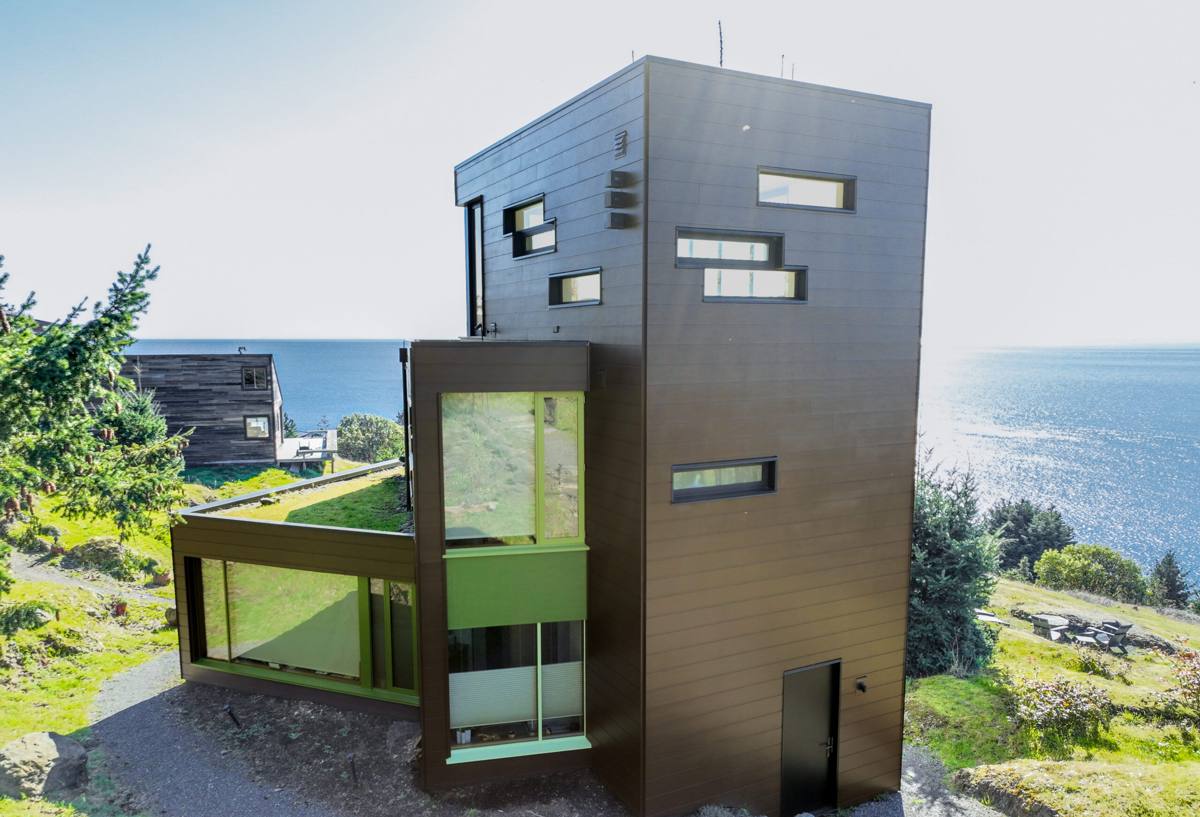
Why We Only Install James Hardie in This Market
James Hardie fiber cement is cement, sand, and cellulose fiber — there's no wood pulp in the core to absorb water and rot, and nothing for moss to feed off the way it can with organic materials. That single difference matters enormously in a climate like Redmond's, where siding spends a large part of the year damp.
We made the decision, as a company, to install James Hardie exclusively. We don't install vinyl, LP SmartSide, Cemplank, Allura, primed spruce, or cedar. That's not a marketing position — it's a standard we hold because we've seen what the Pacific Northwest's wet cycles do to materials that aren't built for it, and we don't want to be the crew that installed something a Redmond homeowner has to fight with in ten years.
Being Fair to the Alternatives
Vinyl is affordable and low-maintenance in the sense that it never needs painting, but it flexes and can crack in cold snaps, fades over time, and doesn't hold up structurally to wind-driven rain intrusion behind the panels the way a rigid fiber cement product does. LP SmartSide and other engineered wood products have improved their moisture resistance over the years, but they still rely on treated wood strand at the core — if a seal ever fails at a seam or fastener point, moisture gets into wood fiber, and that's a losing battle in a climate this wet. Cedar is a beautiful, genuinely traditional Pacific Northwest material, but it demands ongoing staining or sealing, and untreated or neglected cedar is exactly the kind of organic surface moss loves. Each of these products has real strengths. We just don't think any of them hold up to Redmond's climate as reliably, over as long a period, with as little maintenance, as James Hardie does.
What a Correct James Hardie Installation Actually Involves
The material is only half the equation. A huge percentage of the siding failures we get called out to inspect in this region aren't failures of the product — they're failures of installation. James Hardie's own installation specifications are detailed for a reason, and skipping steps is how a good product ends up performing badly.
- Proper water-resistive barrier and flashing integration at every window, door, and penetration — this is the layer that actually stops bulk water, not the siding itself
- Correct fastener type, spacing, and placement so panels don't split or work loose under wind load
- Minimum clearance gaps at the bottom of the siding, at grade, and at roof lines so water has somewhere to go and siding isn't sitting in standing moisture
- Proper joint treatment and caulking at butt joints, using materials rated for the climate, not just whatever's on the truck
- Correct nailing at drip caps and Z-flashing above horizontal trim and window heads, which is where a huge share of moisture intrusion actually starts
- Field-cut edges primed or sealed before installation, since raw cut edges are the most vulnerable point on any fiber cement panel
Get any one of these wrong and you can end up with moisture problems behind siding that looks fine from the curb for a few years before the damage becomes visible. We install to Hardie's published specifications on every job, not as an upsell but as the baseline.
HZ5 Product Line: Built for This Region
James Hardie engineers their siding by climate zone, and the HZ5 line is the version built for regions like ours — areas with significant moisture, freeze-thaw cycling, and extended damp seasons. HZ5 products are formulated for the specific stresses of a wetter, cooler climate rather than a one-size-fits-all national spec. For a Redmond home, that's the correct product line, and it's what we install.
ColorPlus Factory Finish
James Hardie's ColorPlus finish is baked on at the factory under controlled conditions, rather than field-painted after installation. That matters in a climate where field-applied paint has to cure properly to bond and perform, and where weather windows for painting can be unpredictable. A factory finish gives more consistent color, better fade resistance, and a longer interval before the siding needs any refinishing at all — often well beyond what field-applied paint on wood or engineered products can match.
Cost and Maintenance: How the Options Actually Compare
Every siding material has a different cost and upkeep profile over its lifetime. Here's an honest breakdown of the factors that matter most in a climate like Redmond's:
| Factor | James Hardie Fiber Cement | Vinyl | Engineered Wood / Cedar |
|---|---|---|---|
| Upfront cost | Moderate-to-higher | Lower | Moderate |
| Moisture/moss resistance | High (non-organic core) | Moderate (seam/panel intrusion risk) | Lower (organic core or surface) |
| Repainting/refinishing interval | Long (factory finish) | Never repaints, but fades and can't be easily refinished | Frequent (every few years) |
| Performance in wind-driven rain | Strong when flashed correctly | Moderate, panel flex risk | Depends heavily on maintenance |
| Fire resistance | Non-combustible | Combustible | Combustible |
| Typical lifespan when installed to spec | Decades | Varies, shorter in this climate | Shorter without diligent upkeep |
The upfront cost of James Hardie is usually higher than vinyl and comparable to or a bit above engineered wood, but the maintenance savings and longevity in a climate this wet tend to close that gap over the life of the siding.
Our Process for Redmond Jobs
We approach every Redmond project the same disciplined way: a full exterior inspection first, checking existing sheathing and framing for any hidden moisture damage before a single new panel goes up, because covering rot with new siding just hides the problem. From there we handle water-resistive barrier and flashing work properly, install James Hardie's HZ5 products to spec, and finish with factory ColorPlus color so there's no field-painting variability to worry about.
Working regularly in this part of King County means we already understand the drainage patterns, the tree cover, and the moss pressure specific to Redmond lots — we're not learning the local conditions on your project. That familiarity shows up in the details: where we pay extra attention to flashing, which sides of a house typically take the worst weather, and how much clearance to leave at grade given typical landscaping and slope in the area.
Signs a Redmond Home May Need New Siding
- Visible moss or algae growth that keeps returning after cleaning
- Soft spots, bubbling, or delamination on wood-based or engineered siding
- Paint that's peeling or failing faster than it should between repaints
- Warping, buckling, or gaps at panel seams
- Rising energy bills that suggest the wall assembly isn't performing as it should
- Visible cracking at butt joints or around window and door trim
Warranty and What It Actually Covers
James Hardie backs its siding with a transferable, non-prorated product warranty, and ColorPlus finishes carry their own separate finish warranty. Transferability matters for resale — a new buyer inherits the coverage, which is a meaningful selling point in a market where buyers are increasingly asking about exterior condition and materials. That said, a manufacturer warranty on the product doesn't cover a workmanship failure. That's why correct installation, following Hardie's published specifications, is the part we control and the part that determines whether the material ever gets a fair chance to perform the way it's designed to.
Ready for a Straight Answer on Your Siding
If moss, moisture, or aging siding are showing up on your Redmond home, it's worth getting a clear, no-pressure look at what's actually going on before deciding what to do next. We're happy to walk the exterior with you, point out what we see, and put together a straightforward estimate for James Hardie siding done right — no obligation, no pressure. The form below gets you a free estimate.