 Seattle Exterior
 Why University District Homes Ask About James Hardie Siding
University District sits in one of the more challenging pockets of Seattle for exterior materials. The neighborhood's mature tree canopy, its proximity to Portage Bay and Lake Washington, and the mix of older craftsman homes, converted rentals, and multi-family buildings all add up to a lot of shade, a lot of standing humidity, and siding that rarely gets a full day of sun to dry out. Add King County's driving winter rain and the long moss season that follows, and you have an environment that punishes anything but a genuinely water-managed siding system. That's the reason we get asked specifically about James Hardie fiber cement here more than almost anywhere else we work.
We install only James Hardie products. Not as a marketing angle — because after years of tear-offs and re-sides across Seattle, it's the one siding system we've found holds up consistently under exactly the conditions University District throws at a house.
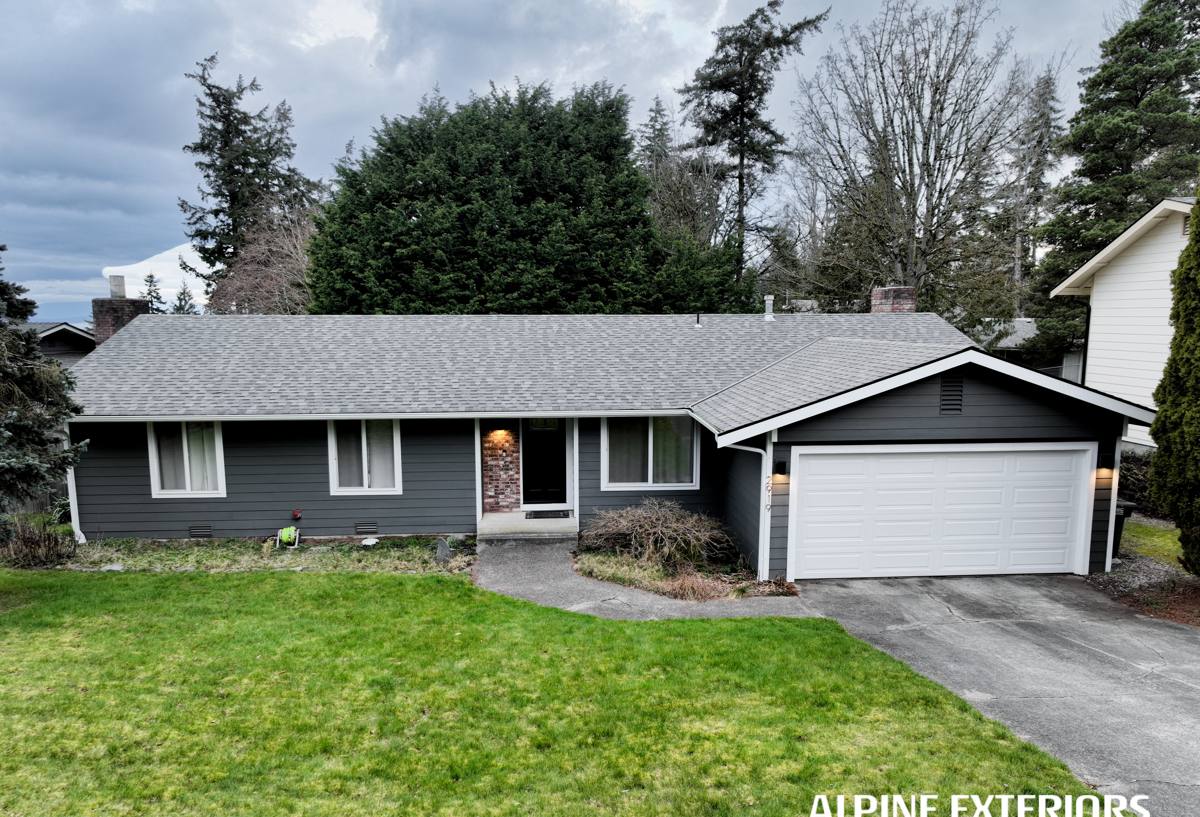
What This Climate Actually Does to Siding
Moisture that never fully leaves
Between the lake influence and the tree cover common on U District lots, exterior walls here stay damp longer after a storm than they would in a more open, sunnier part of the city. Siding that absorbs water or traps it behind the cladding — rather than shedding it and drying out — is on a slow path toward rot, delamination, or paint failure, even if the damage doesn't show for a few seasons.
Driving rain, not just rain
Seattle's rain is rarely a straight-down drizzle. Storm systems push moisture sideways into walls, especially at corners, under eaves, and around window and door openings. Poorly flashed transitions are where almost every water intrusion problem we find on this style of home actually starts.
Moss and the shade that grows it
Shaded, moisture-retentive surfaces are exactly where moss and algae take hold, and University District's older street trees and closely spaced lots create plenty of that shade. Moss holds water against the siding surface far longer than an open, sunlit wall would, which accelerates whatever degradation the material is already prone to.
The Housing Stock Here Adds Its Own Wrinkles
University District's building stock is a genuine mix: early-1900s craftsman bungalows, Tudor-influenced homes from the interwar years, older apartment buildings converted for rental or student housing, and newer infill construction on smaller lots. That mix matters for a siding project in a few practical ways:
- Older homes often have layers of past siding or repairs hiding the real condition of the sheathing underneath — we don't know what we're dealing with until tear-off.
- Rental and multi-family properties need siding that tolerates lower-frequency maintenance attention, since owners aren't always on-site daily.
- Dense lot spacing means limited staging room and closer proximity to neighboring structures, which changes how a crew sequences the job.
- A visible, walkable neighborhood like this one means the finished look matters — patchy color match or visible seams stand out.
A siding system has to work for both a century-old bungalow and a converted fourplex, without a different plan for each. That's part of why we standardized on one product system rather than offering a menu of options depending on budget.
Why James Hardie Is What We Put on These Homes
James Hardie siding is fiber cement — a mix of cement, sand, and cellulose fibers engineered specifically to handle moisture cycling without warping, rotting, or feeding mold the way wood-based products can. A few specific reasons it fits University District's conditions:
Built for wet climates, not just labeled for them
James Hardie manufactures regionally engineered product lines, and the HZ5 line is formulated for climates like ours — places with sustained damp weather rather than freeze-thaw extremes. That's a meaningful distinction from a generic siding product marketed nationwide with no regional formulation at all.
It doesn't feed moss and mildew the way wood does
Fiber cement doesn't provide the organic material that moss and mildew use as a food source the way wood or wood-composite siding can. That doesn't make a home moss-proof — nothing is, if it stays shaded and damp — but it removes one variable that accelerates surface growth and the moisture retention that comes with it.
Non-combustible
James Hardie siding is non-combustible fiber cement, which matters given how close lot lines and structures sit to each other in a dense neighborhood like this one.
Factory-applied ColorPlus finish
Most of what fails first on a re-painted wood or composite siding job is the field-applied paint — it's exposed to the same driving rain and UV as everything else, and it's only as good as the prep work and conditions on the day it was applied. ColorPlus finish is baked on in a controlled factory environment, which gives more consistent color retention and adhesion than a job-site paint job typically can.
A warranty built around long-term ownership
James Hardie backs its siding with a strong, transferable limited warranty — useful in a neighborhood with a healthy mix of long-term owners and rental transitions, where a future buyer benefits from the same coverage.
How James Hardie Compares to the Alternatives
| Factor | James Hardie Fiber Cement | Vinyl | Cedar / Untreated Wood | LP SmartSide |
|---|---|---|---|---|
| Moisture resistance | Engineered for wet climates (HZ5) | Doesn't rot, but seams and gaps can trap moisture behind panels | Absorbs moisture; needs consistent sealing/painting | Wood-strand product; edges are vulnerable if not properly sealed and maintained |
| Combustibility | Non-combustible | Combustible, can melt/warp near heat | Combustible | Combustible |
| Finish durability | Factory ColorPlus finish | Color molded in, can fade/chalk over time | Field-applied paint/stain, needs recoating | Factory primed or finished, still exposed at cut edges |
| Maintenance burden | Low — occasional wash, no repainting cycle with ColorPlus | Low, but cracks and doesn't repair cleanly | High — regular painting/staining and moss treatment | Moderate — edge sealing and moisture vigilance required |
| Warranty structure | Strong, transferable limited warranty | Varies widely by manufacturer/grade | None (natural material) | Manufacturer-specific, installation-sensitive |
We don't install vinyl, LP SmartSide, cedar, or other fiber cement brands like Cemplank or Allura — not because there's no legitimate use case for them anywhere, but because after weighing moisture behavior, maintenance burden, and long-term performance in this specific climate, James Hardie is the one product we're willing to put our name behind.
What a Correct James Hardie Installation Actually Involves
James Hardie siding's real-world performance depends almost entirely on installation quality — the product itself is only half the equation. A correct job on a University District home involves:
- Full inspection and repair of the sheathing and water-resistive barrier before any new siding goes up — not siding over hidden rot
- Correct flashing at every window, door, and roofline transition, since that's where driving rain actually gets in
- Proper fastener placement and spacing per James Hardie's engineering specs, not just "close enough"
- Manufacturer-specified gaps and clearances at the bottom of the siding and at trim, so water has somewhere to go rather than wicking upward
- Caulking only where James Hardie's install guide calls for it — over-caulking traps moisture just as badly as under-caulking lets it in
- Field-cut edges primed or sealed per spec, since a factory finish only protects what the factory cut
Most siding failures we're called out to inspect aren't a materials problem — they're an installation shortcut that let water in somewhere it was never supposed to go.
How Our Process Works
We start with an on-site assessment of the existing siding, sheathing condition, and any trouble spots — moss buildup, staining, soft spots — specific to your home. From there we walk through product and color options, give you a straightforward written estimate, and if you move forward, we handle full tear-off, sheathing repair where needed, correct water-resistive barrier and flashing detail work, and installation to James Hardie's specifications. We inspect our own work before calling a job finished, not after a callback.
Why Hiring a Crew That Already Works This Neighborhood Matters
University District's dense lot layout, older permitting history, and mix of single-family and multi-family properties mean a crew unfamiliar with Seattle's permitting process and King County's inspection expectations can lose real time — and money — figuring things out mid-project. A crew that already knows how to sequence a tear-off on a tight lot, work around shared property lines, and anticipate what's hiding under decades-old siding on this style of home moves faster and catches problems before they become change orders.
What to Expect Long-Term
Installed correctly, James Hardie siding is built to hold its finish and resist moisture damage for decades, backed by a transferable warranty that carries value if you sell. It still needs basic care — periodic washing to keep moss and organic buildup from accumulating in shaded areas, and prompt attention if a gutter or downspout starts dumping water directly onto a wall section. None of that is unusual maintenance; it's the same common-sense upkeep any exterior needs in a wet climate, just with less of it than wood or vinyl typically demands.
If you're weighing a siding replacement or repair in University District, we're happy to come take a look and give you a straightforward, no-pressure estimate — no obligation, just an honest read on your home's condition and what it actually needs.