 Seattle Exterior
 Siding Replacement for Wallingford's Older Housing Stock
Wallingford sits in one of Seattle's classic in-city neighborhoods, tucked between Lake Union and Green Lake, and its housing reflects that history — craftsman bungalows, older Seattle boxes, and infill homes built to fit narrow city lots. A lot of that siding is original, or it's a replacement job from decades ago that's now due again. When we talk to homeowners here, the question isn't usually "should I replace my siding" — it's "what should I replace it with, and who's going to install it so it actually lasts in this climate."
That second question matters more in Seattle than in drier parts of the country. King County's marine climate is hard on exterior materials in ways that aren't always obvious until the siding has already failed underneath.
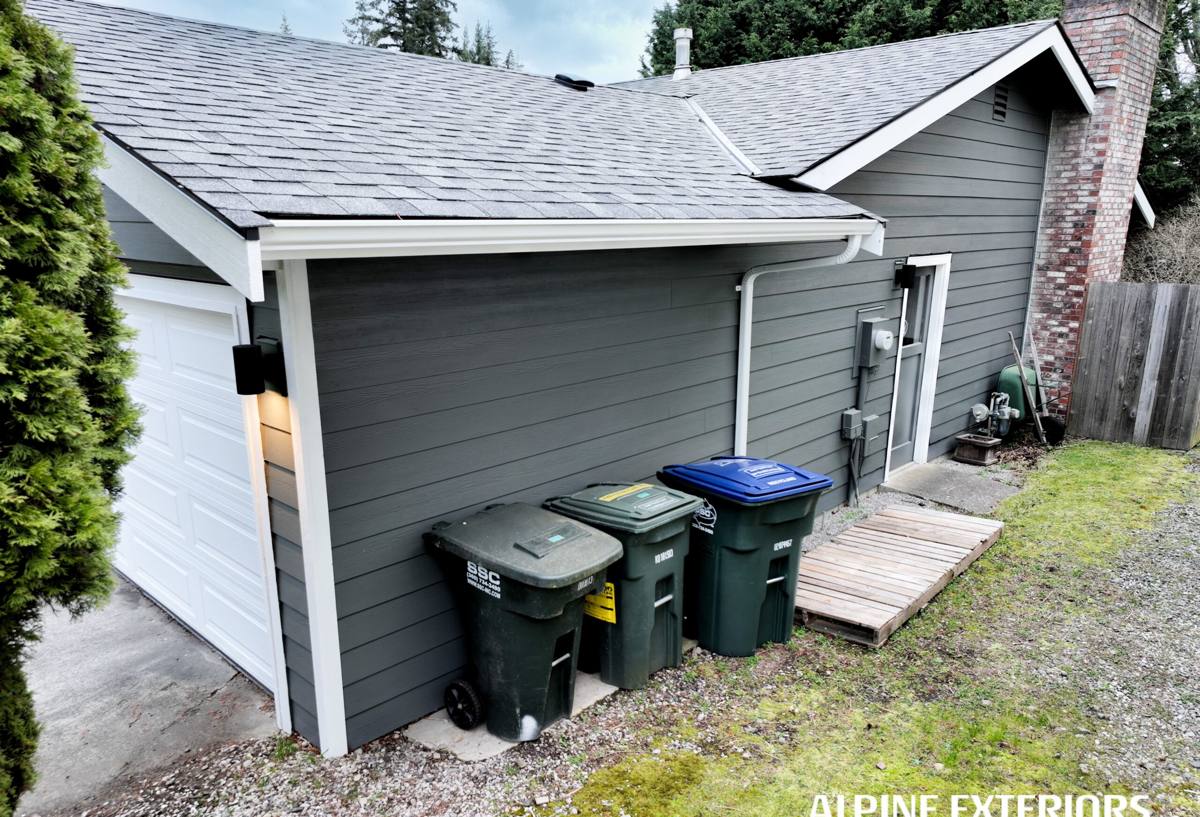
What Puget Sound Weather Does to Siding Over Time
Seattle doesn't get the sudden hailstorms or hurricane winds that beat up siding elsewhere. Instead it wears siding down slowly, through steady exposure that adds up year after year:
- Driving rain that gets pushed sideways into siding seams, trim joints, and butt joints during winter storms off the Sound.
- Salt-laden air carried inland from Puget Sound, which accelerates corrosion of fasteners and degrades poorly sealed finishes over time.
- A long, damp moss and mildew season — often eight or nine months a year of the moisture and shade conditions moss needs to take hold on north-facing walls and anywhere sun doesn't reach.
- Repeated wet-dry cycling that swells and shrinks organic materials like wood and some composite products, loosening paint film and opening hairline gaps at joints.
None of this is dramatic on its own. The damage is cumulative — a home doesn't fail in one storm, it fails from twenty winters of small amounts of moisture finding their way behind siding that wasn't detailed correctly the first time.
Signs a Wallingford Home Needs Siding Replacement, Not Just Repair
Not every siding problem calls for a full tear-off. But there's a point where patching stops making sense and full replacement is the more honest recommendation. Watch for:
- Soft or spongy spots when you press on the siding, especially near the bottom courses and around window and door trim
- Paint that keeps failing in the same spots within a year or two of repainting, even after prep work
- Moss or dark streaking that returns quickly after cleaning, particularly on shaded or north-facing walls
- Visible cupping, buckling, or gaps opening up between boards or panels
- Interior signs — musty smells, peeling paint on interior walls, or warm/cold spots — that suggest moisture is already getting past the exterior skin
- Siding that's original to a home built before the 1990s and has never been fully replaced
If you're seeing two or more of these at once, it's worth having someone look at the sheathing underneath, not just the surface.
What a Correct Siding Replacement Job Actually Involves
A siding replacement is really a whole-wall system, and skipping any layer of it is how homes end up back in the same situation ten years later. A job done right on a Seattle home includes:
Tear-off and inspection
Old siding comes off entirely so the sheathing underneath can be inspected — not just glanced at. This is where hidden rot, soft framing, or old moisture damage from the previous siding job gets found and dealt with before anything new goes up.
Weather-resistive barrier and flashing
A continuous water- and air-resistive barrier goes over the sheathing, with proper flashing integrated at every window, door, deck ledger, and roofline transition. This is the layer that actually keeps driving rain out — the siding itself is the second line of defense, not the first.
Rainscreen gap where it matters
On many Seattle homes, a small drainage gap between the barrier and the new siding gives any moisture that does get through a way to drain and dry out, instead of sitting against the back of the siding. Given how much of the year this region spends wet, that airflow gap earns its keep.
Correct fastening and joint treatment
Fastener type, spacing, and depth all matter for long-term performance, and joints need to be treated the way the manufacturer specifies — not just butted together and caulked. This is where a lot of corner-cutting happens on lower-bid jobs, and it's usually invisible until the siding is ten years old.
Why We Install James Hardie Fiber Cement — and Not the Alternatives
We install James Hardie fiber cement siding exclusively. We don't install vinyl, LP SmartSide, Cemplank, Allura, primed spruce, or cedar, and that's a deliberate professional standard, not a lack of options.
Each of those alternatives has real strengths — cedar looks the part, vinyl is inexpensive, engineered wood products install quickly. But each also carries a trade-off that shows up specifically in a climate like Seattle's: wood-based products need consistent maintenance to keep moisture out of the substrate, vinyl can warp and doesn't hold paint if a homeowner wants to change color later, and engineered wood siding's long-term performance depends heavily on caulking and finish maintenance staying on schedule year after year.
James Hardie fiber cement is non-combustible, holds its factory-applied ColorPlus finish far longer than field-applied paint, and is manufactured in formulations engineered for different climate zones — homes in wetter, milder regions like ours get a product built for exactly that exposure, not a one-size-fits-all mix. It also carries a strong, transferable warranty, which matters to homeowners who may sell before the siding's functional life is up.
Comparing Siding Materials for a Seattle Climate
| Material | Moisture Behavior in PNW Climate | Maintenance Needs | Typical Lifespan |
|---|---|---|---|
| James Hardie fiber cement | Dimensionally stable, resists moss growth well, factory finish sheds water | Occasional wash; no repainting for many years | 30+ years with correct install |
| Cedar | Absorbs and releases moisture with weather, prone to moss and rot without upkeep | Regular staining/sealing on a fixed schedule | 15-25 years, shorter if maintenance lapses |
| Vinyl | Doesn't rot, but can warp or gap; moisture can track behind panels at seams | Low, but limited repair options if damaged | 20-30 years, appearance fades sooner |
| Engineered wood (e.g. LP SmartSide) | Treated to resist moisture but performance depends on sealed edges and joints | Caulk and paint maintenance on a set interval | 20-30 years if maintenance stays current |
The pattern is consistent: materials that depend on a homeowner keeping up a maintenance schedule tend to underperform in a climate this consistently wet, because a missed maintenance cycle here has more consequences than it would somewhere drier.
Our Process for a Wallingford Siding Replacement
- On-site assessment — we look at the existing siding, trim, and as much of the sheathing as we can access, and talk through what we're seeing before quoting anything.
- Written scope and product selection — which James Hardie profile and HZ-engineered formulation fits the home, plus a clear plan for trim, flashing, and any sheathing repair we expect to need.
- Tear-off and sheathing repair — old material removed, any damaged sheathing replaced, framing addressed if it's been compromised.
- Barrier, flashing, and rainscreen installation — the layers that do the actual water management work, installed before a single piece of visible siding goes up.
- Hardie installation to manufacturer spec — correct fastening, joint treatment, and clearances at grade, decks, and rooflines.
- Final walkthrough — we go over the finished job with the homeowner before calling it done.
Why Hiring a Crew That Already Works in Wallingford Matters
Siding work in an established Seattle neighborhood isn't quite the same as siding work on a new-construction lot. Homes here often have older, sometimes non-standard framing, additions from different decades, and trim details that need to be matched or thoughtfully updated rather than ignored. A crew that's worked this kind of housing stock across Seattle knows what to expect before the tear-off even starts, which means fewer surprises and fewer change orders once the walls are open.
There's also the practical side: navigating Seattle's permitting process, scheduling work around the wettest stretches of the year so open walls aren't exposed longer than necessary, and knowing how to sequence a job so a home isn't sitting with exposed sheathing when a King County storm rolls through. None of that is complicated, but it's the kind of local judgment that only comes from doing this work in this specific climate, repeatedly.
What Affects the Cost of Siding Replacement
Every home is different, but the same handful of factors drive most of the variation in price:
- Total square footage of siding and the complexity of the home's shape (gables, dormers, multiple stories)
- Condition of the sheathing underneath — hidden rot repair adds cost that can't be quoted until the old siding comes off
- Amount of trim, corner, and window/door detail work involved
- Siding profile and finish selected within the James Hardie product line
- Access constraints common on narrower city lots
We won't guess at hidden damage costs before we've opened the walls, but we'll always tell you what we find and what it means for the budget before doing the work — not after.
If your Wallingford home's siding is showing its age, we're happy to take a look and give you an honest read on repair versus replacement, with no pressure either way. Use the form below to request a free estimate.