 Seattle Exterior
 Why Ballard Decks Wear Out the Way They Do
Ballard sits close enough to the water that homes here take a different kind of weathering than decks further inland. Salt-laden air off the Sound accelerates corrosion on fasteners, hardware, and any metal connectors that aren't rated for it. Add Seattle's long stretch of driving rain — the kind that comes in sideways off the water more often than it falls straight down — and you get moisture finding its way into joints, ledger boards, and end grain that a drier climate would never stress. Then there's moss. Ballard's tree cover and marine humidity keep decks damp and shaded for months at a time, and moss doesn't just look bad — it holds water against the wood surface and accelerates rot from the top down, not just underneath.
Put those three things together — salt air, driving rain, and a moss season that can run from October through May — and it's easy to see why decks in this part of King County age faster than the manufacturer's warranty card would suggest. A deck that would last 20+ years in a dry inland climate can show structural problems in half that time here if it wasn't built with this specific weather pattern in mind.
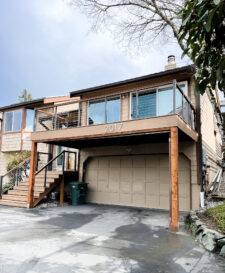
Signs a Ballard Deck Needs Replacement, Not Just Repair
Not every tired-looking deck needs to come out. But there's a point where patching boards is throwing money at a problem the framing has already lost. Here's how we tell the difference on a walk-through:
- Soft or spongy spots in decking boards, especially near the house or in shaded corners where moss has been sitting
- Rust staining or fastener heads that have corroded flush or below the board surface
- Ledger board separation or gaps where the deck meets the house — a common failure point in wet climates
- Posts or joists that show rot at ground contact points or where they meet concrete footings
- Railings that flex or feel loose under normal weight — often a sign the post connections have failed, not just the railing itself
- A deck more than 20-25 years old that has never had its structural connections upgraded to current hardware standards
If the problems are limited to surface boards and the framing underneath is sound, repair or a partial re-deck can make sense. If we're seeing rot at structural connections, undersized or corroded hardware, or a ledger attachment that was never flashed correctly, replacement is the honest recommendation — repairs on a failing frame just delay a bigger problem.
What a Correct Deck Replacement Actually Involves
A deck replacement isn't just pulling old boards and nailing down new ones. In a climate like Ballard's, the parts you don't see matter more than the parts you do.
Ledger Attachment and Flashing
The ledger board — where the deck attaches to the house — is the single most common failure point in Pacific Northwest decks. It has to be properly flashed to shed water away from the house band joist, bolted (not just nailed) into structural framing, and sealed in a way that accounts for the volume of rain this region gets. Get this wrong and you're building a slow leak into the side of the house.
Footings and Post Bases
Footings need to sit below frost depth and bear on undisturbed or properly compacted soil. Post bases should hold posts up off the concrete so end grain never sits in standing water — a detail that matters a lot more here than in a dry climate, since ground moisture around Ballard properties stays elevated for much of the year.
Hardware Rated for Coastal Exposure
Standard galvanized hardware can corrode faster than expected within a few miles of salt water. We spec fasteners and structural connectors rated for corrosive or coastal exposure on Ballard jobs specifically — it costs a little more up front and saves the deck from hardware failure a decade early.
Drainage and Airflow Underneath
A deck built tight to the ground with no airflow holds moisture and grows moss and mildew year-round. Proper joist spacing, ventilation, and in some cases a drainage system underneath keep the structure drying out between rain events instead of staying wet all winter.
Choosing a Decking Material for This Climate
There's no single "best" decking material — the right choice depends on how much maintenance a homeowner wants to take on and what budget they're working with. Here's how the common options actually perform in Ballard's conditions:
| Material | Moisture Performance | Maintenance | Typical Lifespan |
|---|---|---|---|
| Pressure-treated wood | Good if sealed regularly; end grain is the weak point | Annual cleaning and re-sealing recommended | 15-20 years with upkeep |
| Cedar | Naturally rot-resistant but still needs sealing in wet climates | Cleaning, moss treatment, periodic sealing | 15-20 years with upkeep |
| Composite decking | Doesn't absorb water like wood; resists rot | Occasional cleaning to prevent moss/mildew film | 25-30+ years |
| PVC decking | Fully moisture-resistant surface | Low; periodic washing | 25-30+ years |
Composite and PVC products cost more up front but make sense for homeowners who don't want to be out there sealing boards every year, and they hold up well against the moss and mildew that thrive in Ballard's shaded, damp conditions. Wood costs less initially and gives a more traditional look, but it only performs as well as the maintenance schedule behind it — skip a couple years of sealing here and the wood pays for it. We'll walk through the honest trade-offs for your specific yard, sun exposure, and budget rather than push one product across the board.
Our Deck Replacement Process
Every replacement follows the same sequence, adjusted for the specific footprint and conditions of the property:
- On-site assessment — we check the ledger, framing, footings, and posts to confirm what's structurally sound versus what has to go
- Design and material selection — sizing, railing style, and decking material based on your budget and how you use the space
- Permitting — most deck replacements in Seattle require a permit, especially if we're touching footings, height, or the structural connection to the house; we handle this
- Demolition — full removal of old decking, framing, and any compromised footings
- Framing and structural work — new footings, posts, joists, ledger flashing, and coastal-rated hardware built to current code
- Decking, railings, and finish work — installation of the chosen material and railing system
- Final walk-through — we go over the finished deck with you, including care and maintenance specific to the material you chose
Permits and Code in Seattle and King County
Deck work in Seattle is subject to the Seattle Department of Construction and Inspections (SDCI) permitting process, and most full deck replacements require a permit — particularly when footings, structural framing, or the ledger connection are involved. Skipping this step is a real risk: unpermitted deck work can complicate a home sale, create insurance gaps, and in some cases requires costly retroactive correction. We pull the required permits and build to current code as a standard part of the job, not an upsell.
What Drives the Cost of a Deck Replacement
Every deck is different, but the cost of a replacement generally comes down to a handful of factors:
| Factor | Why It Matters |
|---|---|
| Deck size and shape | More square footage and complex angles mean more material and labor |
| Decking material | Composite and PVC cost more per board than pressure-treated wood |
| Framing condition | Rotted footings, posts, or ledger connections add structural rebuild costs |
| Height and railing requirements | Elevated decks need code-compliant railings and sometimes stairs |
| Site access | Tight side yards or limited equipment access can add labor time |
| Permit and inspection scope | Structural changes trigger more thorough review than a straight re-deck |
Rather than quote a number that doesn't reflect your actual property, we prefer to walk the site first — that's the only way to give you a figure you can trust.
Keeping a New Deck Ahead of the Weather
Once a deck is replaced correctly, a little seasonal maintenance keeps it that way. For wood decks, that means cleaning and resealing on a regular schedule, and treating moss before it establishes rather than after. For composite and PVC, it's mostly about keeping debris and organic buildup off the surface so moisture doesn't sit in one spot through the rainy months. In every case, keeping gutters and downspouts clear near the deck area helps — a lot of moisture damage we see traces back to water dumping onto or under a deck from somewhere else on the house.
Why a Crew That Already Works Ballard Matters
Ballard's mix of older homes, tight lots, and proximity to the water means every deck replacement has to account for site conditions that don't show up the same way a few miles inland. A crew that's done this work in the neighborhood knows what the SDCI permit process actually looks like here, has a feel for how the soil and drainage behave on Ballard lots, and specs hardware for coastal exposure by default instead of after a callback. That familiarity shows up in fewer surprises during the job and a deck that's built for the weather it's actually going to face, not generic conditions.
If your deck is showing its age or you're planning ahead for a replacement, we're happy to take a look and give you a straightforward assessment — no pressure, no inflated scope. Reach out through the form below for a free estimate.