 Seattle Exterior
 Beacon Hill's Climate and What It Does to Siding
Beacon Hill sits on a ridge overlooking downtown Seattle and the Duwamish valley, which means homes here catch weather from more than one direction. Wind-driven rain off Puget Sound pushes moisture sideways into wall assemblies, not just straight down, and the tree cover on many streets keeps north- and east-facing walls shaded and damp for long stretches of the year. That combination is exactly what wears out siding in King County: not one big storm, but months of low-grade moisture exposure that never fully dries out between rain events.
The result is a long moss season that can run from fall through spring, salt-tinged marine air that accelerates corrosion on fasteners and trim, and freeze-thaw cycles that are mild by national standards but still enough to open up cracks in caulking and paint film year after year. Siding on Beacon Hill homes isn't failing because Seattle gets hit with extreme weather — it's failing because ordinary Pacific Northwest weather is relentless and siding materials that aren't built for sustained dampness eventually lose the fight.
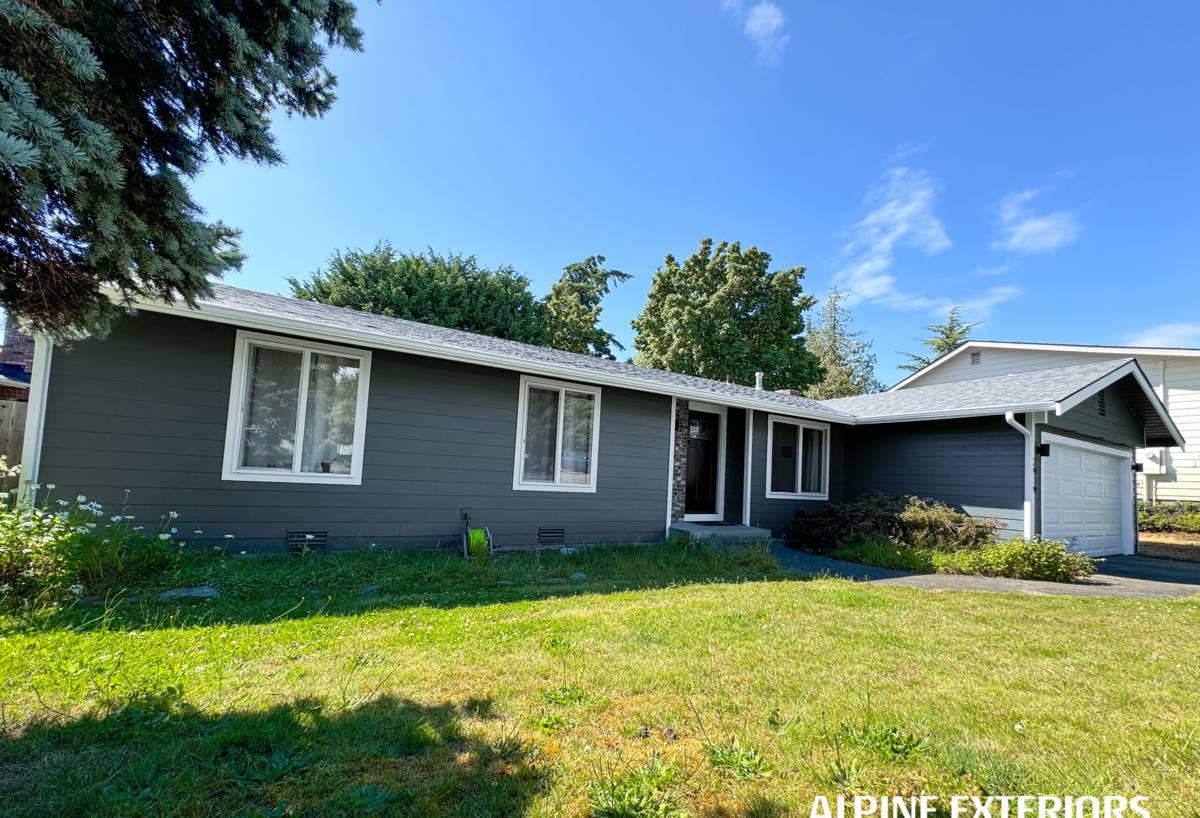
Why We Only Install James Hardie Fiber Cement
We install James Hardie products exclusively — no vinyl, no LP SmartSide, no cedar or primed spruce, no other fiber cement brands. That's a deliberate standard, not a sales pitch. Wood-based sidings, including engineered wood products, rely on a factory or field-applied coating to keep moisture out; once that coating is compromised at a cut edge, a nail hole, or a seam, water gets into the substrate and the clock starts on rot. Vinyl doesn't rot, but it flexes and gaps with temperature swings, fades in UV exposure, and can't be painted a darker color without risking warp. Neither material is inherently bad, but neither is what we'd choose to stand behind on a house that has to survive a Puget Sound winter every year for decades.
James Hardie fiber cement is cement, sand, and cellulose fiber — it doesn't absorb water the way wood does, it won't burn, and it holds paint and factory finish far longer because the substrate itself is dimensionally stable. Hardie also engineers its product line by climate zone (HZ5 for the Pacific Northwest), which means the formulation and installation specs account for exactly the kind of sustained damp exposure Beacon Hill sees. Combined with the ColorPlus factory finish — baked-on color with a stronger warranty than field-applied paint — it's a system built for this weather, not adapted to it after the fact.
What a Correct Installation Actually Involves
Fiber cement siding is only as good as the installation behind it. James Hardie's warranty is conditioned on following their published installation instructions, and most siding failures we get called out to inspect trace back to shortcuts taken during the original install, not a defect in the material itself. A correct job includes:
- A properly lapped and sealed weather-resistive barrier behind the siding, with all penetrations flashed before boards go up
- Rigid or self-furring flashing at every window, door, and roofline intersection so water sheds outward instead of tracking behind the cladding
- Correct fastener type, spacing, and depth — over-driven or under-driven nails are one of the most common causes of early siding failure
- A minimum clearance gap between the bottom of the siding and roofing, decks, and grade, so splash-back moisture doesn't wick into the board ends
- Field-cut edges primed and sealed before installation, since factory ColorPlus finish doesn't extend to a cut you make on-site
- Correct caulking at butt joints and trim intersections, using a sealant rated for the exposure — not general-purpose caulk that will fail in a season or two
None of this is exotic, but it's easy to skip when a crew is moving fast or unfamiliar with fiber cement specifically. We install to Hardie's published specs on every job, which is also what keeps the manufacturer's warranty intact if you ever need to make a claim.
Signs Beacon Hill Homes Show When Siding Is Falling Behind
Beacon Hill's housing stock is a mix — older bungalows and craftsman-style homes with original wood lap siding, mid-century houses that got a vinyl or aluminum re-side at some point, and newer infill construction. Each starting point shows wear differently, but there are common signs worth watching for regardless of what's currently on the wall:
On original wood siding
Soft or spongy boards when pressed, peeling paint that keeps coming back within a year or two of repainting, and visible cupping or warping on shaded walls are all signs the wood is holding moisture it can't shed fast enough.
On vinyl or aluminum re-sides
Panels that have started to bow, gap at the seams, or rattle in wind are a sign the material has reached the end of its dimensional stability. Faded or chalky color that won't come back with washing is normal vinyl aging, not something you can restore.
Common to all siding types
Green or black streaking on north-facing and shaded walls is moss and algae getting a foothold — cosmetic at first, but it holds moisture against the surface and accelerates whatever's underneath. Caulking that has cracked, shrunk, or pulled away from trim is an entry point for water even if the siding field itself still looks fine.
James Hardie Product Lines and Fit for This Neighborhood
Not every Hardie product is the right match for every house style, and part of our job is matching the product line to the home rather than defaulting to one option. Here's how the main lines compare for the kinds of homes common on Beacon Hill:
| Product | Best Fit | Notes |
|---|---|---|
| HardiePlank lap siding | Craftsman and bungalow-style homes | Closest match to traditional wood lap; available in several exposure widths and smooth or cedar-textured finish |
| HardieShingle | Homes with existing shingle detailing or gable accents | Straight-edge or staggered panels; often paired with lap siding as an accent rather than used on the whole house |
| HardiePanel | Mid-century and modern-style homes | Vertical panel look with battens; suits simpler, boxier architecture |
| HardieTrim | All styles | Used at corners, window and door surrounds, and fascia to match the siding's durability |
ColorPlus finish is available across all of these in a range of factory colors, which matters in a climate where repainting every few years isn't something most homeowners want to sign up for.
Our Process, Start to Finish
We start with an in-person estimate, not a phone quote — fiber cement pricing depends on the condition of what's underneath, the complexity of the trim, and the exposure of each wall, and none of that is reliably visible from photos. On-site, we check the sheathing and framing for existing moisture damage once the old siding comes off, since covering up rot with new siding just delays a bigger repair. From there, the sequence is: remove old siding, repair or replace any compromised sheathing, install and flash the weather-resistive barrier, install trim, then install the Hardie siding itself with correct fastening and caulking, followed by a final walk-through with the homeowner before we consider the job done.
We also handle the permitting that Seattle requires for exterior work of this scope, so that's not something you have to chase down separately.
Cost Factors on a Beacon Hill Siding Job
Every home is different, but the line items that actually move the price on a job in this area are fairly consistent:
| Factor | Why It Matters |
|---|---|
| Tear-off vs. overlay | Full removal costs more up front but lets us inspect and repair sheathing — we don't recommend installing over compromised siding |
| Trim and architectural detail | Bungalow and craftsman homes with more window trim, corner boards, and gable detailing take more labor per square foot |
| Wall exposure and access | Steep ridge lots, retaining walls, and limited driveway access on some Beacon Hill streets can affect staging and scaffolding |
| Story height | Two-story and split-level homes require more scaffolding and safety setup than single-story ranches |
| Product line and finish | Panel styles, shingle accents, and premium ColorPlus colors carry different material costs than standard lap siding |
We break all of this down in writing before any work starts, so there's no guessing at what's driving the total.
Caring for Hardie Siding After Installation
Fiber cement is low-maintenance compared to wood, but "low-maintenance" isn't "no-maintenance," especially under Beacon Hill's tree canopy. A short annual routine keeps siding performing for the long haul:
- Rinse siding with a garden hose (not a pressure washer) once or twice a year to knock off pollen, moss spores, and grime before they take hold
- Keep gutters and downspouts clear so overflow doesn't run down the wall face during heavy rain
- Trim back tree limbs and shrubs that keep a wall section shaded and damp longer than the rest of the house
- Inspect caulking at trim joints and penetrations once a year and re-seal anything that's cracked or pulled away
- Address any moss or algae growth early with a gentle wash rather than letting it build up over a season
Why Local Experience on Beacon Hill Matters
A crew that works this neighborhood regularly knows that a wall facing the prevailing weather off the Sound needs different flashing attention than a sheltered wall on the same house, and that shaded, tree-lined streets need different moss-prevention planning than open lots. That local pattern recognition — plus familiarity with Seattle's permitting process and the age and construction quirks of Beacon Hill's housing stock — is what separates a siding job that looks good on installation day from one that's still performing correctly ten winters later.
If your siding is showing wear, or you're planning ahead for a re-side, we'd be glad to take a look and talk through what your home actually needs. Reach out for a free, no-pressure estimate using the form below.