 Seattle Exterior
 Bellevue Decks Face a Different Set of Problems
Bellevue's mix of mature tree canopy, lakefront humidity, and long wet winters puts a deck through a very specific kind of stress. It isn't the intense UV and freeze-thaw cycling you'd design for in a dry climate — it's moisture that never fully leaves. Rain drives in sideways off Lake Washington and the Sound during winter storms, tree cover keeps large sections of many yards shaded most of the day, and that combination adds up to a long moss season and slow-drying wood almost every month of the year. Add in the salt-tinged air that moves through the broader Puget Sound region and you've got a climate that's genuinely tough on fasteners, framing, and finishes.
A deck built without that reality in mind will look fine for a season or two, then start showing the classic signs: dark streaking, spongy boards near the house, moss creeping across shaded sections, and rust bleeding from screw heads. None of that is inevitable — it's almost always a sign the deck wasn't detailed for this specific environment.
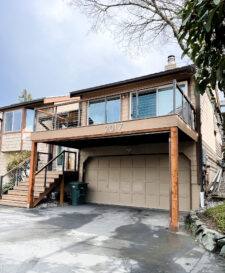
What a Deck Built for This Climate Actually Needs
A correct deck in King County isn't just about picking a nice-looking board. The parts nobody sees are what determine whether the deck is still solid in fifteen years.
Ledger Flashing and Water Management
Where the deck attaches to the house is the single most common failure point we see on Bellevue homes. If the ledger board isn't properly flashed to shed water away from the house wall, moisture works its way behind the siding and into the rim joist, and you don't see the damage until it's advanced. Correct flashing details — metal Z-flashing, self-adhered membrane, and proper lapping — aren't optional extras here; they're the difference between a deck that lasts and one that quietly rots the house behind it.
Joist Protection
Untreated cut ends and exposed joist tops are where standing water sits longest, especially under shaded sections of a Bellevue yard that never fully dry out between storms. Joist tape or a comparable capping product over the top of every joist, plus sealing every field cut, keeps water from wicking into the framing lumber over time.
Fasteners and Hardware
Coastal and near-Sound air carries enough salt to accelerate corrosion on standard hardware faster than most homeowners expect. We spec stainless steel or heavy-duty coated fasteners and structural connectors rated for exterior, corrosive-environment use — not because it's the cheapest option, but because replacing rusted-out hardware in ten years costs a lot more than doing it right the first time.
Airflow Underneath
Low decks built tight to grade, or decks skirted in without ventilation, trap moisture underneath and become a moss and mildew factory. Proper clearance and airflow paths under the structure let it actually dry out between rain events, which in this region can mean weeks at a stretch without a real drying window.
Choosing a Decking Material for Bellevue's Climate
There's no single "best" decking material — every option is a trade-off between upfront cost, maintenance commitment, and how it behaves in sustained wet, shaded conditions. Here's how the common choices actually compare for a Bellevue project:
| Material | Moisture Behavior | Maintenance | Typical Lifespan Here |
|---|---|---|---|
| Pressure-treated lumber | Absorbs and releases moisture readily; prone to cupping/checking if not sealed | Needs re-staining/sealing every 1-2 years in this climate | 15-20 years with upkeep |
| Cedar | Naturally rot- and insect-resistant, but still needs finish maintenance to fight graying and moss | Re-oil or stain every 1-2 years | 15-25 years with upkeep |
| Composite (capped) | Doesn't absorb water or rot; can stay damp on the surface longer, which favors moss/algae growth without cleaning | Periodic washing; no staining or sealing | 25-30+ years |
| PVC decking | Fully moisture-resistant; least prone to organic growth of the group | Occasional washing | 25-30+ years |
For homes with heavy tree cover or north-facing decks that stay shaded most of the day, we lean homeowners toward composite or PVC precisely because moss and algae get a foothold faster on wood in those spots. For sunnier, more exposed decks, a well-maintained wood deck is still a completely reasonable choice — it just comes with a real maintenance commitment that we're upfront about before you commit to it.
Structural and Permitting Realities in Bellevue
Decks above a certain height or size require a building permit in Bellevue, and King County's structural requirements around footings, ledger attachment, and guardrail design aren't optional details — they're inspected. A few things that come up often on local projects:
- Footing depth and sizing depend on soil conditions, which vary block to block in this area — we don't guess, we check.
- Guardrails are required above a specific height threshold and have minimum height and baluster-spacing rules that get checked at inspection.
- Ledger attachment to the house structure has specific fastening and flashing requirements — this is the detail inspectors look at closest, and for good reason given what we see on rot repairs.
- Stair geometry (rise, run, landings) has code minimums that are easy to get wrong on a DIY or unpermitted build.
We pull permits and handle inspections as part of the build — it's not an upsell, it's how you end up with a deck that's actually sound and won't cause problems if you sell the house later.
How We Approach a Bellevue Deck Project
1. On-Site Assessment
We look at sun exposure, tree cover, drainage patterns, and how the site handles heavy rain before we talk materials. A deck design that ignores where water actually goes on your lot is starting from a bad assumption.
2. Design and Material Selection
We walk through the material trade-offs honestly — including telling you when a lower-maintenance option makes more sense for a shaded, damp section of your yard even if it costs more upfront.
3. Permitting
We handle the permit application and coordinate inspections so you're not chasing paperwork.
4. Build
Framing, flashing, and fastener details get done to the standard described above — not the minimum code allows, but what actually holds up in this climate.
5. Final Walkthrough
We go over care and maintenance specific to your deck's material and exposure before we consider the job done.
Living With a Deck in a Wet, Shaded Climate
Even a well-built deck needs some seasonal attention here. A simple, honest maintenance routine goes a long way toward getting the full lifespan out of the structure:
- Sweep leaves and debris off the deck surface regularly in fall — trapped organic matter holds moisture and feeds moss growth.
- Rinse or scrub shaded, moss-prone areas at least once or twice a year, especially north-facing sections.
- Check that gaps between boards stay clear so water can drain through rather than pooling.
- Inspect the ledger flashing area annually for any signs of staining or gaps opening up.
- Re-seal or re-stain wood decking on the schedule the finish product calls for — don't wait until it's visibly gray and worn.
- Confirm under-deck ventilation isn't blocked by stored items, planters, or overgrown landscaping.
Common Problems We Find on Existing Bellevue Decks
When we're called out to look at an aging deck rather than build a new one, the issues tend to repeat: soft or spongy decking near the house wall from ledger leaks, moss buildup in shaded corners that's been left untreated long enough to start holding moisture against the boards, corroded fasteners bleeding rust stains, and guardrails that were never properly anchored to begin with. Most of these are catchable early with a straightforward inspection — the expensive versions are the ones that go unnoticed for a few wet seasons.
Why It Matters to Hire a Crew That Works This Area Regularly
A deck detailed for a drier inland climate — thinner flashing details, standard-grade hardware, tight-to-grade framing — will underperform here. A crew that regularly builds and repairs decks around Bellevue and the greater Seattle area already knows which details actually matter in this climate versus which ones are just upsells, what King County inspectors look for, and how local soil and drainage conditions affect footing design. That local pattern recognition is worth more than it sounds like on paper — it's the difference between fixing a problem in the design phase and fixing it five years later when the framing's already compromised.
If you're planning a new deck or want an honest look at one that's showing its age, we're happy to come take a look. Fill out the form below for a free, no-pressure estimate — we'll tell you straight what your project needs and what it doesn't.