 Seattle Exterior
 Why "Custom" Isn't a Marketing Word in Bellevue
Bellevue's housing stock spans several decades — postwar ranch and split-level homes, 1970s and 80s construction, and a steady mix of newer builds closer to downtown and the lake. On almost none of these houses do window openings match a stock size off the shelf. Framing settles, older jambs go slightly out of square, and additions or remodels over the years often left openings that were never quite standard to begin with. That's why a proper window job here starts with a tape measure at the actual rough opening, not a catalog number.
When a crew treats every opening as identical, you end up with shims covering gaps, trim that doesn't sit flush, or units that get forced into place and bind within a year or two. Custom, in practice, means measuring what's actually there, accounting for how the house has moved since it was built, and either ordering to that exact opening or field-fitting stock units correctly instead of cutting corners to make them fit.
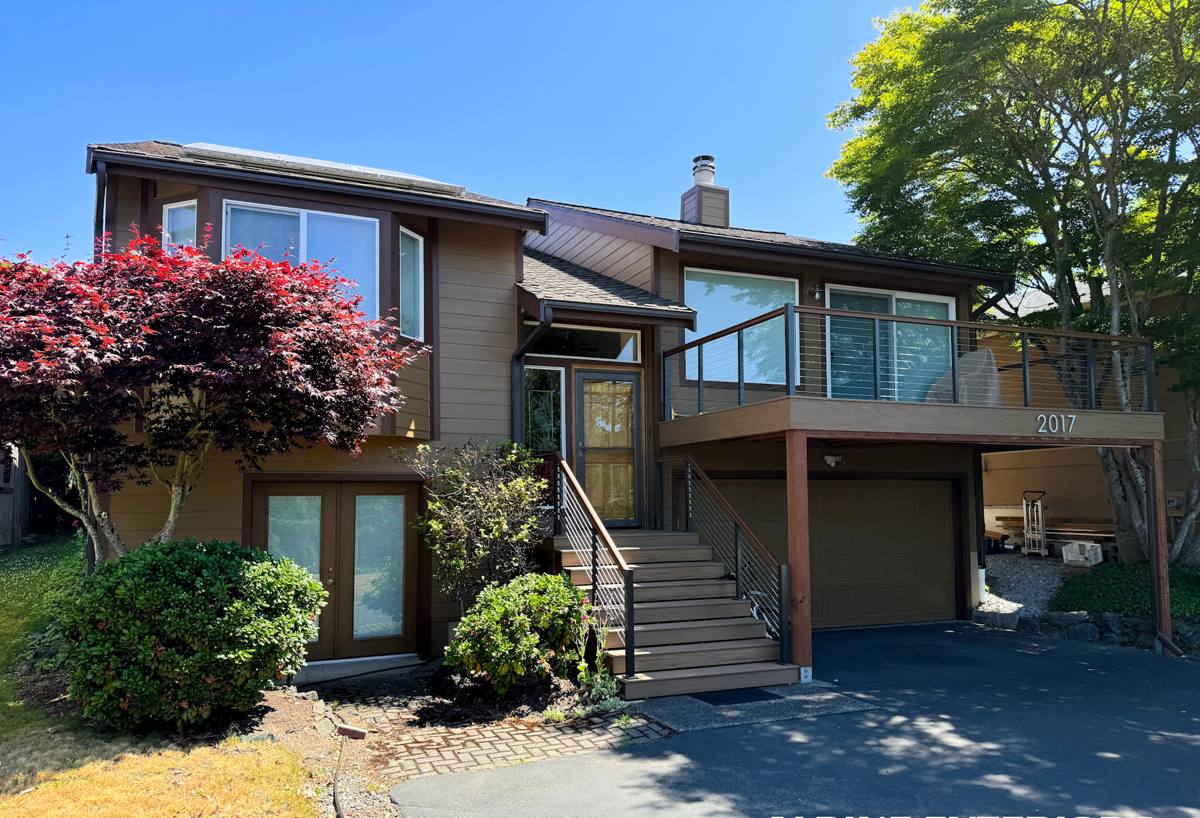
The Climate Factor Bellevue Homeowners Actually Deal With
Bellevue sits on the east side of Lake Washington, in King County, which puts it a bit removed from the direct salt air exposure that homes right on Puget Sound's saltwater shoreline deal with. That's worth being honest about — salt-driven hardware corrosion is more of a concern for houses closer to the Sound itself. What Bellevue does get, in full measure, is the region's long wet season: months of steady, often wind-driven rain, high ambient humidity, and — on the wooded, tree-shaded lots common throughout the area — surfaces that stay damp longer than they would in full sun. That combination is what drives moss and algae growth on north-facing trim, sills, and siding, and it's the biggest factor we account for around window openings specifically.
Driving rain matters more for windows than people expect. It's not the rain falling straight down that causes problems — it's wind-driven rain hitting a wall at an angle, working its way behind trim and into any gap in the flashing. A window that looks fine on a dry day can be feeding water into the wall cavity every time a southwest storm blows through. Over a few seasons, that shows up as soft framing, stained interior sills, or paint that won't hold no matter how many times it's redone.
Signs Your Current Windows Are Already Failing
Window problems are usually gradual, which is why homeowners often live with early warning signs for years before addressing them. Worth checking for:
- Fogging or a hazy film between panes — the sealed unit has failed and lost its gas fill
- Soft, spongy, or discolored wood at the sill or lower frame corners
- Moss, algae, or dark streaking on exterior trim, especially on shaded or north-facing walls
- Noticeable drafts or a faint whistle during windy weather
- Frames that stick, won't latch fully, or have visibly warped out of square
- Visible daylight or gaps around the frame when the window is closed
- A steady climb in heating costs with no other explanation
Any one of these can be an isolated issue. Two or three together, especially on the same wall, usually points to a flashing or seal problem that's been sending moisture into the wall for a while.
Choosing a Frame Material for a Wet Climate
Frame material is one of the few decisions that genuinely changes how a window performs over 15-20 years in this climate, not just how it looks on day one.
| Material | Moisture Resistance | Maintenance | Typical Cost Range |
|---|---|---|---|
| Vinyl | Very good — won't rot, minimal upkeep | Low — occasional cleaning | Lower |
| Fiberglass | Excellent — stable in wet/dry cycles, resists warping | Low | Mid to upper |
| Wood-clad | Good on the clad exterior; interior wood needs care | Moderate — interior finish upkeep | Upper |
| Aluminum | Fair — durable but prone to condensation without thermal breaks | Low | Varies widely |
We don't push any one material as universally "best." A vinyl window with a well-detailed installation will outlast a premium wood-clad unit that was flashed poorly. Material matters, but installation quality is what actually determines whether water stays out.
Glass and Glazing: What Actually Makes a Difference Here
In a climate that's mild rather than extreme, the glazing decisions that matter most aren't about surviving deep freezes — they're about controlling condensation and glare. Double-pane units with a low-E coating and argon fill are the standard baseline for this area, and for most Bellevue homes they're the right call. Low-E coatings cut down on UV fading of flooring and furniture and help manage heat gain on lake-facing or west-facing glass, which sees a lot of direct afternoon sun on clear days.
Triple-pane glass gets marketed heavily, and it does offer a marginal efficiency bump, but the added weight and cost rarely pay for themselves in a climate this temperate. Where we see real, lasting performance differences is in seal quality and the spacer system between panes — a well-made double-pane unit with a durable warm-edge spacer will resist condensation and seal failure far longer than a cheaper triple-pane unit with a weak spacer, regardless of what the pane count implies.
How the Job Actually Runs, Start to Finish
- Assessment and measurement. We look at every opening individually — actual dimensions, condition of the surrounding framing and sheathing, and how water has historically moved (or not moved) around each window.
- Product selection. We walk through frame material, glazing, and configuration options based on the specific wall's sun exposure and moisture history, not a one-size answer for the whole house.
- Ordering and lead time. Custom units take longer to fabricate than stock sizes — we set expectations up front rather than guessing at a date.
- Removal and inspection. Old units come out carefully so we can check the framing and sheathing underneath for rot or prior water damage before anything new goes in.
- Repair as needed. Any soft or damaged framing gets addressed before the new window is set — installing a new window into compromised framing just hides the problem for a few more years.
- Installation and flashing. Proper flashing sequencing — so water sheds down and out, never behind the next layer — matters more to long-term performance than almost any other single step.
- Sealing, insulation, and trim. Interior and exterior finish work is matched to the home's existing sightlines so the new windows don't look like an obvious patch job.
- Walkthrough and warranty paperwork. We go over what was done, what's covered, and what routine maintenance looks like going forward.
What Drives the Cost of a Window Job
Every bid looks different because every house and scope is different. The main variables:
| Cost Factor | Why It Matters |
|---|---|
| Number of openings | More units means more material, labor, and disposal |
| Custom vs. near-standard sizing | True custom fabrication takes longer to produce than stock sizes |
| Frame material chosen | Vinyl, fiberglass, and wood-clad carry different material costs |
| Condition of existing framing | Rot repair adds labor before the new window can even be set |
| Access and height | Second-story or hard-to-reach openings take more time and equipment |
| Trim and finish matching | Matching existing exterior trim profiles adds finish carpentry time |
We'd rather walk a homeowner through these factors honestly during an estimate than hand over a number with no explanation behind it.
Permits and Code: The Bellevue-Specific Details
Window replacement in Bellevue, like elsewhere in King County, can trigger permitting depending on the scope — particularly if an opening is being resized, a structural element is affected, or the work touches egress requirements for bedroom windows. Washington's state energy code also sets minimum performance standards for replacement windows, which affects which products are compliant for the job. A crew that pulls permits regularly in this specific jurisdiction knows what triggers a permit and what doesn't, and won't leave a homeowner exposed to a stop-work order or a resale headache down the line because paperwork was skipped.
Why It Matters That We Already Work Bellevue
None of the above is exotic knowledge, but it only becomes useful when it's applied consistently, job after job, in the same area. A crew that regularly works Bellevue has already seen how the neighborhood's mature tree cover affects moisture retention on north walls, which house styles tend to have out-of-square openings, and what the city's permitting desk actually expects on a submittal. That familiarity shows up as fewer surprises mid-job — not because the work is easier, but because the questions have already been answered on other houses nearby. It also means a real local presence if a warranty question comes up two winters from now, rather than a phone number that rolls to a call center outside the area.
If your windows are showing any of the signs above, or you're simply ready to stop patching around an old set, we're happy to walk the house with you and give you a straight, no-pressure estimate. There's a form below — reach out and we'll get a look scheduled.