 Seattle Exterior
 Why Green Lake Decks Wear Out the Way They Do
Green Lake is one of the shadiest, greenest pockets of Seattle, and that's exactly why decks here take a different kind of beating than decks in more open, sun-exposed parts of the city. The mature tree canopy around the lake and throughout the surrounding blocks keeps yards cool in summer, but it also means decking, framing, and railings stay damp long after a storm has passed. Add in the Pacific Northwest's long, wet stretch from fall through spring, and you've got wood and fasteners that rarely get a real chance to dry out.
Seattle's marine climate — the humidity that rolls in off Puget Sound even miles from open water — keeps moisture in the air on days when it isn't actively raining. On a shaded Green Lake lot, that translates into a deck surface that's damp to the touch more mornings than not. Combine that with driving rain that gets pushed sideways under railings and against ledger boards, and you have the two biggest drivers of deck failure in this neighborhood: sustained moisture and moss.
None of this means a deck here is doomed. It means the repair work has to account for how these decks actually fail, not how a deck fails in a drier climate. That's the difference between a patch that looks fine for a season and a repair that holds up through another decade of King County winters.
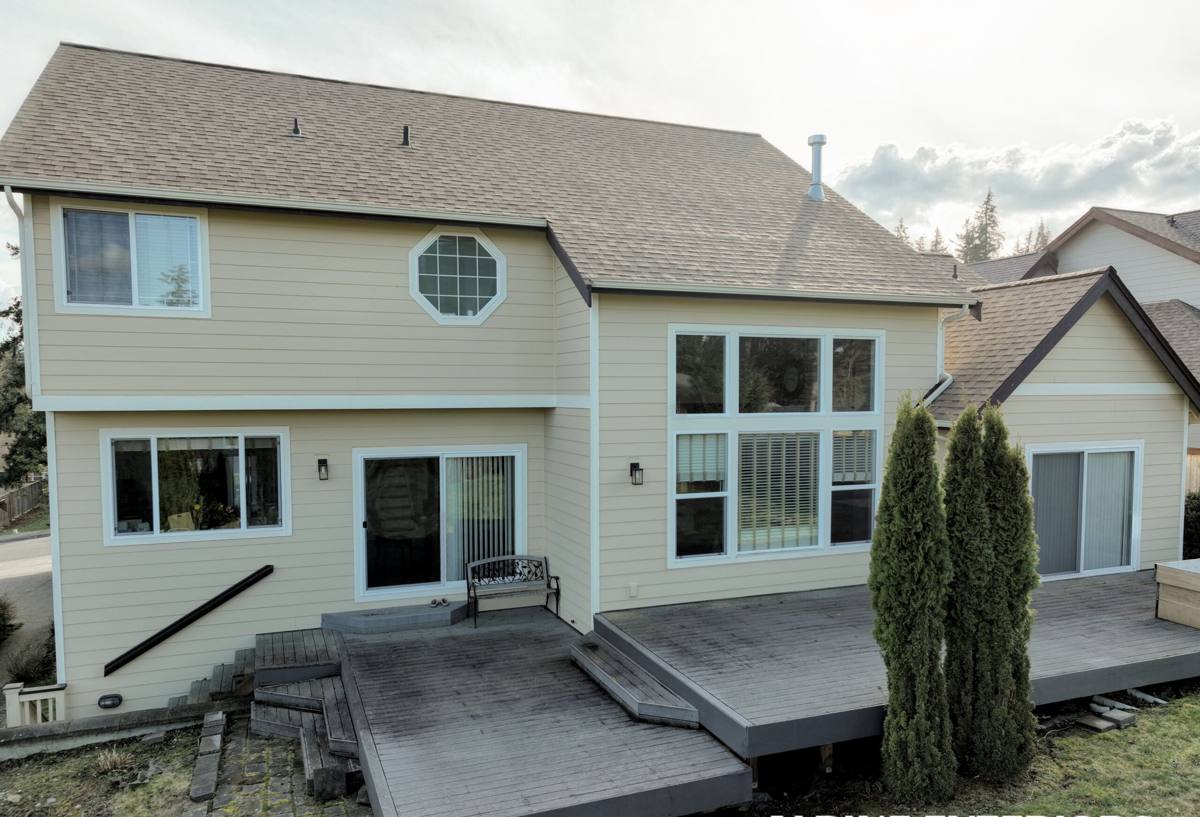
What "Deck Repair" Actually Covers
Deck repair isn't one job — it's several possible jobs depending on where the damage is. A proper assessment looks at the whole structure, not just the boards you can see from the yard.
The ledger board and house connection
This is where the deck attaches to the house, and it's the single most safety-critical connection on the structure. Flashing behind the ledger is supposed to keep water from running down between the deck and the siding or sheathing. On older Green Lake homes, that flashing is often missing, undersized, or simply worn out. Once water gets behind the ledger, it can rot both the ledger itself and the rim joist or framing behind it — damage you won't see until you start probing with a screwdriver.
Framing: joists, beams, posts, and footings
Underneath the decking, the joists and beams do the real structural work. Shaded, damp framing is slower to dry between rains, which speeds up rot at joist ends, post bases, and anywhere wood sits close to soil or grass. Footings themselves rarely fail outright, but posts that were never properly isolated from ground moisture often show rot at the base long before the rest of the structure shows problems.
Decking surface and moss
Moss and algae on a deck surface aren't just cosmetic — they hold moisture against the wood or composite surface and create a slip hazard that gets worse every wet month. On a shaded Green Lake lot, moss can come back within weeks of a cleaning if the underlying moisture problem (poor drainage, standing debris, tight spacing between boards) isn't addressed at the same time.
Guardrails, stairs, and fasteners
Loose guardrail posts and wobbly stair stringers are usually a fastener problem before they're a wood problem. Older nails and undersized screws corrode and lose their grip faster in a consistently damp environment, and a guardrail that "just needs tightening" often turns out to be attached to a post base that's already partially rotted.
Repair or Replace? How We Actually Decide
Homeowners often assume any deck problem means a full teardown, and just as often assume a repair will fix something that's actually beyond saving. The honest answer depends on how far the damage has spread and how the structure was originally built.
| Factor | Repair Usually Makes Sense | Replacement Is Often Smarter |
|---|---|---|
| Structural framing (joists, beams, posts) | Rot is isolated to one or two members | Rot has spread through most of the framing |
| Footings and posts | Footings are sound; posts show only surface wear | Footings are undersized, shifted, or not code-compliant |
| Ledger board attachment | Flashing has failed but the ledger itself is solid | The ledger or rim joist behind it is soft or rotted |
| Decking boards | A handful of boards are cupped, split, or soft | Most of the deck surface is deteriorating at once |
| Age and original build quality | Under 15-20 years old, built to a reasonable standard | Original framing is decades old and undersized by current code |
We'd rather tell a homeowner honestly that a targeted repair will hold up than sell a full rebuild that isn't needed — and we'd rather say plainly when a repair would just be delaying a bigger problem. That call gets made after we're actually under the deck with a flashlight and a screwdriver, not from the yard.
Our Deck Repair Process in Green Lake
Every deck repair starts the same way, regardless of how big or small the job looks from the surface.
- Inspection. We check the ledger connection and flashing, probe framing members for soft spots, look at post bases and footings, and check every guardrail and stair connection for movement.
- Scope and estimate. You get a plain-language explanation of what's actually wrong, what it takes to fix it correctly, and an honest price range — not a vague number that changes once work is underway.
- Permit check. Structural repairs — replacing a ledger, rebuilding framing, altering footings — typically require a permit through Seattle's permitting process. Cosmetic work like replacing surface boards or refinishing usually doesn't. We'll tell you which category your job falls into before work starts.
- Repair. Damaged framing, ledger, or decking is replaced with appropriately rated lumber or fasteners, flashing is corrected where it's failed, and connections are brought up to current structural standards.
- Cleanup and moss guidance. We clean up debris and, where moss or algae has been a recurring issue, walk you through what's actually driving it on your specific lot — usually shade, poor drainage, or debris buildup between boards — so you're not just fighting it again next season.
Wood vs. Composite: Repair Considerations
What the deck is made of changes how it fails and how it gets repaired.
Wood decking is straightforward to repair — individual boards can be replaced, and damage is usually visible once you know what to look for. The tradeoff is maintenance: wood needs regular cleaning, sealing, and moss management to hold up through a Seattle rainy season, especially on a shaded lot.
Composite decking resists moss and surface rot better than wood, but it isn't maintenance-free, and repairs come with their own limitations. Matching an older composite board's color and profile can be difficult once a product has been discontinued or the existing boards have faded, and moisture problems in the framing underneath a composite deck can go unnoticed longer because the surface itself doesn't show rot the way wood does. We repair composite decking from the major manufacturers, but we're upfront that a composite surface only solves the surface problem — the framing underneath still needs the same inspection a wood deck gets.
Signs Your Green Lake Deck Needs Attention Now
Some deck problems are cosmetic and can wait for a convenient time. Others are safety issues that shouldn't sit through another wet season. If you're seeing any of the following, it's worth having someone look before it gets worse:
- Decking boards feel spongy or flex noticeably underfoot
- Moss or green growth comes back within weeks of being cleaned off
- Fasteners are backing out, or you see rust streaks bleeding from nail or screw heads
- The whole deck feels like it moves or sways when a few people are standing on it
- A gap has opened up where the ledger board meets the house
- Guardrail posts wiggle when you push on them
- Stair stringers show soft spots, splitting, or visible sagging
Permits and Code Basics for Seattle Decks
Deck work in Seattle is governed by the city's building code, and King County's broader building standards apply where relevant. A few basics that come up constantly on repair jobs: guardrails generally need to meet a minimum height and can't have gaps wide enough for a small child to pass through; ledger attachment to the house has specific fastening and flashing requirements because it's a life-safety connection; and any structural change — not just a cosmetic one — usually triggers a permit requirement. We handle the permit process on jobs that need one, so you're not left figuring out city requirements on your own.
Why a Crew That Already Works Green Lake Makes a Difference
Deck problems in this neighborhood follow patterns we've seen over and over: ledger flashing that was installed correctly for a drier climate but not for the amount of shade and rain a specific lot gets, post bases that rot faster under mature trees, and moss that keeps returning because a deck was built without enough airflow underneath. A crew that works Green Lake regularly recognizes these patterns quickly instead of treating every deck as a first-time mystery.
That familiarity also means a more accurate estimate. We're not guessing at how a Seattle winter will treat a repair — we've seen how these repairs hold up on decks a few blocks away, in the same shade and rainfall conditions your deck deals with every year.
Get a Straight Answer About Your Deck
If your deck has soft spots, moss that won't quit, or just doesn't feel as solid as it used to, we're happy to take a look and give you an honest read on what it needs — repair or otherwise. The estimate is free, there's no pressure attached to it, and you'll get a clear explanation of what we find. Use the form below to get started.