 Seattle Exterior
 New-Construction vs. Replacement Windows: Why the Distinction Matters
A lot of homeowners use "new windows" and "window replacement" interchangeably, but for a crew doing the work they're two different jobs with two different sets of rules. New-construction windows have a nailing fin around the perimeter of the frame. They get installed before the exterior finish goes on — house wrap, flashing, and siding or fiber cement all lap over that fin in a specific order to shed water. Replacement (or "pocket") windows go into an existing opening with the old frame still partly in place and rely on different sealing details because there's no fin to integrate into the wall assembly.
If you're building new in Fremont, adding a dormer or bump-out, converting a garage, or putting up an ADU, you're in new-construction territory. That means the window install is really a rough-opening and water-management job first, and a window-hanging job second. Get the sequencing wrong and the window itself doesn't matter — water will find the gap.
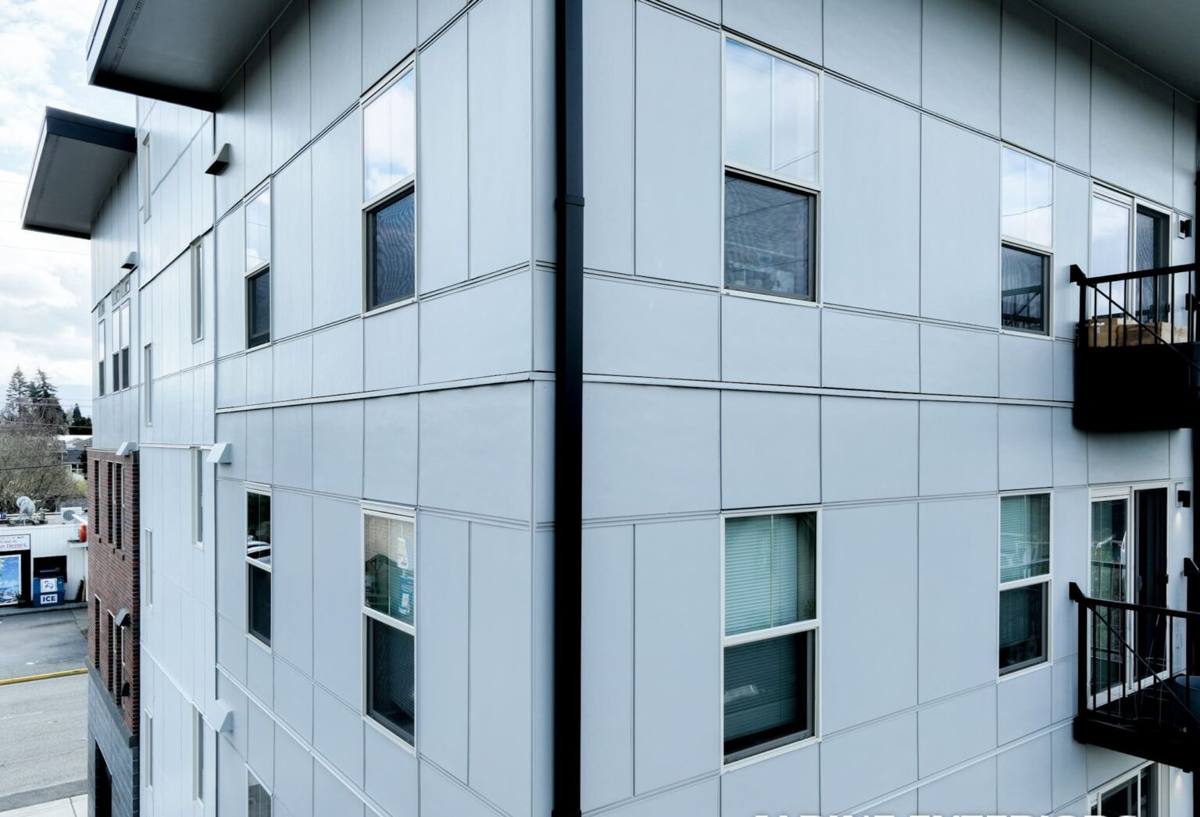
What Fremont's Weather Actually Does to a Window Opening
Fremont sits close to the Ship Canal and Lake Union, which means homes here deal with a damp, salt-tinged air layer on top of the usual King County rain load. That combination shows up in a few predictable ways over the life of a house:
- Driving rain off the water pushes moisture sideways into wall assemblies, not just straight down — a window that only sheds water from directly above isn't enough.
- Salt-laden air accelerates corrosion on unprotected fasteners and lower-grade metal flashing, which is one reason we're picky about hardware, not just the window unit.
- Long stretches of overcast, humid weather mean anything that gets wet behind the cladding stays wet longer, which is exactly the environment moss and rot organisms need.
- Older Fremont bungalows and the newer infill townhomes going up around them both see the same moss creep on north- and west-facing walls, and window trim is one of the first places it shows.
None of this is exotic — it's standard Puget Sound exposure. But it means a window install that would pass fine in a drier climate can fail here in a handful of wet seasons if the details are skipped.
The Water-Management Details That Make or Break the Install
Flashing sequence
Every new-construction window opening should be built as a shingled, lapped system: sill pan or sill flashing first, then the window, then jamb flashing, then head flashing, then house wrap taped over the top in that order so water always drains outward and down, never behind the next layer up. Skipping the sill pan is the single most common shortcut we see cause callbacks — it's invisible once the wall is closed up, and it's the detail that matters most in a driving-rain climate.
Sealants and backer rod
We use sealants rated for the temperature swings and UV exposure of a Pacific Northwest exterior, and we back deep joints with backer rod so the sealant forms a proper hourglass bead instead of a flat skin that cracks in a season or two.
Weep paths
Any water that does get past the outer seal needs somewhere to go. We make sure weep holes and drainage gaps in the sill area aren't accidentally sealed shut or blocked by insulation — an easy mistake if the crew is moving fast.
Frame Material and Glass: What We Recommend and Why
There's no single "best" window for every Fremont project — it depends on budget, the home's style, and how exposed the wall is. Here's how the common options stack up for our climate specifically:
| Frame Material | Moisture Performance | Maintenance | Typical Fit |
|---|---|---|---|
| Vinyl | Good — won't rot, handles damp exposure well | Low | Budget-conscious new builds, additions |
| Fiberglass | Excellent — very stable in wet/dry and hot/cold cycling | Low | Higher-end new construction, larger openings |
| Wood-clad | Good on the exterior, but interior wood face needs finish maintenance | Moderate to high | Craftsman or period-style Fremont homes wanting a wood interior look |
| Aluminum | Poor thermal performance, prone to condensation without thermal breaks | Low | Rare in residential; mostly commercial or specific modern designs |
For glass, we spec dual-pane, low-E units as the baseline on nearly every job — the energy savings pay for themselves in a climate with as many heating-degree-days as ours, and low-E coatings cut UV fading on interior finishes. Argon-filled units are a small upcharge worth it for the added insulation value. We'll walk through the trade-offs for your specific project rather than defaulting to the most expensive option — a straightforward vinyl or fiberglass window with a good low-E package is the right call for most Fremont new-construction work.
Our New-Construction Window Process
- Rough opening check. We verify every opening is square, plumb, and sized correctly before a window ever shows up on site — catching framing issues now is far cheaper than after installation.
- Sill pan and flashing install. Sill pan flashing goes in first, sloped to drain outward, before the window is set.
- Window set and shimmed. The unit is set plumb, level, and square, shimmed at the manufacturer's specified points — not just at the corners — so it operates correctly and doesn't rack over time.
- Fastening through the nailing fin. Fasteners go in per the manufacturer's schedule, using corrosion-resistant hardware suited to our salt-air exposure.
- Jamb and head flashing. Flashing is lapped in the correct shingle order and tied into the house wrap.
- Interior and exterior sealing. Backer rod and sealant at the exterior; low-expansion foam or backer rod at the interior gap — never packed solid with can foam, which can bow the frame.
- Final operation and water test. We cycle every operable window and check the seal before we consider the opening closed up.
Timing Windows Into Your Build or Remodel Schedule
New-construction windows have to land at a specific point in the build sequence — after the wall sheathing and house wrap are on, but before siding, trim, and interior finish work start. Order too late and you stall the framing and siding crews waiting on lead times, which on some window lines can run several weeks. Order too early without confirmed rough-opening dimensions and you risk a mismatch that delays everything behind it.
We coordinate directly with builders and GCs on Fremont projects to hit that window — literally — so the schedule doesn't back up. If you're the homeowner managing your own build or working with a builder who wants a specialist crew for the window package specifically, we can slot in as a sub without disrupting the rest of the schedule.
A Checklist Before Windows Go In
Whether you're a homeowner keeping an eye on your build or a builder bringing in a window sub, these are worth confirming before the first unit is set:
- Rough openings have been measured and confirmed against the window order — not just the plans
- House wrap or weather-resistive barrier is installed and lapped correctly around each opening
- Sill pan flashing is specified and on site, not being skipped to save time
- Fastener and flashing hardware is rated for coastal/salt-air exposure, not generic interior-grade hardware
- Glass package (low-E, argon fill) matches what was quoted, not a downgraded substitute
- A water test or visual inspection is planned before siding closes up the opening for good
Why a Crew That Already Works Fremont Matters
Fremont's housing stock is a mix — older bungalows getting additions, teardown-rebuilds, and new townhome and ADU construction all going up close together, often on tight lots with limited access. A crew that regularly works this neighborhood already knows how to stage material and equipment on small lots, how to sequence around Seattle's inspection process, and what the moss and moisture patterns look like on similar homes a few blocks over. That's not something you get from a crew that installs windows in a drier part of the state and treats every job the same way.
We also stand behind our own installation work, separate from the manufacturer's product warranty — if a flashing or sealant detail we installed ever fails, that's on us to make right, not something you have to chase down later.
If you're planning new construction, an addition, or an ADU in Fremont and want a window package done right the first time, we're happy to take a look at your plans and give you a straightforward, no-pressure estimate using the form below.