 Seattle Exterior
 Redmond's Climate and What It Does to a Deck
Redmond sits on Seattle's Eastside, in King County, and while it isn't right on the saltwater shoreline the way some Puget Sound neighborhoods are, it still sits inside the same wet marine climate that defines Western Washington. What sets Redmond apart is the tree cover. Mature evergreens around Lake Washington and Lake Sammamish keep a lot of yards and decks shaded well into the afternoon, and that shade means moisture sticks around longer after every rain. Combined with our long, wet season, that's a recipe for moss, algae, and slow-moving rot that homeowners in drier climates never have to think about.
None of this means a deck is doomed. It means a deck built or repaired without accounting for how water actually behaves here will fail faster than it should. We've repaired decks all over the Eastside and the pattern is consistent: the damage almost always starts where water gets trapped, not where it simply falls.
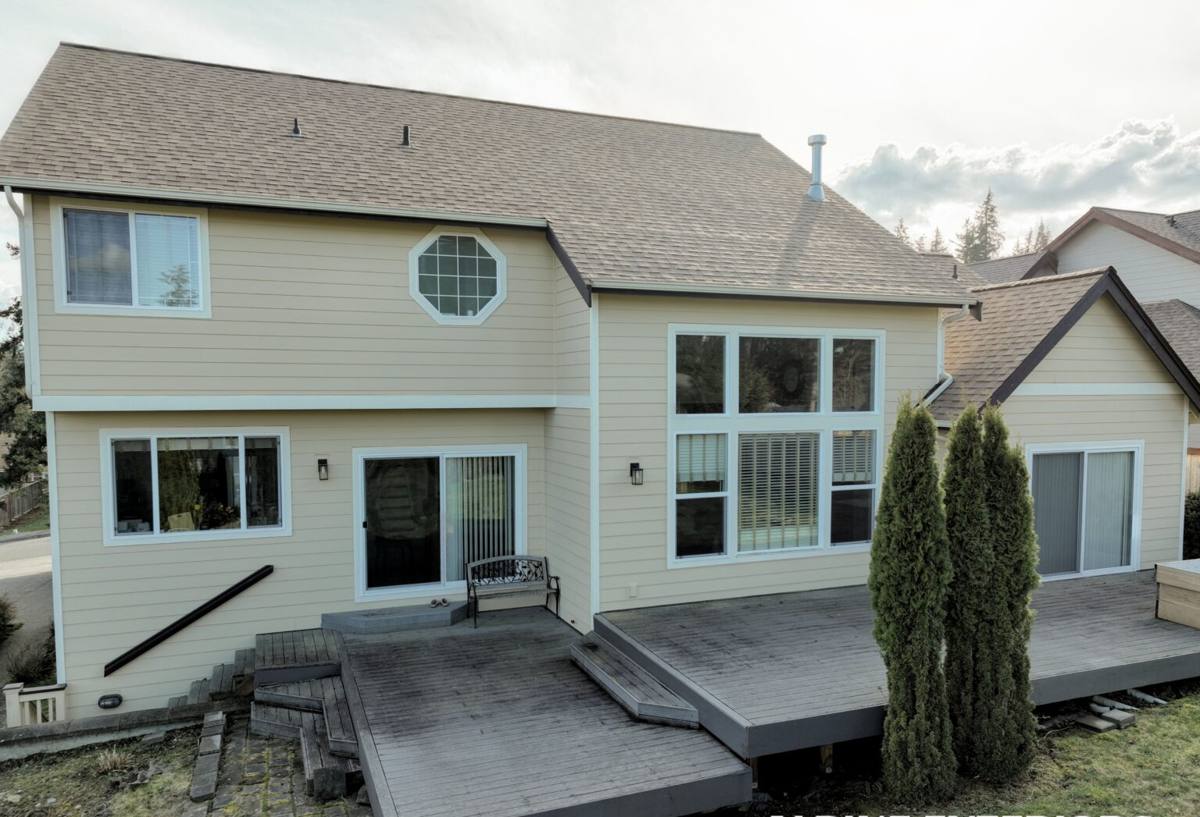
Signs Your Redmond Deck Needs Repair
Most deck problems don't show up as a dramatic collapse. They show up as small, easy-to-ignore details that get worse every wet season. Here's what we tell Redmond homeowners to check for, ideally before the rain starts each fall:
- Soft or spongy spots underfoot, especially near the house or along board edges
- Dark staining, streaking, or a musty smell where the deck meets the house wall
- Moss or green algae film that returns within weeks of cleaning it off
- Gaps opening up between decking boards, or boards that have started to cup or crown
- Rust streaks around screws or nail heads, or fasteners that back out on their own
- A railing or post that flexes or wobbles more than it used to
- Visible daylight or gaps where the ledger board attaches to the house
- Stairs that feel less solid than the rest of the deck
Any one of these on its own might be minor. Several together, or anything involving the ledger board or main support posts, is worth a proper inspection before it turns into a bigger job.
What a Correct Deck Repair Actually Involves
A repair that just replaces a rotten board and stops there often misses the reason that board rotted in the first place. In our experience, a repair that actually holds up in this climate has to look at the whole water path, not just the visible damage.
Structural Framing First
Before we touch surface boards, we check the framing underneath: joists, beams, and posts. Surface decking can look fine while the structure below it is quietly failing, especially in shaded, damp corners of a yard. Any repair plan has to start here, because replacing boards over compromised framing just hides the problem for another season.
The Ledger Board and Flashing
Where a deck attaches to the house is the single most common failure point we see in this region. If flashing is missing, damaged, or was never properly installed, water works its way behind the ledger board and into the rim joist, and that damage is hidden until it's significant. Correcting this properly, not just caulking over it, is often the difference between a repair that lasts and one that doesn't.
Fasteners and Hardware
Standard fasteners corrode in our wet climate faster than most homeowners expect, and corroding hardware weakens connections gradually and invisibly. A proper repair uses fasteners and structural connectors rated for exterior, ground-contact, or treated-lumber use, matched to whatever decking material is involved.
Drainage and Airflow
Water that can't drain or evaporate is what causes rot, not water that simply lands on the deck. Part of a correct repair is making sure water sheds properly off the surface and that there's enough airflow underneath to let the structure dry out between rains, which matters more under Redmond's tree canopy than it does in more open, sun-exposed yards.
Common Repair Issues We See on Redmond Decks
Rot at the House Connection
This is the repair we're called out for most often. It's usually not obvious from a casual look, and it's usually more extensive than the homeowner expects, because by the time staining or softness is visible on the surface, the framing behind it has often been wet for a while.
Moss-Driven Surface Decay
Moss doesn't just look bad. It holds water directly against the wood grain and around fastener heads, and in shaded Redmond yards it can re-establish within a month of cleaning if the underlying moisture problem isn't addressed too. Surface cleaning without fixing drainage or airflow is a short-term fix at best.
Failing or Undersized Railings and Stairs
Older decks, or decks that have had informal repairs over the years, sometimes have railings or stair stringers that don't meet current structural standards. We flag these even when they weren't the reason for the service call, because they're a safety issue, not just a cosmetic one.
Composite-Over-Wood-Frame Issues
A lot of Redmond decks have composite decking boards over a wood substructure. The boards themselves often look fine for years while the wood frame underneath deals with the same moisture exposure as any other deck. These repairs usually involve pulling boards to address framing, then reinstalling or replacing the composite surface.
Repair or Replace? What Actually Drives That Decision
Homeowners often assume any visible damage means a full replacement. Often it doesn't. The honest answer depends on how much of the structure is affected, not how bad the surface looks.
| Factor | Usually Points to Repair | Usually Points to Replacement |
|---|---|---|
| Damage location | Isolated boards, one section, one connection point | Widespread rot across multiple framing members |
| Structural framing | Solid, with localized soft spots | Joists, beams, or posts compromised in several areas |
| Ledger board condition | Flashing failure caught early | Long-term water intrusion into the house rim joist |
| Deck age | Under 15-20 years, built to a reasonable standard | Original construction was undersized or non-compliant |
| Cost comparison | Repair cost is a modest fraction of replacement cost | Repair scope approaches full rebuild cost anyway |
We'll tell you plainly which side of that table your deck falls on. There's no benefit to us in talking a homeowner into a repair that won't hold, and there's no benefit in replacing a deck that a targeted repair can genuinely fix.
Our Deck Repair Process
- Full inspection — we check framing, ledger connection, fasteners, drainage, and railings, not just the damaged area you called about
- Honest scope and estimate — you get a clear explanation of what's actually wrong, what it will take to fix correctly, and what it costs, with no pressure to upsell into a full rebuild you don't need
- Repair the cause, not just the symptom — that usually means addressing flashing, framing, or drainage alongside any board replacement
- Rebuild with correctly rated materials and hardware — matched to your existing deck or agreed upon in advance
- Final walkthrough — we show you what was fixed and flag anything worth watching going forward
Materials: Matching the Repair to the Deck
Most Redmond deck repairs involve either pressure-treated lumber or composite decking, and each has real trade-offs worth understanding rather than a single "best" answer.
Pressure-treated lumber is the standard for structural framing regardless of what the surface decking is made of, because it's rated for exposure and ground or near-ground contact. For visible decking boards, it's affordable and easy to spot-repair, but it does require regular maintenance — cleaning, and periodic sealing or staining — to keep performing well in a wet climate.
Composite decking needs far less surface maintenance and resists moss staining better than bare wood, which matters under Redmond's tree cover. The trade-off is that composite repairs are less forgiving of shortcuts: manufacturer spacing, fastening, and ventilation specs have to be followed closely, or you trade a wood maintenance problem for a moisture-trapping problem underneath. We'll walk you through what fits your deck, your budget, and how much upkeep you actually want to do, rather than defaulting to whichever material is easiest for us to install.
Why Hire a Crew That Already Works in Redmond
Deck repair done right isn't generic. A crew that works across King County and the Eastside regularly has already seen how Redmond's tree cover, drainage patterns, and long wet season affect decks differently than a drier, more open part of the region would. That matters when you're deciding how much drainage and airflow a repair actually needs, or how far damage has likely traveled behind a wall before it became visible.
It also matters for accountability. A local crew has a reputation in the neighborhoods it works in and isn't disappearing after the invoice clears. We give straight answers about what's actually wrong with a deck, what can be reasonably repaired, and what can't — because that's how we keep getting called back.
Keeping a Repaired Deck in Good Shape
A correct repair buys you years, but a little seasonal attention buys you more. A few habits go a long way in this climate:
- Clear leaves and debris out of gaps between boards before fall rains set in
- Keep an eye on moss regrowth in shaded corners and address it early each spring
- Check that gutters and downspouts near the deck aren't dumping extra water onto it
- Re-seal or stain wood decking on the schedule your product calls for, typically every one to three years
- Walk the deck periodically and note any new soft spots, movement, or fastener issues before they spread
If you're not sure whether what you're seeing is normal wear or the start of a real problem, that's exactly what an inspection is for. We're happy to put eyes on your deck and give you a straightforward, no-pressure estimate and honest opinion on what it needs — nothing more, nothing less. The form below gets you started.