 Seattle Exterior
 Why Renton Decks Wear Out Faster Than People Expect
A deck in Renton doesn't fail the way a deck in a dry climate fails. It's not sun-bleaching that does the damage first — it's water. Between the long stretches of driving rain, the humid air moving off Lake Washington and Puget Sound, and the months-long moss season that follows, most decks here are wet far more often than they're dry. That constant damp cycle is what breaks decks down: wood that never fully dries between storms, fasteners that corrode quietly under the surface, and moss and algae that hold moisture directly against the boards.
Homeowners in Renton often come to us thinking their deck just needs a few new boards. In a lot of cases, the surface boards are the least of the problem — the framing underneath, the ledger board attachment to the house, and the flashing details are where the real damage has been building for years. A deck replacement done right addresses all of it, not just what's visible from the yard.
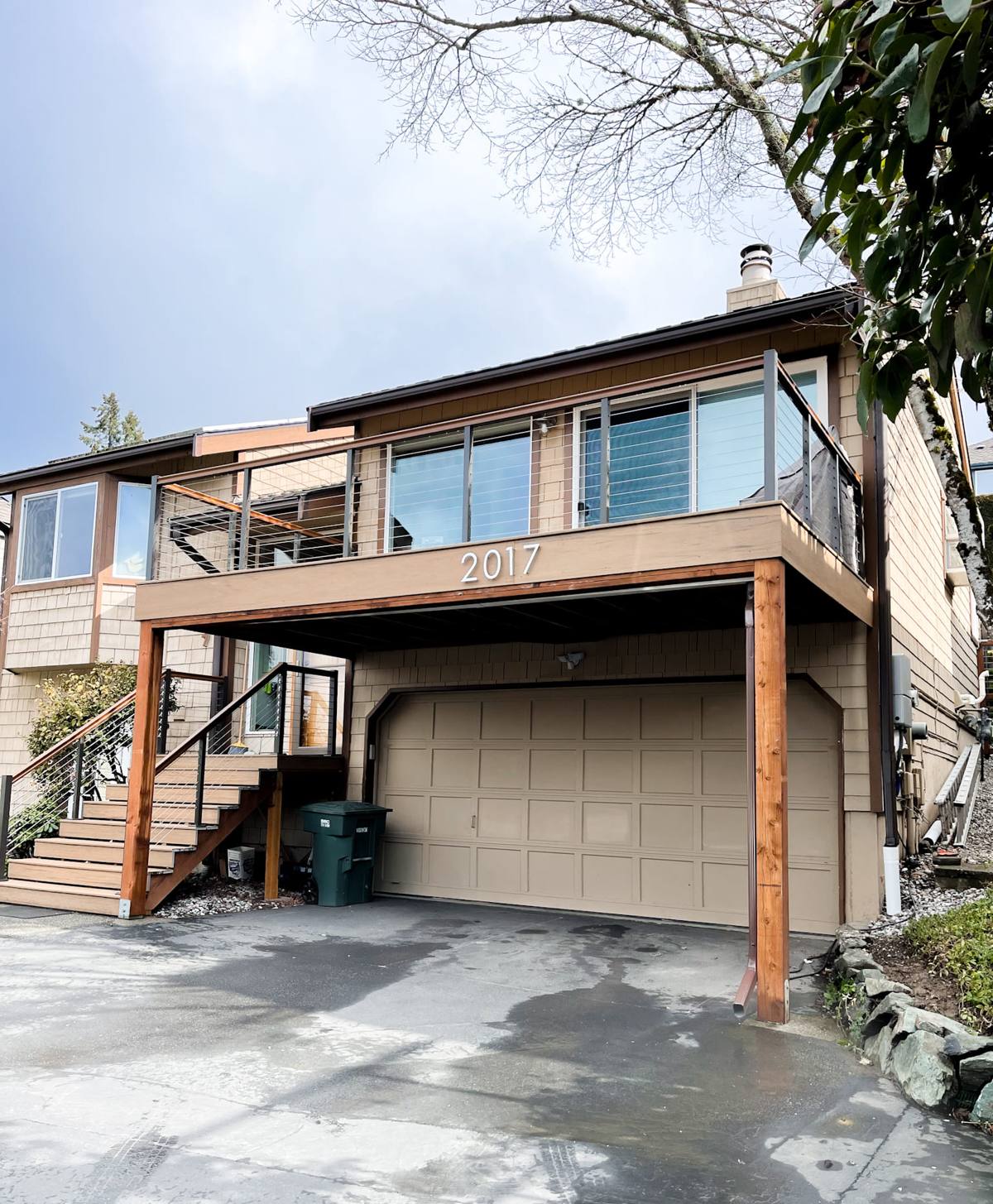
Signs It's Time to Replace, Not Just Repair
Repair makes sense when the problem is isolated — a few damaged boards, a loose railing baluster, a squeaky spot. Replacement becomes the honest recommendation when the problems are structural or widespread. Some signs we look for on Renton decks:
- Soft, spongy, or spring-back decking across multiple boards, not just one or two
- Visible rot or dark staining at the ledger board where the deck meets the house
- Rust streaking around fastener heads, which usually means the fastener itself is failing underneath
- Footings or posts that have shifted, settled, or show cracking at the base
- Railings that flex noticeably when leaned on — a safety issue, not a cosmetic one
- A deck more than 15-20 years old that has never had the substructure inspected
If even two or three of these show up, patch repairs usually end up being a short-term fix on a structure that needs to come off. We'll tell you plainly which situation you're in — there's no benefit to us or you in replacing a deck that only needs targeted repair, and no benefit in patching one that's actually done.
Why This Matters More Here Than in Drier Climates
In a dry region, a marginal deck might limp along for years with cosmetic issues. In our climate, marginal problems compound. Trapped moisture under a failing board doesn't just sit there — it wicks into the joist below, and a wet joist in a shaded King County backyard can take weeks to dry out between rain events. That's the mechanism behind most of the "surprise" rot we find once we open a deck up.
What a Correct Deck Replacement Actually Involves
A deck replacement is a structural project, not a cosmetic one, even though the decking boards are what everyone notices first. Doing it correctly means treating the whole system — ledger, framing, footings, and flashing — as one connected assembly.
Ledger Board and House Connection
The ledger board, where the deck attaches to the house, is the single most common failure point we find on older decks in this area. If it wasn't flashed correctly when installed, water gets behind it and rots both the ledger and the rim joist of the house itself. We flash this connection properly on every replacement, with the flashing lapped to shed water away from the house rather than trapping it against the wall.
Framing and Joists
Joist spacing and sizing need to match the decking material and the loads the deck will actually see — furniture, hot tubs, gatherings. We use fasteners and hardware rated for exterior, wet-service conditions, since standard interior-grade hardware corrodes quickly under our year-round moisture.
Footings and Posts
Footings need to sit below frost depth and bear on undisturbed soil, not fill. On sites with poor drainage — common on older Renton lots — we'll often recommend footing depths or drainage measures beyond the bare minimum, because a footing that's marginal on paper tends to become a real problem after a few wet winters.
Flashing and Drainage Details
Beyond the ledger, every point where the deck structure meets the house or penetrates the decking surface (posts, stair stringers) needs attention to drainage. Water that pools instead of shedding is what starts the rot-and-moss cycle all over again, even on a brand-new deck.
Choosing the Right Decking Material for a Renton Backyard
There's no single "best" decking material — there's a best fit for your budget, your maintenance appetite, and how much shade and moisture your specific yard deals with. Here's how the common options actually compare in our climate:
| Material | How It Handles Our Climate | Maintenance | Typical Lifespan Here |
|---|---|---|---|
| Pressure-treated wood | Affordable, but absorbs moisture readily; needs consistent sealing to resist the wet-dry cycle | Re-stain/seal every 1-2 years | 10-15 years with upkeep |
| Cedar | Naturally rot-resistant and handles rain well, but shaded, mossy areas still need cleaning | Periodic cleaning and oiling | 15-20 years with upkeep |
| Capped composite | Resists moisture absorption and moss growth much better than wood; performs well in shaded, damp yards | Occasional washing, no sealing/staining | 25-30+ years |
| PVC decking | Fully synthetic, doesn't absorb water at all; among the best performers in constant-moisture spots | Occasional washing | 25-30+ years |
We're generally cautious about entry-level, uncapped composite products in this climate — older-style composites can absorb moisture at the core over time, which shows up as swelling or dark staining a few years in. That's a maintenance-burden and warranty-structure trade-off we'd rather explain up front than have you discover later, which is why we default to capped composite or PVC when someone wants a low-maintenance deck.
What Affects the Cost of a Deck Replacement
Every deck is different, so we won't quote a number without seeing the site, but the main cost drivers are consistent from project to project:
| Factor | Why It Moves the Price |
|---|---|
| Decking material | Pressure-treated wood costs less upfront than composite or PVC; composite/PVC cost more but reduce long-term maintenance spend |
| Deck size and height | Larger decks and multi-level or elevated decks need more framing, footings, and stair/railing work |
| Substructure condition | If footings and framing are sound and code-compliant, we may be able to reuse them; if not, that adds scope |
| Railing and stair complexity | Custom railing styles, glass panels, or multiple stair runs add labor and material cost |
| Site access | Tight side yards, slopes, or limited equipment access on some Renton lots can add labor time |
| Permit and inspection requirements | Larger or elevated decks typically require permitting, which adds time but ensures the work is code-compliant |
Our Deck Replacement Process, Start to Finish
We keep the process straightforward and don't skip steps to move faster:
- On-site assessment: We inspect the existing deck's framing, footings, and ledger connection — not just the surface — to confirm replacement is the right call and to scope the work accurately.
- Design and material selection: We walk through decking material options, railing style, and layout based on how you actually use the space and how much maintenance you want going forward.
- Permitting: Where required, we handle the permit application and coordinate inspections so the finished deck is fully compliant, not just built to look right.
- Removal: The old deck is removed and hauled away, with the site protected and cleaned up as we go.
- Framing and footings: New or corrected footings, framing, and properly flashed ledger connection go in first — this is the part that determines how long the deck actually lasts.
- Decking, railing, and stairs: Surface materials and railings are installed to manufacturer specifications, which matters for both performance and warranty coverage.
- Final walkthrough: We review the finished deck with you, including basic care guidance specific to the material you chose.
Permits, Codes, and Guardrail Requirements
Most jurisdictions in King County, including Renton, require a permit for deck replacement once the deck exceeds a certain size or height above grade, and guardrail and stair requirements are governed by the building code regardless of permit status. Requirements can also differ depending on whether you're inside Renton city limits or unincorporated King County. Rather than guess, we confirm what applies to your specific property before work starts and handle the permit and inspection process as part of the job. Skipping this step is one of the more common ways homeowners end up with a deck that looks fine but doesn't pass inspection at resale.
Keeping Your New Deck Looking Good Through Moss Season
Even a well-built deck needs some seasonal attention in our climate — the goal is just to prevent the wet-and-shaded conditions that let moss and algae get a foothold. A simple annual routine goes a long way:
- Sweep leaves and debris off the deck surface regularly in fall, especially in shaded corners
- Clean gutters and downspouts near the deck so water isn't draining directly onto it
- Rinse off moss and algae buildup before it has a chance to stain the surface
- Check that furniture and planters aren't sitting directly on the decking, which traps moisture underneath
- For wood decks, reapply sealant or stain on the manufacturer's recommended schedule, not just when it looks worn
- Have the substructure glanced at every few years, particularly the ledger connection, even if the surface looks fine
Why Hiring a Crew That Already Works in Renton Matters
A deck built for a drier climate, following generic specs, tends to underperform here — not because the workmanship is bad, but because it wasn't built with our rain patterns, drainage challenges, and moss cycle in mind. A crew that regularly works Renton and the broader Seattle area already knows which details — flashing laps, footing depth, material selection for shaded yards — actually matter locally, instead of learning it on your project. That local pattern recognition is what separates a deck that looks good on installation day from one that still looks good in ten years of King County winters.
If your deck is showing its age, or you just want an honest opinion on whether repair or replacement makes more sense, we're happy to take a look. Fill out the form below for a free, no-pressure estimate — we'll give you a straight answer either way.